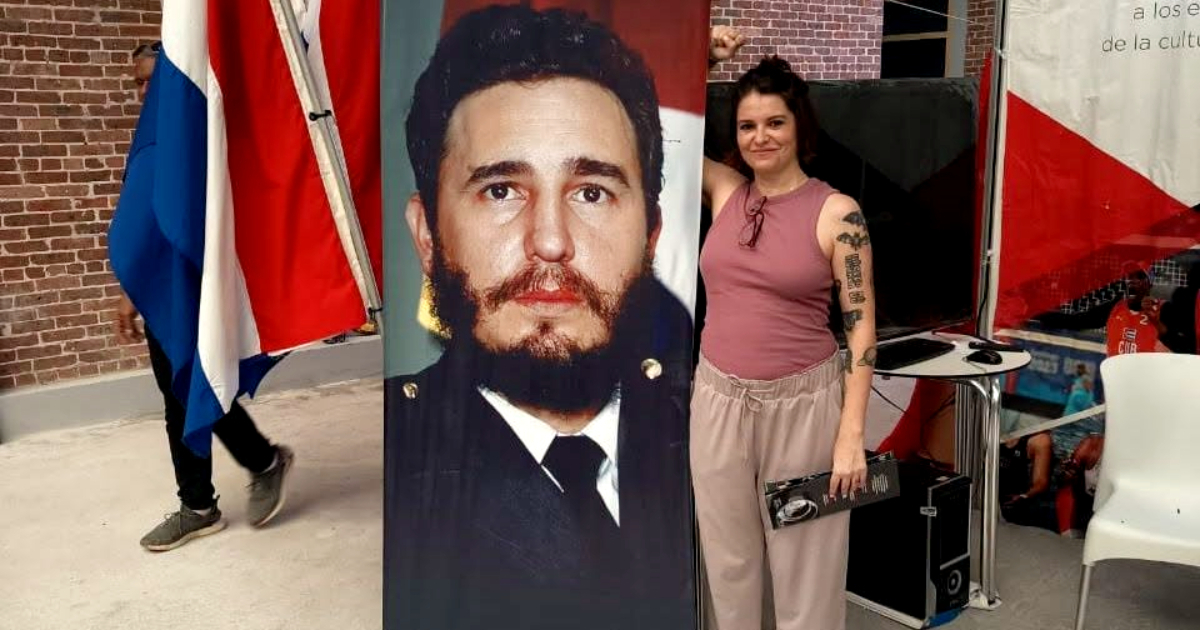
Ana Hurtado has written again on Cubadebate as if Cuba were hers, as if Cubans had granted her a mandate and as if she had moral or any kind of authority to place them in a trench.
In her article “The living will envy the dead”, the Spanish propagandist invokes Vietnam, Afghanistan, and Iraq to warn Washington that a war against Cuba might be easy to start, but impossible to finish without coffins, weariness, and moral defeat.
The problem is not that he criticizes a potential war. That would be legitimate. The problem is that he turns that war into a literary piece in service of the regime he defends. Where there should be caution, he places epic narratives. Where there should be questions, he replaces them with verses. Where there should be real Cubans, he inserts imaginary fighters.
Hurtado does not write against death. He writes to narrate it.
The foreigner who speaks for Cubans
Hurtado speaks of "homeland," "home," "children," and "the dead buried there."
But she is not Cuban. She was not born under the system she defends, she has not lived like an everyday Cuban, and she will not be the one who pays the highest price if the country she romanticizes ends up submerged in a greater confrontation.
That is the morally obscene point of his text: plays at resistance with other people's lives.
Cubans have had enough of their leaders repeatedly placing them in a trench without consulting them. They do not need a Spaniard, shielded by the power structure she defends, to come and equip them with a helmet, rifle, and epitaph.
If Hurtado wants to engage in revolutionary politics, he can go to Puerta del Sol in Madrid, run for elections in Spain, join the PCE, the Catalan CDRs, or the anti-capitalists in Podemos.
What I should not do is speak on behalf of a people whose future the Cuban regime does not allow to choose freely.
Let them ask, if they believe so much in the people
The question is simple: if Hurtado and the regime believe that Cubans are willing to give their lives for the so-called "revolution," then they should have the courage to ask them.
Not in a monitored square. Not in a petition drive organized by the Party. Not in a campaign of slogans where dissenting can cost you your job, your place in university, or even land you in jail.
Let them do it in a transparent consultation, with international observers, legalized opposition, a free press, and guarantees to vote without fear.
Survey in Cuba, driven by over 20 independent media outlets, gathered more than 42,000 responses and showed an overwhelming rejection of the system: 94% of participants expressed being very dissatisfied with the political system, and 95% believed that citizens do not have a real voice in the country's decisions.
CiberCuba also reported that 82.2% identified the lack of civil and political liberties as one of the main issues on the island.
The survey does not replace free elections. However, it is sufficient to dismantle the arrogance of those who speak of the "people" as if they owned them.
An epic comfort, written from the mattress of power
Hurtado does not write from the exposure of the common Cuban.
Journalistic investigations identify her as the wife of Senén Casas Más, pointed out as a key operator in Alejandro Castro Espín's inner circle, the son of Raúl Castro and a figure associated with the regime's security and intelligence apparatus.
CiberCuba, citing research from Martí Noticias and Mario J. Pentón, reported that Casas Más may have had access to diplomatic passports from the Ministry of Interior and participated in dozens of missions abroad alongside Castro Espín.
That data is not decorative. Change the perspective from which its text should be read. Hurtado does not speak as an external observer or as a powerless citizen. She speaks from a closeness to the power that administers repression, intelligence, propaganda, and privileges.
Moreover, their public activity is not limited to Cubadebate. CiberCuba documented that in 2025 they published an article in TeleSur about the alleged "oil sovereignty" of Cuba, which was later refuted by the regime's own data on the island's energy dependence.
It is also linked to international networks such as Green Zone Foundation, a private institution founded in Doha, Qatar, dedicated to cultural exchange and the promotion of the Arabic language in Latin America and the Caribbean. The foundation itself has signed cooperation agreements with TeleSur for cultural and media projects between the Arab world and the region.
That is not the world of blackouts, the ration booklet, the hospital without supplies, or the crushed salary. It is another cushion. Another safety net. Another comfort.
From there, it is very easy to write about sacrifice.
Poetry as a pretext
Hurtado employs the song "Dile a tu hijo que no venga" by Indio Naborí to wrap his warning in a familiar emotion: the Cuban mother, the American son, the threatened homeland.
The resource works literarily. Politically, it is a trap.
Because the poem serves to avoid speaking about the present. It does not mention political prisoners, blackouts, destroyed hospitals, youth fleeing, broken families, or a country where citizens cannot change the government through free elections.
The homeland that is invoked is not that of the Cubans who wish to decide. It is the homeland managed by an elite that does not ask because it fears the answer.
The dead as propaganda material
In her previous post, Hurtado spoke about the "murder of the 32 Cuban heroes" associated with the protection of Maduro and Cilia Flores. Now she is using American coffins from Iraq to warn that the living might envy the dead.
In both cases, the bodies are subordinate to the narrative.
Cuban deaths serve as epic. American deaths, as a threat.
But the fundamental question never arises: who sends those Cubans to die?, who decides for them?, why should the life of an island citizen be tied to the survival of Maduro, the Castro family, or any ally of the regime?
Hurtado does not analyze death. He uses it.
Vietnam, Afghanistan, and Iraq like little cards
The article mentions Vietnam, Afghanistan, and Iraq to argue that the United States can intervene, but does not always know how to exit. The argument has a valid point: wars can spiral out of control, and their costs often exceed initial calculations.
But Hurtado does not conduct a comparative analysis. He does not examine differences in context, scale, internal legitimacy, social fractures, military capacity, diaspora, economic collapse, or the fatigue of the Cuban population.
He only takes American defeats or weariness and turns them into anti-imperialist tokens.
If he truly cared about preventing a war, he would call for a political solution. If he genuinely cared about Cubans, he would ask for their input. If he really feared for life, he wouldn’t write as if death were a convenient literary device.
The dilemma it doesn't want to name
The alternative does not have to be war or surrender. There is another option: to initiate a verifiable transition, release political prisoners, legalize the opposition, allow a free press, accept international observers, and hold a genuine consultation on the future of the country.
That would indeed be listening to the people.
But Hurtado does not write to open that door. He writes to close it. His function is to present any external pressure as imperial aggression and any resistance to the regime as betrayal. In this way, the dictatorship fades behind the flag, and the elite disguises itself as the homeland.
That is the old trick: turning the permanence of power into national sovereignty.
If the regime keeps claiming that all its woes stem from the "blockade," it has a political avenue to try to dismantle it without putting Cubans in a trench: by fulfilling the conditions set forth in U.S. law to suspend and lift the embargo, starting with the release of political prisoners, legalizing dissent, allowing basic freedoms, and calling for free elections with international observers.
But that path requires consulting the country, not speaking for it; and there the epic of Hurtado ends and the real fear of the dictatorship begins.
That he leaves the Cubans in peace
Ana Hurtado can write whatever she wants from Cubadebate, TeleSur, or any friendly platform. She can quote Naborí, pose as an anti-imperialist, and turn every tension with Washington into a scene of heroism.
What I shouldn't do is speak on behalf of Cubans.
Less so to suggest that they are willing to die for a "revolution" that does not allow them to vote freely, protest without fear, associate without permission, or decide if they want to continue living under the same power as always.
Talking about resistance from the regime's perspective is easy. What is truly challenging is to do so from a line, a blackout, a political prison, a hospital without medicines, or a home where every meal depends on the remittance that might still come.
Hurtado plays at war epic with the lives of others. And that is not solidarity with Cuba. It is propaganda at the expense of others.
Related videos:
Filed under: