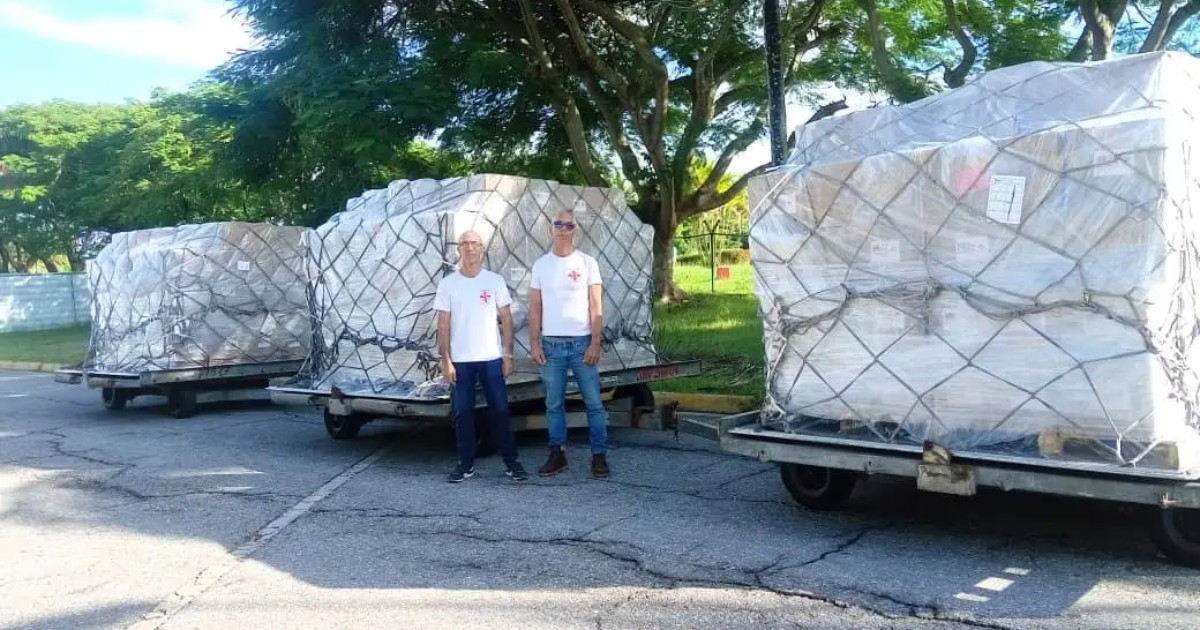
A second plane with humanitarian aid from the United States government arrived in Matanzas this Thursday, carrying a shipment of 700 kits intended for vulnerable families in that Cuban province, where the Catholic Church will continue distributing food and basic necessities.
The flight landed at Juan Gualberto Gómez International Airport in Varadero, as reported by Cáritas Cuba in a statement which also confirmed that this is the second shipment received by the Diocese of Matanzas under the assistance program funded by Washington.
The new allocation will allow for the continued distribution of supplies to families previously identified by Cáritas, with priority given to those facing the greatest economic and social difficulties.
In this instance, the distribution will focus on the territory of the parish of Nuestra Señora de la Caridad, which includes Unión de Reyes, Bolondrón, Güira de Macurijes, and rural communities in that area.
The parish volunteers, along with the priest Enrique Peñate Galán, will be responsible for delivering assistance to the selected homes based on the criteria established by the donors.
The shipment takes place just eight days after the arrival of the first cargo destined for Matanzas, which was received on October 14 at the same Varadero airport.
During that first delivery, U.S. assistance began to arrive for 700 of the 2,100 selected families at the Vicaría Nuestra Señora de la Caridad, a district that includes several localities in the municipality of Unión de Reyes.
The reception was led by Monsignor Juan Gabriel Díaz Ruiz, Bishop of Matanzas, and María de los Ángeles Castelo Elías Calles, director of Caritas in the diocese.
Among the prioritized beneficiaries are adults over 60 years old, people with disabilities, individuals with chronic illnesses, pregnant or breastfeeding women, and families with children under five years old who are facing particularly vulnerable situations.
Cáritas explained that the households are selected in advance by their parish teams and volunteers, with the aim of directing supplies to those who have the greatest needs.
The first distribution has already taken place in communities such as Alacranes and San Antonio de Cabezas, where volunteers delivered the modules directly to the homes.
In their statement this Thursday, Cáritas Matanzas expressed gratitude for the experience of those initial deliveries and highlighted the work of the volunteers involved in the process.
The challenges faced by some of the beneficiary families were reflected in the testimonies gathered during the visits.
On October 17, Cáritas documented the delivery of aid to residents of rural communities in Matanzas who live in conditions of extreme hardship.
One of the cases was that of José Agustín Farray Ponce, known as "Tito," a resident of Cuatro Caminos, who welcomed the volunteers into a home located in an area without electricity.
"How could I have imagined that someone would remember me, that they would come to see me this afternoon!" he expressed upon receiving the supplies.
In other homes, deliveries also reached bedridden individuals, elderly adults, and families who rely on the assistance of neighbors or relatives to meet their daily needs.
The new shipment is part of the 100 million dollars humanitarian assistance program announced by the U.S. administration in May 2026, an initiative aimed at distributing food, hygiene products, and other supplies among the Cuban population.
Of that amount, 60 million dollars are funneled through Catholic Relief Services (CRS), Cáritas Cuba, and the Catholic Church network, while the remaining 40 million correspond to distribution mechanisms through independent humanitarian organizations.
The U.S. State Department presented the program as a means of direct assistance to Cuban citizens, without providing resources to the Havana government.
The Catholic Church has explained that the 60 million dollars are not handed over in cash to Cáritas Cuba. The funds are used to purchase supplies and finance the logistics needed to transport and distribute them among families.
The products are purchased and transported in coordination with CRS, while the volunteers from Cáritas carry out the distribution within Cuban territory through their diocesan and parish structures.
The program had its first national flight on July 21, when a cargo plane departed from Miami to Havana with modules of food and hygiene initially destined for 700 families.
That shipment inaugurated the distribution of the new package of 100 million dollars, announced by Secretary of State Marco Rubio, and was coordinated with the Catholic organizations responsible for delivering the products to the beneficiaries.
Related videos:
Filed under: