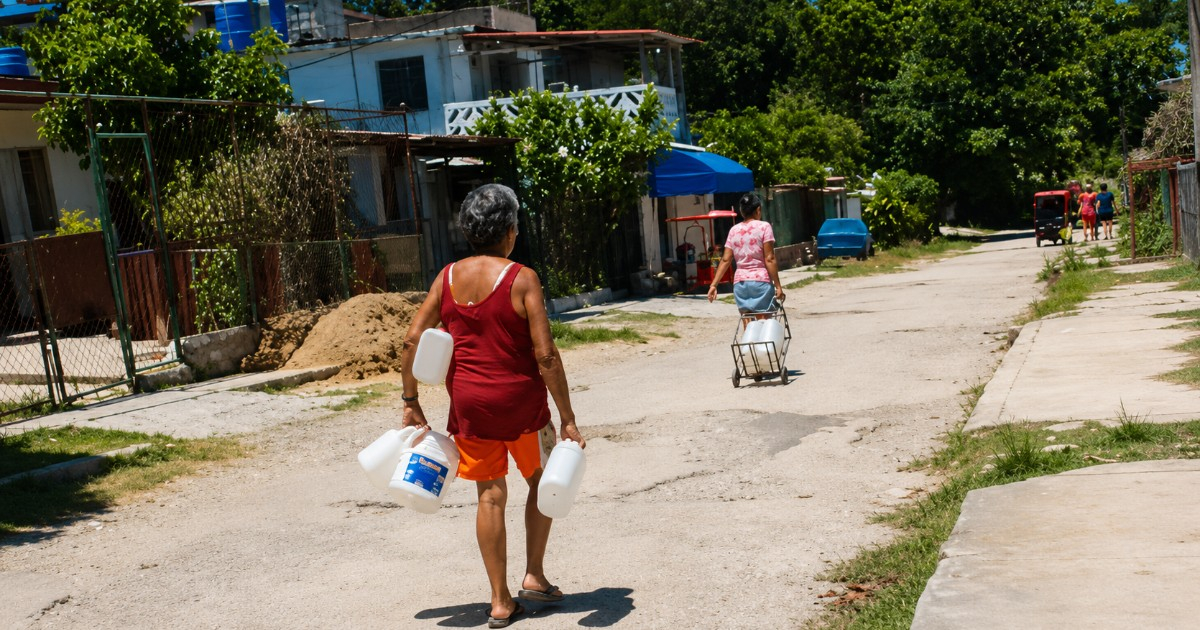
Residents of San Juan y Martínez, in Pinar del Río, and from the center of Songo-La Maya, in Santiago de Cuba, reported this week periods of three to four months without access to water through the aqueduct systems, according to a report by journalist Ivette Pacheco published in Martí Noticias.
In the La Estrella area of the municipality of San Juan y Martínez, a resident reported that families in the area have gone more than four months without supply in their homes.
According to their testimony, neighbors boil rainwater for drinking and cooking because they cannot afford the cost of private water trucks, which range from 15,000 to 20,000 Cuban pesos, nor the price of 200-liter tanks, which are sold for between 1,000 and 1,200 pesos.
He also pointed out alleged irregularities in the local management of the aqueduct and possible illegal connections to the main network that could reduce flow pressure, accusations that have not been independently verified.
From the eastern part of the country, the activist and independent journalist Yadira Serrano reported that in the center of Songo-La Maya, shortages have persisted for three to four months, with some communities facing issues of up to a year without regular service.
Serrano explained that residents turn to artisanal wells or pay between 1,000 and 1,500 pesos for a tank from independent sellers, while water tank trucks can cost up to 15,000 pesos, an amount that significantly exceeds many state salaries.
In the province of Granma, the activist Yurisnel Domenech reported from Media Luna that several areas of the locality have accumulated between five and six days without access to the resource, in sectors that previously had service.
The situation in Pinar del Río has shown documented deterioration for several months now. By mid-October, seven broken pumping units in the main lines of the provincial capital and power outages lasting over 16 hours a day left entire communities without supply for between 67 days and more than three months.
In Songo-La Maya, the situation is equally serious: in May 2026, residents reported more than 50 consecutive hours without electricity or water, and in September, the state-owned company Aguas Turquino acknowledged severe supply difficulties in the municipality, where some areas had gone approximately six months without receiving water through the networks.
The link between the water crisis and power outages is direct: the National Institute of Hydraulic Resources acknowledged that over 85% of the country's pumping stations rely on the National Electric System to operate, and that power cuts and equipment failures account for 88% of the reasons for the collapse in supply.
The stations require between 10 and 12 continuous hours of electricity to pressurize the network, a condition that is impossible to meet under the current blackout schedules.
The state agency admitted that around 2.5 million people —equivalent to 32% of the population supplied through public networks— are experiencing issues with drinking water service throughout the country. Meanwhile, the United Nations Office for the Coordination of Humanitarian Affairs (OCHA) estimated in September that about 3.5 million Cubans were facing difficulties in obtaining water supply.
Related videos:
Filed under: