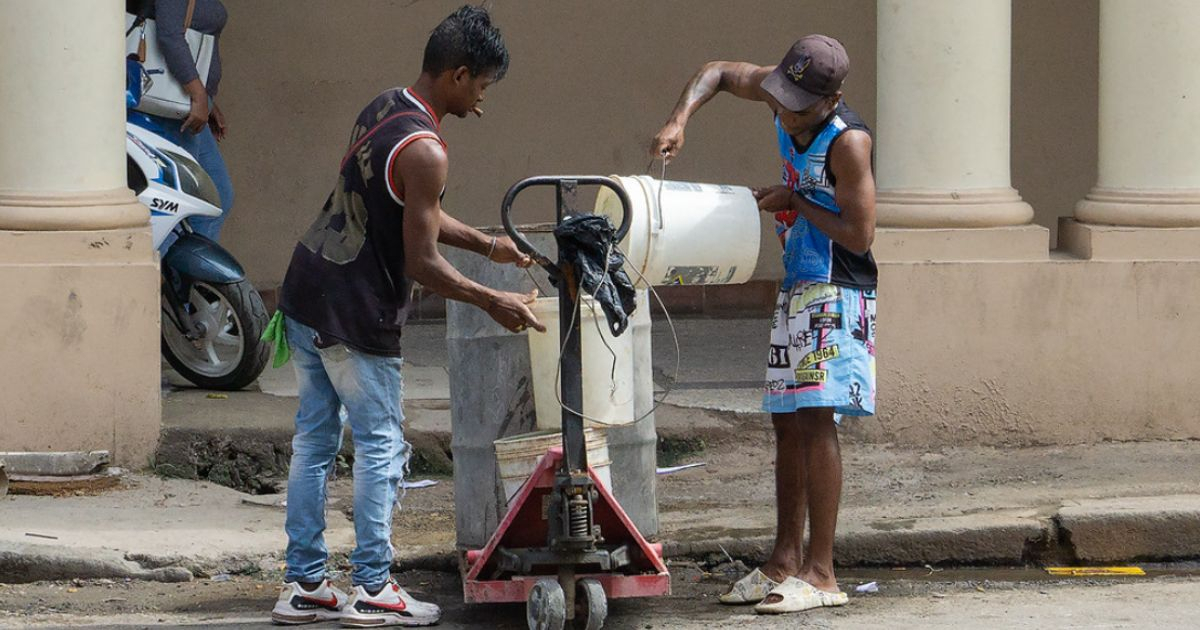
The Cuban regime itself acknowledged that around 2.5 million people across the island are experiencing total or partial access issues to drinking water as a direct consequence of the blackouts, according to statements by Alexis Acosta, vice president of the Water and Sanitation Business Group of the National Institute of Hydraulic Resources (INRH).
Television coverage is significant because it brings a crisis to national attention that the regime had only acknowledged in a fragmented way, province by province.
"The situation remains complex due to the contraction in electricity generation. As of yesterday, we closed with 32 percent of the population receiving water supply services through networks, either partially or fully, affecting around 2.5 million residents," stated Acosta.
In other words, on Sunday, only one in three Cubans served by the public network received a full supply of water.
Havana and Matanzas, the two most populated provinces in the western part of the country, are leading the impacts. In the capital, the crisis worsened over the weekend due to simultaneous mechanical failures in the Cuenca Sur —78 inches— and Cosculluela pipelines, the two main arteries of the Havana system.
The underlying problem is structural: the pumping stations require between 10 and 12 hours of continuous electricity to operate, a threshold that becomes unattainable when the Electric Union reports blackouts exceeding 20 hours in urban areas and 30 hours in rural zones.
The INRH has documented that the lack of electricity and pump failures account for 88% of the national incidents of water shortages; drought only accounts for 4%. 87% of the aqueducts in the country depend on the National Electroenergetic System, which turns every power outage into a simultaneous water outage for hundreds of thousands of families.
The figure from Monday is not an isolated peak. At the beginning of October, the INRH had already acknowledged 2.7 million affected individuals, practically the same proportion as in May, which shows that the crisis is not subsiding.
The UN Office for the Coordination of Humanitarian Affairs estimated in September that the actual number could reach 3.5 million people.
Behind the blackouts lies an energy crisis that the regime has been unable to reverse. Throughout 2026, Cuba has only received a shipment of 100,000 tons of Russian crude, which arrived at the end of March and eased the blackouts for just two weeks.
This Tuesday, the Electric Union forecasted a availability of 830 megawatts against a demand of 2,820 megawatts, resulting in a generation deficit of nearly 2,000 megawatts.
The health consequences are severe. The Ministry of Public Health acknowledged at the end of September a simultaneous increase in dengue, diarrhea, hepatitis, and respiratory infections, directly linking diarrheal diseases and hepatitis to sanitation issues arising from a lack of water. A Cuban pediatrician raised an alert weeks later about the rise in hepatitis and diarrheal infections in children.
The contradiction between the real crisis and the official discourse became evident on October 16, when Miguel Díaz-Canel, during the National Defense Day, asserted that Cuba has greater "invulnerability from a military and defense standpoint," while a quarter of the country lacked stable access to water.
The long-term solution announced by the regime—installing 200 megawatts of photovoltaic solar energy to make the pumping independent from the electrical grid—is not expected until the first months of 2027.
Related videos:
Filed under: