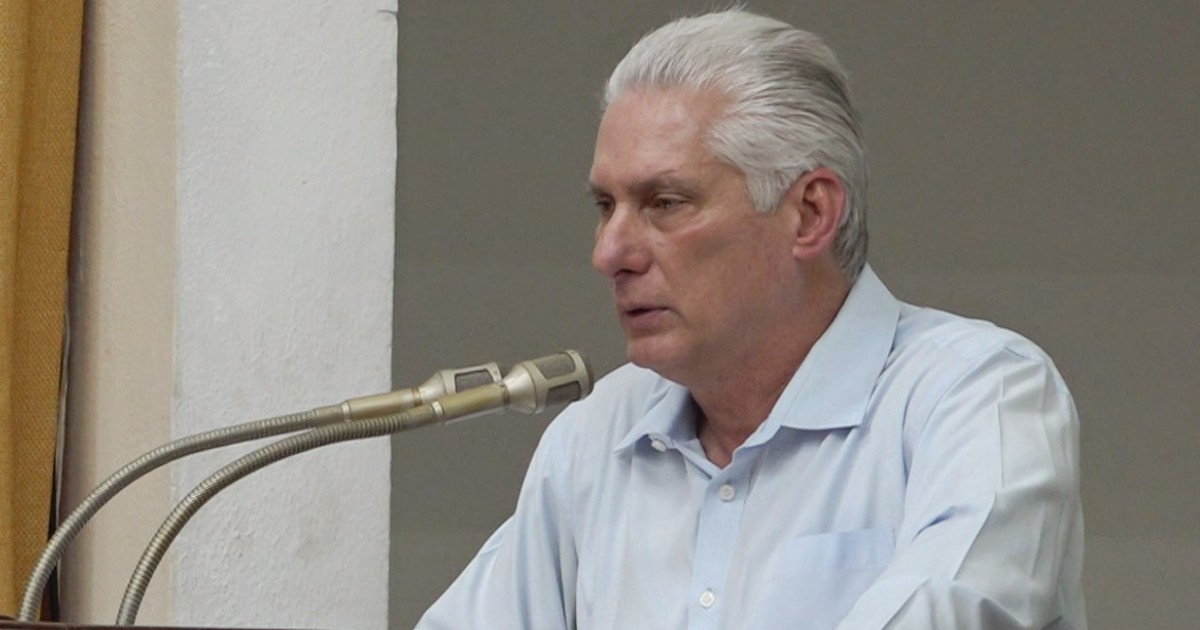
Miguel Díaz-Canel acknowledged this Thursday that food production is an essential condition for the political survival of the regime, during the conclusion of the visit by the Central Committee of the Communist Party to the Ministry of Agriculture to assess the progress of the 176 economic and social transformations approved in June.
If there are no food supplies, there is no social stability; if there are no food supplies, there is no well-being that the socialist construction process aims to achieve in our country," he stated. The leader placed food sovereignty and the stability of the National Electric Power System among the main priorities of the moment.
He also acknowledged the material difficulties that the countryside faces: "Producing food today, with practically no fuel, is very difficult," he noted, also mentioning "rural migration and the decrease in the workforce."
Despite that diagnosis, he insisted on the message of resilience: "We will not give up, because we need to produce the food we require in our country."
The leader presented agricultural activity as a political defense task: "Every hectare that is planted, every ton that is harvested, and every liter of milk that is collected is an act of defense of the Revolution and, in the current conditions, it is also an act of resistance."
«Agriculture is also an ideological and social battleground,» he added. As he expressed, improving the conditions of rural communities, stopping migration, and opening opportunities for young people are inseparable parts of the transformations. He also reiterated a slogan from Raúl Castro: «We must turn to the land and make it productive.»
The warning comes as 96.91% of the Cuban population lacks adequate access to food, with 33.9% of households reporting that at least one member has gone to bed hungry in the past 30 days, and 25% of Cubans going to bed without dinner, according to data from the Food Monitor Program.
The Prime Minister Manuel Marrero Cruz, who was also present at the event, reported that the policies for 170 out of the 176 transformations have already been developed, supported by 214 legal norms. However, just three weeks earlier, he had publicly acknowledged that "there is still no noticeable improvement in the quality of life of the population."
The gap between official announcements and reality is staggering. Rice production plummeted from 304,000 tons in 2018 to just 79,000 in 2025. Between 2018 and 2023, pork fell by 95%, beans by 70%, and milk by 58%. Agricultural production as a whole recorded a decline of 53% in 2024, while Cuba spends over 2 billion dollars annually to import between 70% and 80% of what it consumes.
The pattern of unfulfilled promises is systematic. In May, Díaz-Canel stated that Cuba "will eat what it can produce." In June, he declared "there is no sovereignty with an empty plate" when presenting the 176 measures. In October, the regime postponed the results again to 2027.
The Deputy Minister of Agriculture, Telce González, admitted on October 16 that giving a specific date for food improvement would be “irresponsible,” and added a revealing confession: “Rules alone will not work. The obstacle lies in our mindset.”
The macroeconomic context worsens the situation. The CEPAL projects a contraction of the Cuban GDP of 10.3% for 2026, the worst in Latin America, with food inflation at 36.01% year-on-year in August and the informal dollar exceeding 700 pesos in September.
The economist Elías Amor described the reform package as "a great deception," pointing out that between January and May 2026, net sales in the state sector fell by 29.2%, and the number of loss-making companies increased from 252 to 363.
The response from Cubans on social media summarizes the accumulated exhaustion: "We have lost hope because it has been and is too much time and too many unfulfilled promises. Results are what we reward and expect. Good intentions and efforts do not put food on the table."
Related videos:
Filed under: