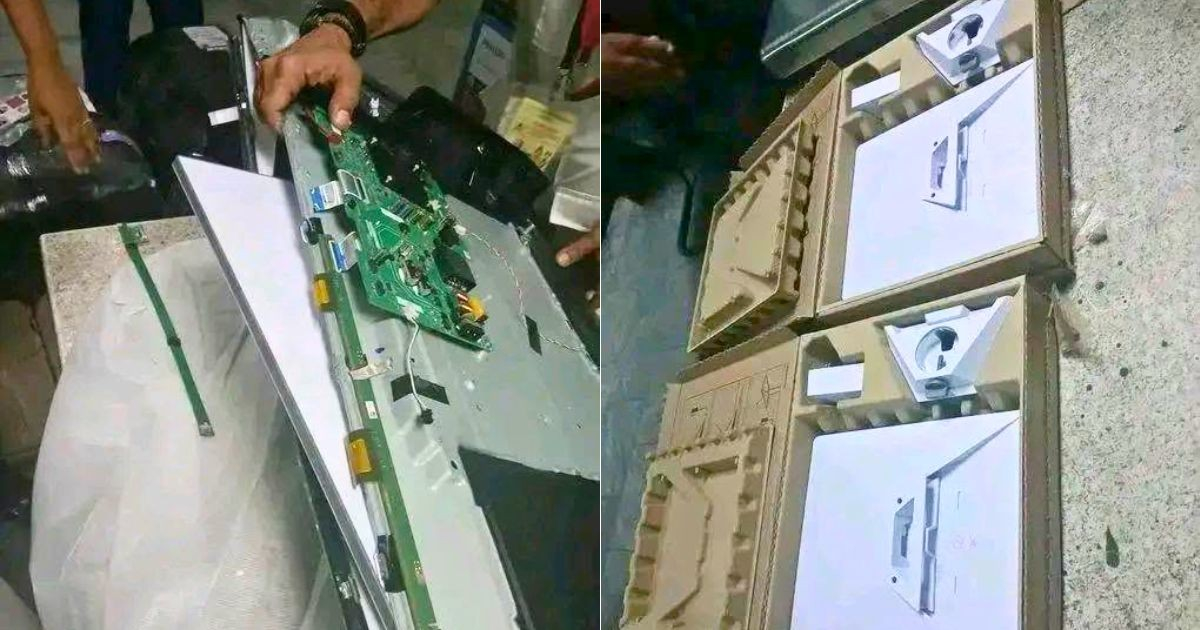
A group of Cubans —men and women— was sentenced to prison terms ranging from four to five years for being part of a network engaged in the illegal sale of Starlink antennas in Santa Clara, according to a report from an official government-aligned Facebook profile identified as "Alejandro Noticias Cuba."
According to that publication, the events took place weeks before this Friday, and the sentences were confirmed by sources close to the families of the defendants in court. The information does not come from an officially published court ruling or from an institutional channel of the regime.
In the searches conducted at the homes of the detainees and in the residences of those receiving the merchandise, 37 antennas that had entered the country through illegal means were seized, the official profile specified; and added that the equipment "had entered the country through illegal means and was being sold unlawfully."
The sanctions were not limited to the main sellers. The transporters linked to the network also received criminal sentences, while the receivers faced fines of 100,000 Cuban pesos (CUP) and the seizure of equipment. The publication warned that "repeat offenders will face harsher penalties" and emphasized that "sanctions were imposed on the entire criminal chain: the importer, the transporter, the seller, and the buyer."
The applicable legal framework in this case includes Article 295.1 of the Cuban Penal Code (Law 151/2022), which classifies the crime of illegal dissemination of satellite, television, and radio signals, telecommunications services, or other similar services. The regulation establishes penalties of three to eight years of imprisonment for those who, without legal authorization, direct, organize, distribute, profit from, or finance the dissemination of such signals or services.
The same penalty is outlined in article 295.2 for those who market or distribute means, equipment, or technologies, or facilitate the illegal activities described in the previous section. In May 2026, the Ministry of Communications strengthened this regulatory framework with Resolution 1/2026, which prohibits the importation of equipment and devices used to access computer or telecommunications networks without authorization and establishes technical authorization requirements for other equipment, including satellite television receivers and their antennas.
The official profile justified the severity of the penalties by arguing that Starlink terminals "have been linked to war operations" and that their clandestine introduction "is used for a parallel network outside the control of the State." This narrative echoes the regime's stance, which since 2025 has categorized the antennas as tools of U.S. "digital aggression," without any independently verifiable evidence to support these claims.
The case of Santa Clara falls within a systematic campaign by the Cuban Customs against Starlink devices that intensified starting in 2025, with seizures at airports where the devices were hidden in boxes of monitors, soldering equipment, and music systems, coming from Miami.
The demand for these antennas among the Cuban population has a direct explanation: ETECSA, the state monopoly on telecommunications in Cuba, operates in a country where the mobile internet download speed was only 7.21 Mbps in May 2026, according to figures from the Speedtest Global Index that ranked the island last in Latin America.
Despite the deficiencies in the service, the company maintains a pricing scheme introduced in May 2025 that restricts ordinary top-ups in Cuban pesos and offers additional packages in both national currency and dollars. Among the announced rates was an option for 3 GB for 3,360 CUP, which is even higher than the Cuban monthly minimum wage set at 3,210 pesos, as well as larger capacity packages available in dollars.
In March 2026, Elon Musk confirmed that Starlink signal reaches Cuba, although it cannot be officially marketed on the island. Despite the restrictions, the equipment circulates in the informal market at prices above 1,000 dollars.
The reaction of internet users to the news was eloquent. One wrote ironically: "Me reading the news from Santa Clara with my Starlink." Another drew a historical parallel: "This reminds me of the dollar; how many celebrated a birthday just for having one dollar, and now we have an economy where everything is in dollars."
A third party pointed to the root of the issue: "There is another backdrop. If ETECSA provided better service, there would be no need to sell those antennas." And a Cuban who read the news from Jamaica summed up the paradox in one sentence: "How can they be called criminals for wanting access to the Internet, they asked me, and I answered, that's Cuba."
Related videos:
Filed under: