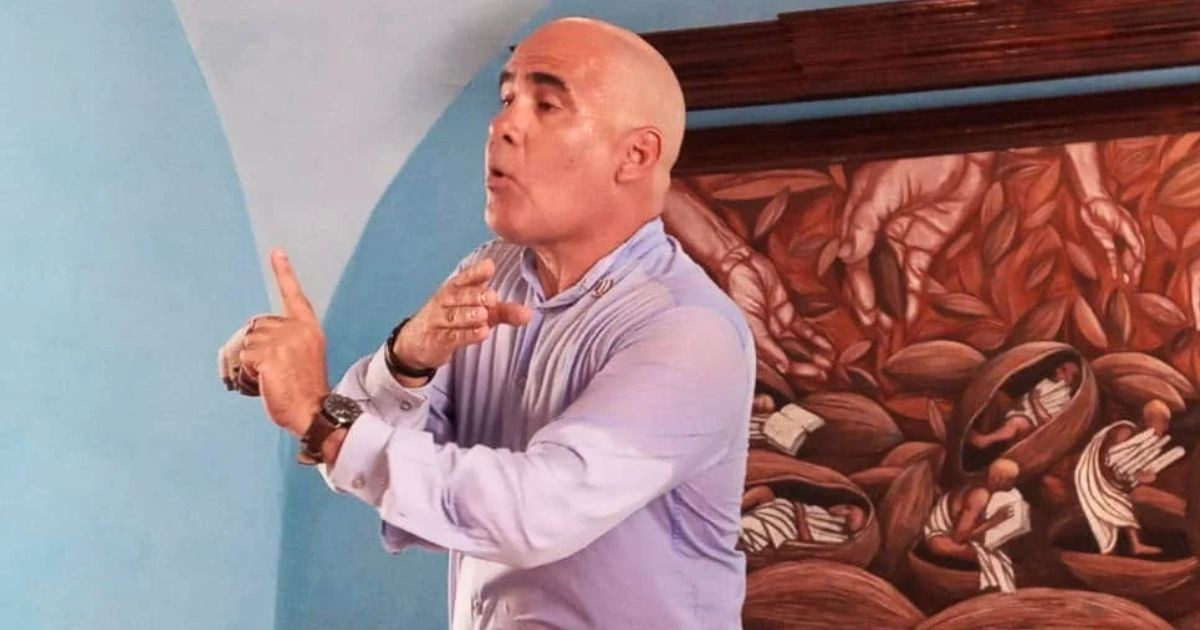
The jurist and academic René Fidel González García published an extensive reflection on Facebook this Sunday from Santiago de Cuba, in which he calls for the construction of a "new political thought in Cuba" and urgently warns: "We no longer have any time to waste."
Doctor in Legal Sciences and former tenured professor at the University of Oriente, González García has developed a series of critical statements in recent years, with increasing emphasis throughout 2026, that form an ever more urgent political diagnosis of the Cuban reality. The text from this Sunday is the most recent link in that series.
In his publication, the academic places political equality at the heart of his argument: "It is essential to start understanding the need to aspire to and demand the right to political equality for Cubans, for each one of us," he writes, defining it as "the most important and fundamental demand of our time."
González García draws a crucial distinction: the difference between being active citizens and merely being consumers of content. "We need politicians who are not content creators; we need to be citizens, not content consumers," he states, urging the need to approach politics "as both an individual and collective practice, rather than politics turned into cultural consumption or a product."
The academic describes the Cuban political system as one "based on the denial of the political equality of all citizens" and warns that its decline could lead to "the ultimate and disastrous ruin of our common home."
The Santiago professor advocates for a political thought that "paves the way and embodies itself in our daily lives, in our neighborhoods and communities devastated by poverty, in our institutions paralyzed and rendered obsolete by despotism and arbitrariness, by exalted mediocrity." He raises a strong call for unity: "We need to be, and we cannot do this without uniting those of us who believe in the same cause."
This Sunday's publication joins other reflections that González García has shared over the past months. In July, he stated that Cubans today have fewer rights and political freedoms than in 1953, under the dictatorship of Fulgencio Batista. In August, he used the concept of "political indigence" to describe the exclusion experienced by the majority, and argued that "political indigence inevitably leads to economic and social indigence."
In September, he diagnosed a "structural and irreversible disconnect" between the regime and the citizenry. At the beginning of October, he described Cuba as "a society paralyzed by political underdevelopment," using as a starting point the 876,522 people in the most vulnerable situation recognized by Prime Minister Manuel Marrero. And just a week ago, he suggested that a "new policy" requires "new politicians" capable of practicing what they claim to defend.
The context in which González García writes is one of unprecedented structural crisis. The Cuban Observatory of Human Rights estimated, in August 2026, that 94% of Cubans live in extreme poverty, according to a study based on 1,318 interviews conducted in 79 municipalities across the 15 provinces. ECLAC projects a contraction of the Cuban GDP by 10.3% in 2026, the worst in Latin America.
According to the latest report from Prisoners Defenders, Cuba ended September 2026 with 1,351 political prisoners, a new record in the organization's records, among them 152 women and 40 individuals arrested while they were minors.
González García knows firsthand the cost of dissent. He was removed from his position at the University of Oriente in late 2016 after publishing critical articles in independent media; the institution claimed that his texts lacked scientific merit and negatively influenced the education of the students.
He and human rights organizations reported that it was a political reprisal. In October 2022 he filed a lawsuit with the Supreme Court against Miguel Díaz-Canel and Attorney General Yamila Peña Ojeda for alleged constitutional violations.
This Sunday’s text concludes with a phrase that encapsulates the aspiration found throughout many of its statements: that it may never again be the hope of Cubans to find elsewhere in the world what is denied to them here out of love for power, disdain for freedom, and fear of the rights to happiness.
Related videos:
Filed under: