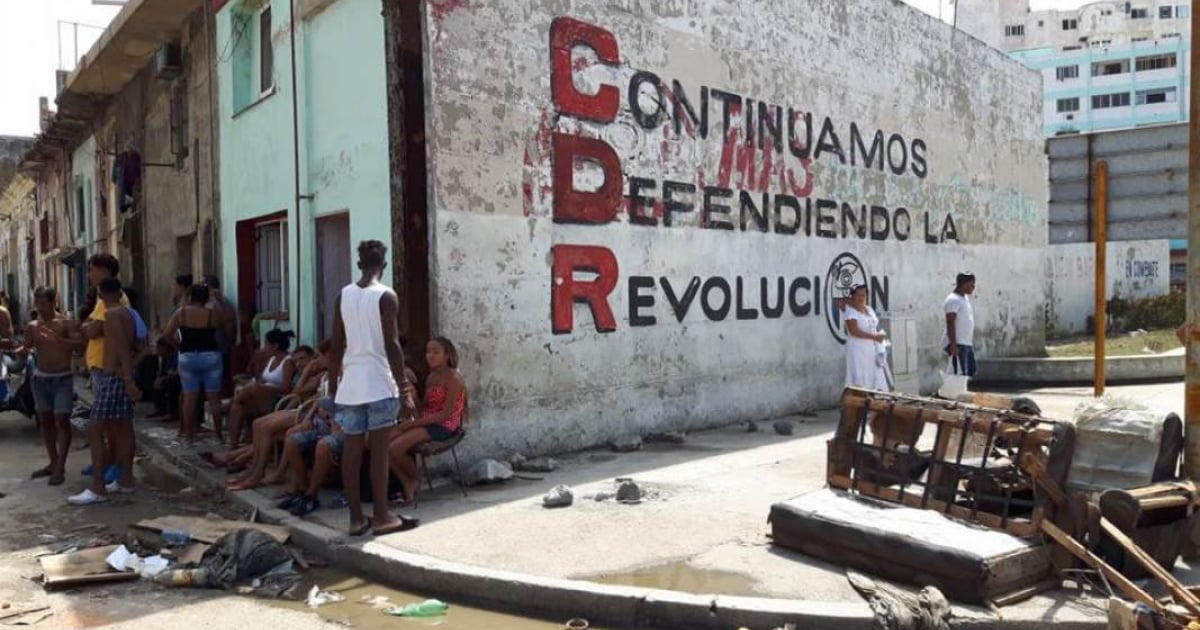
In the days leading up to the 73rd anniversary of the assault on the Moncada Barracks, the lawyer René Fidel González García published a powerful reflection on Facebook this Saturday, stating that Cubans today have fewer rights and political freedoms than they had in 1953 under the dictatorship of Fulgencio Batista.
"Just a few hours before the anniversary of the assault on the Moncada and Carlos Manuel de Céspedes barracks in 1953, it is clear that we in Cuba today have fewer rights and political freedoms than the Cubans of that time," wrote the Doctor of Legal Sciences and former professor at the Universidad de Oriente in Santiago de Cuba.
González García did not limit himself to comparing freedoms; he extended the diagnosis to the economic and social dimension.
"The social and economic problems that shattered the life and happiness plans of men and women during that time, in both cities and the countryside, as a form of injustice, inequality, and poverty, not only exist today exacerbated and in full expansion, but they are also evolving within a process of decline that currently affects the entirety of Cuban society, its cultures, and worldviews," he noted.
The jurist described that process of mutation as an opportunity seized by an elite that controls power: "a minority —along with its vassals and front men— that makes use of privilege, the monopoly of despotism, arbitrariness, and the subjugation and instrumentalization of public institutions to achieve their goals."
For González García, the cycle opened by Moncada is coming to an end: "The historical cycle initiated by the foundational event of a nearly extinct political generation is closing."
The text calls for the restoration of political equality and the guarantee of equal rights for all citizens, "so that its exclusive and arbitrary use does not continue to be a privilege of impunity, whim, and the will of unrestrained power: the inherited legacy from one minority to another, even worse, for being mediocre and trivial."
The central concept introduced by the jurist is that of the "right to the future," which he defines as "perhaps the least known and one of the most important" rights that Cubans have been deprived of. He describes it as "imprescriptible, inherent, inalienable, universal, indivisible, and interdependent" with all other rights.
"We must advocate for and exercise the right to the future, and the only way to do so is through politics," she concludes.
The publication comes as the regime celebrates the anniversary of Moncada in Pinar del Río under the slogan "My Moncada is the Homeland," in a country that faces blackouts, shortages, and widespread deterioration.
The repressive context is equally severe: Prisoners Defenders documented 1,281 political prisoners at the end of May 2026, while the Cuban Observatory of Human Rights recorded 332 repressive actions just in that month, including 55 arbitrary detentions.
González García was removed from his position at the University of Oriente in November 2016 after publishing critical texts in independent media. The institution justified his dismissal by arguing that his writings "lacked scientific character" and "negatively influenced the comprehensive training of professionals."
In October 2025, he filed a lawsuit with the Supreme Court against Miguel Díaz-Canel and the Attorney General Yamila Peña Ojeda for alleged constitutional violations. On April 19, he had already warned that there were "more reasons than in 1953" for a radical change in Cuba, and on May 1 he pointed out that "it's not about the people who march, but about the people who cannot express themselves."
"Cubans must begin to reclaim our right to the future, to decide our future, in front of everyone, in front of everything," he wrote this Saturday, marking his most direct statement to date.
Related videos:
Filed under: