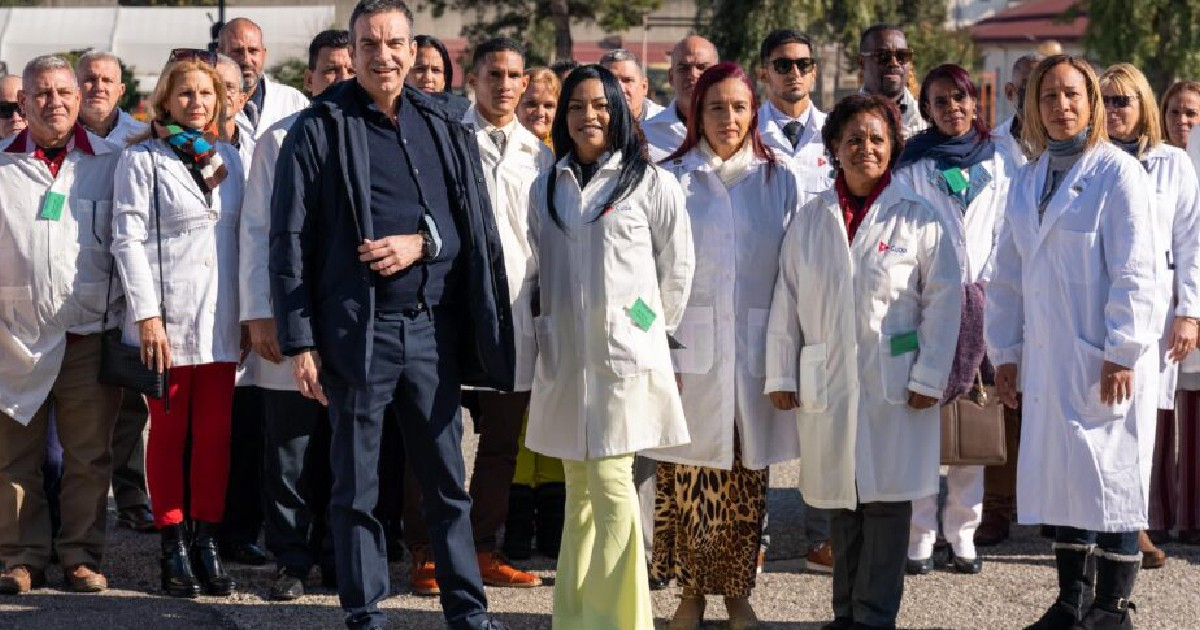
A report from the Cuban Observatory of Human Rights (OCDH), prepared by journalist and researcher Annarella Grimal, reveals with concrete figures the extent of the salary retention experienced by Cuban doctors assigned to the Calabria region in Italy. The Italian agency ANSA featured the document, which quantifies a practice that has been reported for years.
According to the report, Italy allocated 25.7 million euros for the base salaries of 333 professionals until March 2025, but the Cuban regime —through the state company Comercializadora de Servicios Médicos Cubanos (CSMC)— has only transferred about 6.2 million euros to the doctors, roughly 24% of the total.
The gap between what Italy pays and what the doctor receives is staggering: the agreement establishes a gross salary of about 4,700 euros per month per professional, but the CSMC allows them to keep a maximum of 1,200 euros.
The discount chain becomes even more aggressive during overtime hours. According to Grimal, the CSMC first applies a 43% retention presented as an "Italian tax," and then requires the doctor to transfer 50% of what remains. The result: the professional is left with 22.5% or less of the payment for overtime hours.
The state-owned company not only controls the amounts that doctors can retain but also the hiring processes, imposing parallel contracts to those signed with the Italian healthcare system.
In this context, around 63 Cuban doctors in Calabria have expressed interest in working directly for the Italian health authorities, independent of the CSMC. Some have already been individually hired by the region, although in certain cases they continue to voluntarily send part of their salary back to Cuba.
The financial outlook of the mission has become even more complicated since last July, when U.S. sanctions against the CSMC blocked transfers to Havana. The operating account of the company at the Italian bank BPER has been disabled, according to testimonies from mission members consulted by Diario de Cuba. "It seems that, for now, there will be no more transfers. The account is blocked," stated a Cuban doctor in the province of Cosenza.
Due to the inability to complete the shipments, the head of the mission instructed the doctors to temporarily hold the amounts that they normally had to send in their personal accounts. Among the alternatives explored was the possibility that the professionals themselves would carry cash to Cuba during their vacations, although there is no evidence that this solution has been implemented.
The case of Calabria is part of a growing international pressure on the model of Cuban medical missions.
In September, the OCDH made a formal request to Brussels for the European Union to investigate possible human trafficking practices involving the brigade. The delegation relied on a resolution from the European Parliament dated June 18, 2026, which explicitly mentions Cuban medical brigades as a potential form of trafficking.
The report from the U.S. State Department on human trafficking for October 2026 kept Cuba at Level 3 —the most severe category— and described a "government policy or pattern" of forced labor in the labor export program, with withholdings ranging from 50% to 95% of the salaries paid by recipient countries. The CSMC is linked to the Cuban military business conglomerate GAESA.
Related videos:
Filed under: