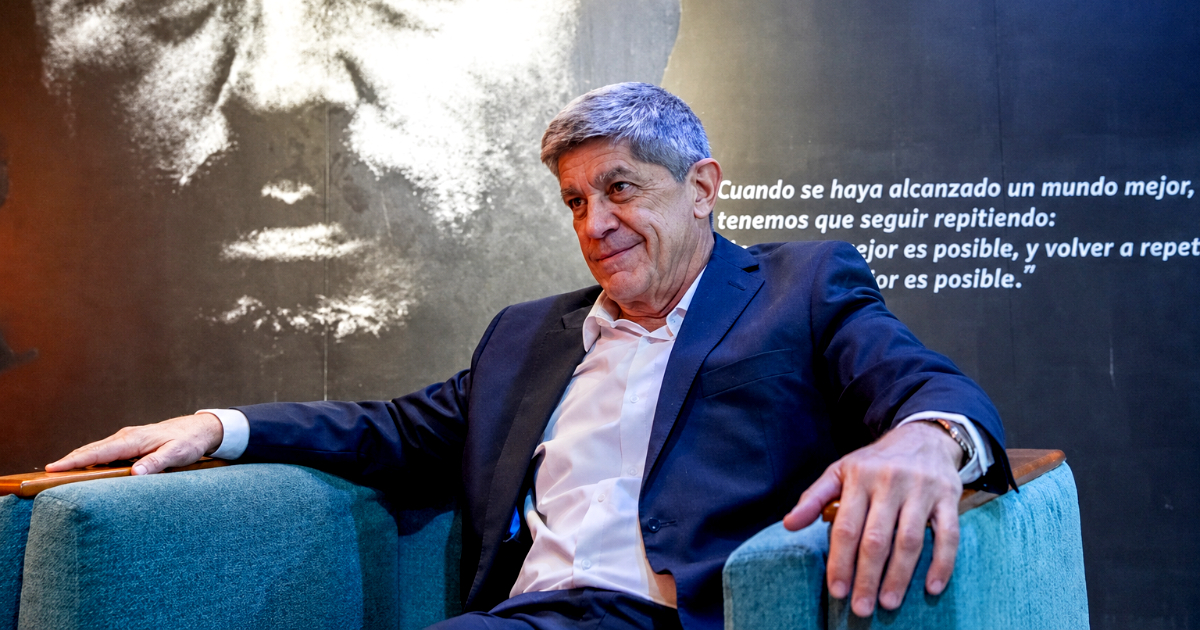
The Cuban Deputy Minister of Foreign Affairs, Carlos Fernández de Cossío, reiterated his denunciation of the military interventions and covert operations by the United States, while asserting the supposedly peaceful nature of the foreign policy of the Castro regime.
In a post on Facebook, the diplomat listed the wars, coups, and espionage activities attributed to Washington to conclude that Cuba "does not threaten, aggress, or interfere in the internal affairs of any country." According to his account, the U.S. government lies to its citizens to make them believe that the island poses a threat.
The message replicates the usual victimization rhetoric of Havana, but omits more than six decades of military interventions, support for guerrillas, intelligence operations, and involvement in foreign repressive apparatuses, documented by international organizations, journalistic investigations, declassified files, and court rulings.
Venezuela: from Guerrillas to Torture Allegations
One of the most compelling precedents comes from the Organization of American States (OAS), which in 1964 officially condemned the intervention and aggression of Fidel Castro's government against Venezuela, after investigating the supply of Cuban arms to insurgent organizations. In 1967, Cuban fighters participated in the guerrilla landing at Machurucuto, aimed at combating the government of Raúl Leoni.
Decades later, Cuban influence reached the security structures of Chavismo. A 2019 investigation by Reuters revealed military agreements from 2008 that allowed Havana to advise and reorganize Venezuelan intelligence agencies, train agents, and develop internal surveillance mechanisms.
The Independent International Fact-Finding Mission of the UN documented in 2022 the involvement of Cuban advisors in the training of officials from the General Directorate of Military Counterintelligence (DGCIM), including interrogation and surveillance techniques.
On its part, reports from the CASLA Institute, led by Tamara Suju, collect testimonies from victims who reported the direct involvement of Cuban officials in interrogations and torture. In 2024, the organization filed a complaint with the Office of the Prosecutor of the International Criminal Court against the Cuban state for its alleged involvement in crimes against humanity committed in Venezuela.
Havana officially recognized another dimension of that presence in January 2026, following the capture of Nicolás Maduro: 32 members of the Cuban Armed Forces and the Ministry of the Interior died during the U.S. operation, while carrying out security and defense missions in Venezuelan territory, according to the Cuban government itself.
Latin America and Africa: exporting the revolution
The history of foreign operations practically began with the triumph of the so-called "revolution".
In 1959, armed expeditions organized from Cuba attempted to intervene in Panama and the Dominican Republic.
During the 1960s, Havana promoted, trained, or supplied resources to guerrilla movements in Venezuela, Bolivia, Colombia, Guatemala, Peru, Ecuador, and other Latin American countries. The expedition led by Ernesto Che Guevara in Bolivia is one of the most well-known examples.
Historical investigations and declassified intelligence documents also record activities supporting insurgent organizations in Argentina, Brazil, Chile, and Uruguay, as well as military assistance to Nicaraguan Sandinistas and the Salvadoran guerrilla during the following decades.
The military projection extended to Africa, with expeditions to Congo, assistance to anti-colonial movements in Guinea-Bissau, and military operations in Algeria, Angola, and Ethiopia.
Angola concentrated more than 50,000 Cuban soldiers at the same time, while thousands participated in the Ogaden War in support of the Ethiopian government.
Several of these operations were in response to alleged requests from allied governments or to support anti-colonial movements, circumstances that differ from clandestine infiltrations but demonstrate the military reach of Cuban foreign policy.
Espionage in the United States and new international allegations
The Cuban intelligence history also includes cases that have been legally recognized in the United States.
Ana Belén Montes, an analyst for American military intelligence, was sentenced to 25 years in prison for espionage on behalf of Cuba; Walter Kendall Myers, a State Department official, received a life sentence for a conspiracy that developed over decades; and Víctor Manuel Rocha, a former American ambassador, was sentenced in 2024 to 15 years after admitting that he worked clandestinely for Cuban intelligence since 1973.
These cases also include the Red Avispa, whose members infiltrated exile organizations and gathered information about American targets in Florida, ultimately providing the necessary intelligence for the downing of two aircraft from the Hermanos al Rescate organization, which resulted in the deaths of four Cuban Americans.
In July 2026, the Department of State published the report Cuba: the Capital of 21st Century Communism, aimed at reconstructing the espionage operations, political influence, and support for revolutionary movements promoted from Havana. The document includes numerous verified historical and legal precedents.
Fernández de Cossío then responded calling the report deceitful, without specifically refuting the main espionage cases it mentioned.
His new publication insists on portraying Cuba as a victim of a U.S. intimidation campaign. However, the interventions by Washington that the diplomat denounces do not erase the Cuban operations documented by the OAS, the United Nations, human rights organizations, and U.S. courts.
The assertion that Cuba never interferes in other countries does not differentiate between clandestine activities, support for insurgencies, or military interventions requested by allied governments. One of the oldest pieces of evidence for this contradiction remains the OAS resolution of 1964, which expressly condemned the Cuban regime for interfering in Venezuela.
Related videos:
Filed under: