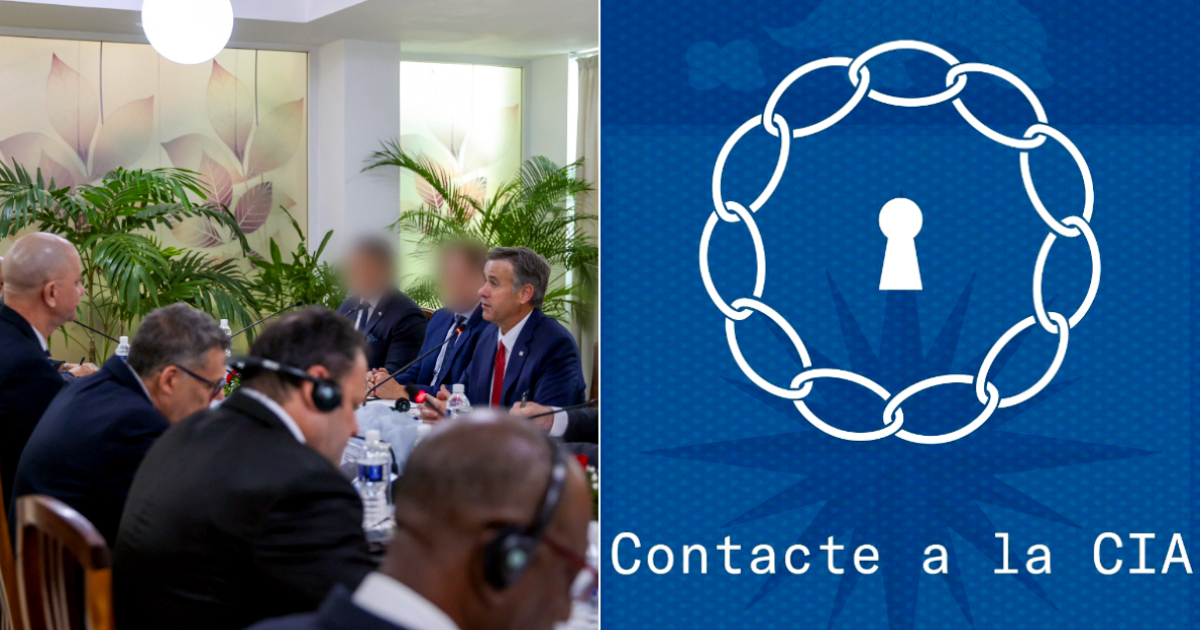
The public appeal from Marco Rubio and the Central Intelligence Agency (CIA) to Cubans to discreetly collaborate with U.S. intelligence services represents a new chapter in a pressure strategy on Havana that seems to be progressing along two simultaneous paths: negotiation with the current leaders and the pursuit of information, contacts, and potential fissures within the power structure.
The initiative comes after months of discussions, proposals, and exchanged messages between Washington and the Cuban regime, whose representatives have made it clear that they are not willing to negotiate changes in the political system, the leading role of the Communist Party (PCC), or the holding of multiparty elections.
The contradiction is evident: while the Trump administration demands transformations that impact the foundations of the Cuban power system, its counterparts in Havana insist on preserving precisely those structures.
And although the U.S. president continues to speak of an agreement, the CIA has intensified its efforts to gather information and explore the internal divisions of the ruling elite.
A negotiation that stumbles upon the survival of the regime
Contacts between Washington and Havana have included high-level interlocutors and proposals that, according to various media reports, go far beyond the migration or security issues that have traditionally dominated bilateral discussions.
In May, the CIA director, John Ratcliffe, made an unusual visit to Cuba, where he met with the Minister of the Interior, Lázaro Alberto Álvarez Casas, and other representatives of the security apparatus.
The meeting confirmed the existence of communication channels between the intelligence services of both countries, even amidst a growing political confrontation.
Subsequently, information emerged regarding indirect contacts between Rubio and Raúl Guillermo Rodríguez Castro, the grandson and close collaborator of Raúl Castro, known as El Cangrejo.
According to a study by The Atlantic, the conversations hit a snag when Washington proposed the exit of Miguel Díaz-Canel. Havana is also said to have rejected a proposal for energy assistance linked to economic reforms and privatizations.
Although the details of those contacts come from journalistic leaks and not from an officially recognized agreement, they align with a position repeatedly stated by Cuban leaders: they can engage in conversations with the United States, but they do not accept that the future of their political system is part of the negotiation.
Díaz-Canel has rejected any discussion on what he calls internal matters, while Vice Minister Carlos Fernández de Cossío has insisted that the Cuban political and constitutional order is not open to negotiations with foreign governments.
The Minister of Energy and Mines, Vicente de la O Levy, recently reaffirmed this stance by rejecting U.S. demands related to free elections, multipartyism, and the elimination of the leading role of the PCC.
The regime's position presents a fundamental problem: the reforms that Washington deems necessary to reach a political agreement are precisely those that the Cuban leadership refuses to consider.
The CIA is seeking information and potential fractures within the power structure
U.S. pressure is not limited to diplomacy.
In August, The New York Times revealed that the CIA had strengthened its operations concerning Cuba through a specialized task force and elevated the island to a top-priority category for its intelligence activities.
Among the objectives assigned to that initiative were exploring the existing divisions within the ruling elite, identifying potential sources, and enhancing the understanding of the internal dynamics of power.
The information becomes particularly significant in light of Rubio's statements regarding the possibility of working with members of the Cuban state apparatus who are willing to facilitate a political and economic transition.
The strategy suggests that Washington does not necessarily view the Cuban leadership as a monolithic block, but rather as a structure within which divergent interests, rivalries, or sectors willing to negotiate alternatives could exist.
However, there is not enough public information to determine whether the CIA has managed to establish new sources within Cuban institutions or if there are high-level officials willing to collaborate with the United States.
What is verifiable, however, is the American interest in obtaining information from within the system.
Of the operations reserved for public recruitment
The most noticeable shift came this Friday, when Rubio publicly invited Cubans who want change on the island to discreetly collaborate with the CIA.
Hours later, the agency itself reproduced the call and spread instructions in Spanish for establishing contact safely.
The message goes beyond a generic invitation. The CIA urges potential informants to identify their workplace, location, and the type or level of access they have to information of interest to the organization.
This detail is significant because it reveals the importance that the agency places on the position and access opportunities of those who offer to collaborate.
The publication also has a political dimension: by turning recruitment into a public message, Washington makes its interest in establishing connections with individuals who can provide insider knowledge about the functioning of Cuban institutions and organizations visible.
It does not necessarily mean that the CIA has modified its intelligence methods, nor that the campaign is a direct consequence of the diplomatic impasse. The special structure dedicated to Cuba already existed before the latest statements by Trump and Rubio.
But the coincidence of both initiatives shows that the U.S. administration keeps open tools of pressure that are distinct from negotiation with the current leaders.
Trump still wants a deal
The intelligence offensive contrasts with the statements of Donald Trump, who this Friday again discussed the possibility of reaching an agreement with Cuba and stated that he would send Marco Rubio to finalize the discussions.
During a political event in Florida, the president also joked about the potential deployment of military ships to the shores of Cuba.
His statements reflect a combination of pressure and willingness to negotiate that has characterized much of U.S. policy toward Havana in recent months.
From the regime, the responses have ranged from reaffirming its political boundaries to dismissing U.S. initiatives.
Fernández de Cossío mocked the CIA's call, interpreting it as a sign of desperation from U.S. intelligence services. Bruno Rodríguez Parrilla, for his part, responded to the recent U.S. statements with a warning about the resistance they would encounter in Cuba.
But none of those reactions resolve the contradiction that has stalled the conversations: Washington proposes political and economic reforms, while Havana insists that the one-party system cannot be up for negotiation.
Negotiate with the regime or seek alternative interlocutors?
The question that arises from this sequence is whether the United States is preparing alternatives to a negotiation that solely relies on the current ruling elite.
Ratcliffe's visit to Havana demonstrates that Washington has maintained direct communication with the Cuban security apparatus. Reports regarding contacts with Raúl Castro's circle suggest the exploration of other channels within the elite. Additionally, the strengthening of CIA operations confirms an interest in gaining a better understanding of the internal divisions and power dynamics.
The public call for potential collaborators adds a new dimension to this process, although it does not allow for the conclusion that there is a specific operation for the replacement of leaders or a defined transition plan.
The Trump administration appears to keep both possibilities open: reaching an agreement with sectors of the Cuban power structure or expanding its capacity for pressure and information if the conversations continue without results.
The question is whether the leaders in Havana will be willing to change their positions or if Washington will find interlocutors within the state apparatus who are capable of negotiating what the current leadership refuses to discuss.
For now, Trump continues to discuss closing a deal while the CIA seeks new sources of information. Two different paths progressing in parallel against a regime that continues to declare its political monopoly non-negotiable.
Related videos:
Filed under: