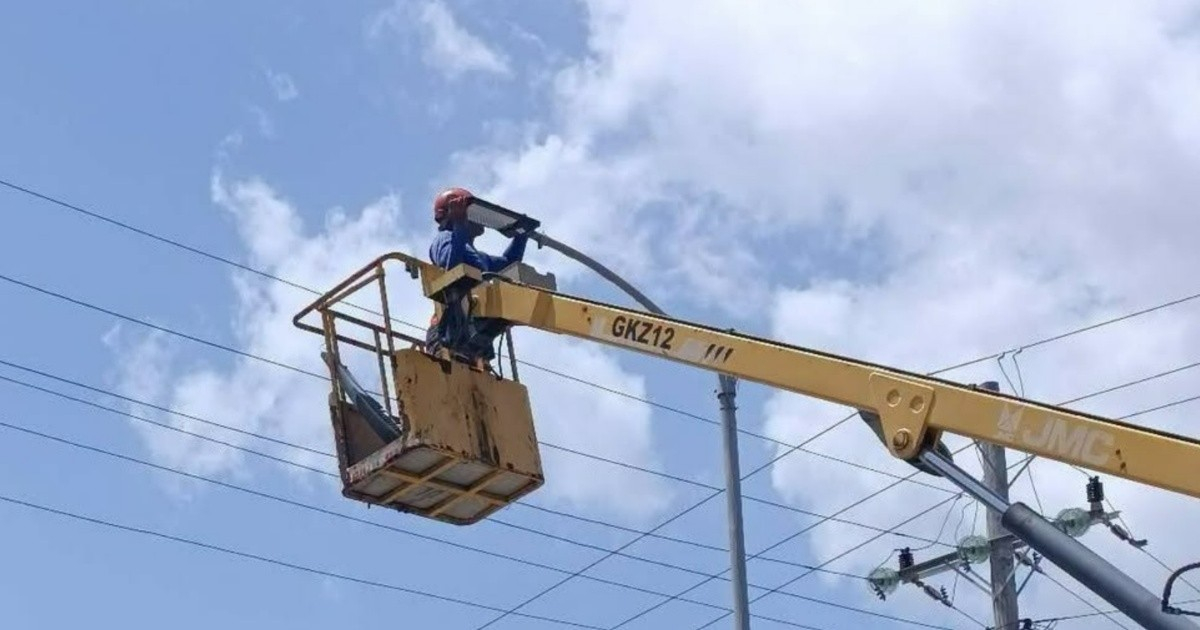
Photovoltaic lights installed less than a month ago on the main avenues of Santiago de Cuba were stolen by unknown individuals, leaving sections of the city's busiest roads in darkness once again.
The report was published by CMKW Radio Mambí on their Facebook page, with text and photos by journalist Rey Luis Correa.
The initiative had been promoted by the Provincial Government as a temporary measure in response to the electrical crisis: installing solar lights on avenues such as Las Américas, Céspedes, Garzón, Plaza de Marte, and Ferreiro to maintain lighting during prolonged blackouts and reduce the strain on the National Electroenergetic System. The project lasted only a few days.
"Unscrupulous and opportunistic individuals have stolen them, taking advantage of the cover and complicity of the night," stated Radio Mambí in its publication.
So far, it has not been publicly reported how many lights have disappeared, whether the police are investigating the incidents, or if any responsible parties have been identified. The Electric Company of Santiago de Cuba has also not provided an official response.
The testimonies of citizens on social media reveal details that worsen the situation. A resident identified as Susana Martínez recounted that workers from the Mella campus of the Universidad de Oriente called the police while the robbery was happening right in front of them, but the officers never arrived: "The ninjas threatened to hit the university workers with stones and sticks if they intervened. Where are we headed?"
Another citizen, Anabel Castro, questioned how the theft was possible considering that several streetlights were located in front of state institutions with guards, including the Municipal Government itself: "Many of those streetlights are in front of state institutions including the Municipal Government, with guards. And where is the patrol police? This is the job of the Revolutionary National Police, which does absolutely nothing."
Beatriz Héctor pointed in the same direction: "This is a sign that there is no longer surveillance in the parks like there used to be, and the streets are not being patrolled as they once were. We know there is no fuel, but when there's a will, there's a way."
The theft is not an isolated incident. Santiago de Cuba is experiencing a surge in the theft of energy infrastructure, which includes ETECSA panels in the Flores neighborhood, a solar panel in Micro 9-2 that left over 560 users without service, and now these public-use photovoltaic lights. On a national level, the phenomenon encompasses stolen solar lights from churches in Havana, dismantled structures of solar parks in Granma, and street lighting cables in multiple provinces.
The energy context partly explains the magnitude of the problem: on August 2, Cuba experienced a total disconnection from the national electric system, and Santiago de Cuba was the last province to reconnect after nearly 48 hours without electricity. In that scenario, solar equipment has become highly valuable assets in the informal market.
The regime has responded with a stricter penal approach: Article 125 of the Penal Code categorizes these thefts as sabotage, with penalties of up to 30 years, and the Opinion 475 of the Supreme People's Court has expanded this classification to include photovoltaic parks and telecommunications. Nevertheless, the thefts persist, and citizens are denouncing police inaction as the factor that makes them possible.
As noted by the portal Santiago de Cuba Hoy in its report: "It's not enough to install equipment, take photos of it, and announce the project on social media: it is also necessary to ensure that it remains where it was placed."
Related videos:
Filed under: