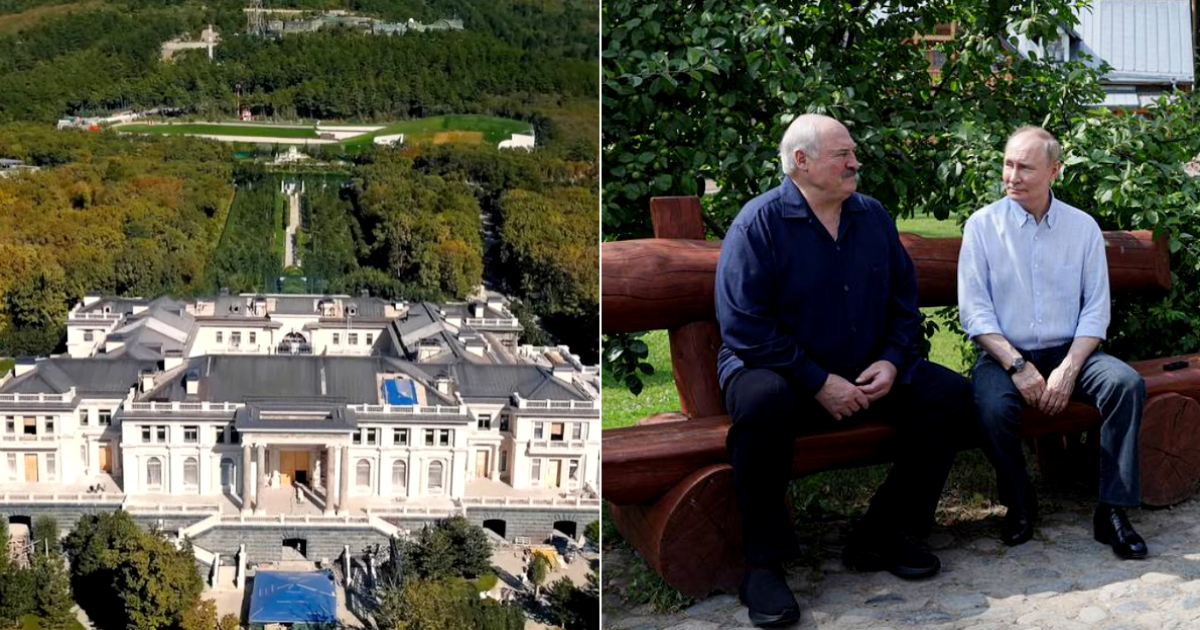
Vladimir Putin has turned his favorite residence in Valdai, in northwestern Russia, into one of the most fortified facilities in the country: at least 15 new air defense towers have been built around the complex, raising the total number of anti-air positions to about 50, according to satellite images analyzed by Radio Free Europe/Radio Liberty.
The information is striking due to its disproportion: this small, sparsely populated locality in the Novgorod region now has approximately half of the air defense of the entire city of Moscow, which is home to more than 19 million people, according to calculations by the British media The Telegraph.
The new positions are located within a radius of about 50 kilometers from the residence and are believed to be equipped with Pantsir and Tor short-range systems, considered Russia's best resources for neutralizing aerial threats such as low-flying drones.
Each unit can cost over 21 million dollars, resources that could be allocated to protect the Russian civilian population instead of the personal mansion of the Kremlin leader.
The new defensive perimeter also encompasses the military airfield of Khotilovo—connected to the residence by a private railway line—and Lisiy Island, which contains a complex of laboratories linked to the Russian biological weapons program, according to the same analysis of satellite images.
The Valdai complex, set in a wooded peninsula between two lakes, reportedly includes a multi-story palace, a wooden dacha of about 1,200 square meters, an underground bunker, and a replica of the Kremlin's presidential office to make it harder to pinpoint Putin's exact location. It is believed that his partner, former rhythmic gymnast Alina Kabaeva, resides there with their two children.
The security reinforcement reflects the growing paranoia of the Russian leader in the face of the threat posed by long-range Ukrainian drones, which have demonstrated the ability to strike deep into Russian territory.
In December 2025, the Kremlin accused Ukraine of having launched more than 90 drones against the residence in Valdai, an accusation that both Kiev and the CIA denied. Despite this, protective measures have continued to intensify.
In June of this year, Yandex Maps —the Russian equivalent of Google— concealed approximately 2.1 square kilometers of satellite imagery of the area, while Putin's residences in Sochi and Gelendzhik remain visible.
Anti-drone networks were also detected over truck parking areas near the M10 highway, about 10 kilometers from the estate, in response to tactics such as the Ukrainian Operation Spiderweb, in which drones hidden in trucks attacked Russian military airfields.
Putin's obsession with his personal security contrasts sharply with the opaque fortune attributed to him. He officially declares an annual salary of about $140,000 and modest assets, but unofficial estimates place his real net worth between $40 billion and $200 billion, managed through a network of frontmen and oligarchs.
The investigation by Alexéi Navalny published in January 2021 revealed a palace in Gelendzhik valued at approximately 1.37 billion dollars.
While Putin fortified his mansion, on Monday night a barrage of Ukrainian drones breached Russian defenses in Voronezh, killing at least two people and injuring another 17, and hitting a petrochemical plant that produces synthetic rubber and polymers used in armored vehicles and solid fuel for Iskander missiles. It was, according to The Telegraph, the third Ukrainian attack in three days against a Russian synthetic rubber factory.
The war that the Kremlin anticipated as a "three-day operation" when it launched the large-scale invasion of Ukraine in February 2022 has now dragged on for over four years without resolution, and Putin's response has been, among other things, to surround his personal refuge with an air defense system that rivals that of the capital of his own country.
Related videos:
Filed under: