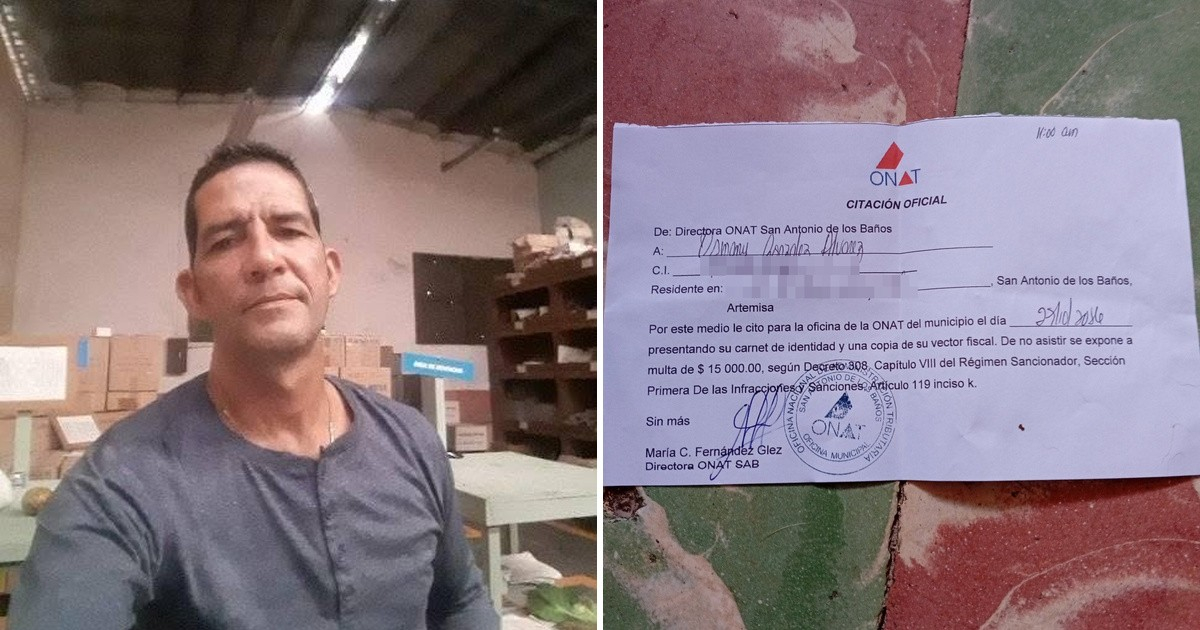
An official citation from the National Office of Tax Administration (ONAT) threatened a fine of 15,000 Cuban pesos to a resident of San Antonio de los Baños, Artemisa, who had closed his bakery-sweet shop over a year ago and had processed the corresponding cancellation. The case, reported on Facebook by Osmany González Álvarez, was resolved after a joint review revealed an inconsistency in the institution's computer system.
González Álvarez recounted that after closing the business, he submitted his resignation to the Ministry of Labor and that since then, he had to visit the ONAT six times and the Ministry of Labor twice, in addition to receiving two visits from inspectors at his home.
Despite all those efforts, the ONAT of San Antonio de los Baños sent her an official summons signed by its director, María C. Fernández Glez, which scheduled an appearance for October 27 and warned that failure to appear could result in a penalty of $15,000.00, in accordance with Decree 308, Chapter VIII of the Sanctioning Regime, Article 119, clause k.
"After that, I have had to go to the ONAT six times and to the Ministry of Labor twice. Inspectors have visited me on two occasions, and now they are summoning me again," wrote the affected individual, who indignantly asked, "Who do we fine for the poor work they do? Who compensates for my time?"
The fine was a warning for non-appearance, not a sanction that had already been imposed or collected.
This Tuesday, González Álvarez published an update in which he informed that the matter was clarified following a meeting with the directors of both institutions. "They reviewed all the paperwork, and the corresponding records were in the books. There was an inconsistency in the system, but everything went through the proper channels," he explained.
"Both attended to me as one would attend to a human being," he noted, although he acknowledged that securing a meeting with an executive in Cuba is, in his own words, a rarity.
González Álvarez concluded his post with a piece of advice for other Cubans facing similar procedures: "Always keep all the documents they give you, and if they don’t give you one, ask to take a photo. Stay engaged in the process you are going through and ask questions because asking costs nothing."
The case illustrates a problem that ONAT itself has acknowledged: when the digital communication of a cancellation between the processing office and the Tax Administration fails or is not updated, the taxpayer may remain active in the database and accumulate tax obligations, even if their physical records are in order.
In the comments on the post, several Cubans shared similar experiences. A resident of Palmira, Cienfuegos, described receiving a threat of a fine for 40,000 pesos five years after closing his business and ended up paying to resolve the issue. Another commentator recounted that his son requested a deregistration, emigrated, and three years later was summoned to explain why he had not paid taxes.
The context of oversight regarding self-employed workers has intensified in Cuba. The regime warned in October that it could seize bank accounts due to tax debts, and in the IV National Tax Control Exercise in February 2026, 249 million pesos in determined debts were recorded along with 174 fines totaling over six million pesos.
Related videos:
Filed under: