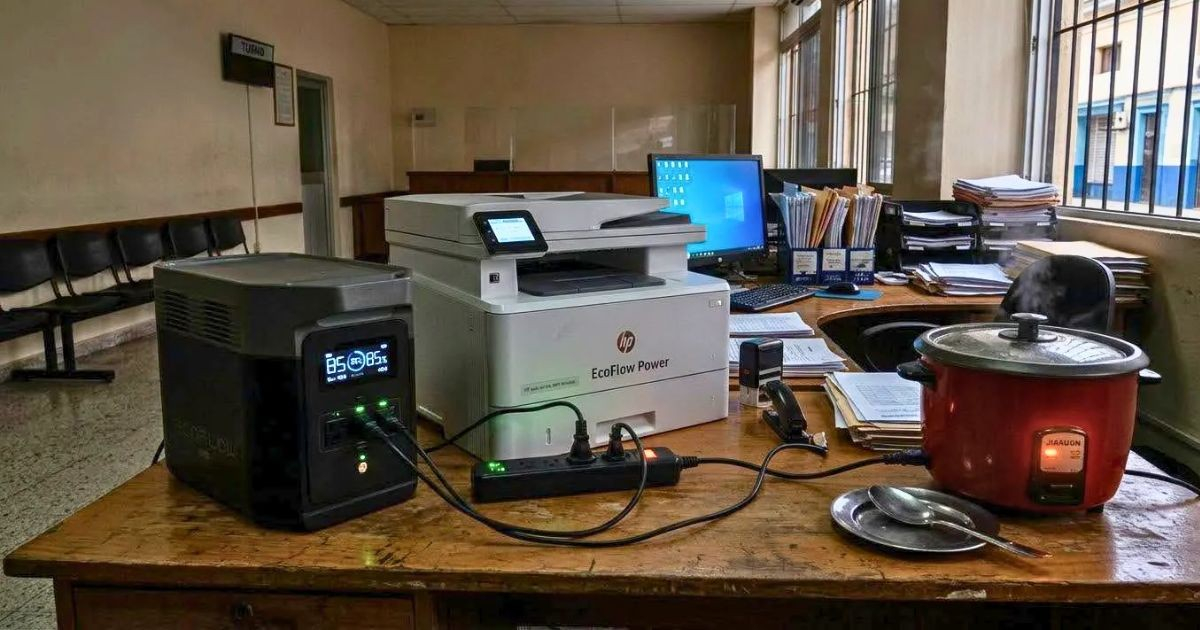
The playwright from Pinar del Río, Irán Capote, published on Saturday on Facebook a story that blends humor, absurdity, and Cuban reality with a precision that only comes from the experience of living on the island: the tale of "Juan," a citizen who discovered that the master key to resolving a bureaucratic process is not patience, nor early mornings, nor having the proper documents, but an EcoFlow.
"Yesterday, I was told a story. Not a Chinese story, a Cuban one. I can’t say for certain if it’s true, but considering this bitter and picturesque Cuba, this absurd, real, marvelous Cuba, this Cuba that is a breeding ground for tales, I believe it could very well be true," wrote Capote to introduce the story.
The protagonist—whom the author names "Juan" to protect his identity—woke up early, traveled from another municipality, and waited seated at the office door until the clerks arrived, around 9:00 in the morning, "with expressions that were anything but friendly, just like any self-respecting clerk or office worker."
At 9:30, Juan approached the counter, presented his documents, and awaited the verdict. The clerk placed her glasses on the tip of her nose, glanced at the papers, then at Juan, looked back at the papers, and again at Juan. An awkward silence ensued. Then, removing her glasses, she declared: “Juan, Juan… dear, Machi, to do what you want me to do, to do what you need, to do what you traveled so far for, we need power, Juan, dear, Machi… I really feel for you! You have to come back another day. Or wait there until the power comes back.”
The scene is not a literary exaggeration: in the current October, the National Electro-Energy System registers generation deficits that usually exceed 1,600 MW daily, and in Pinar del Río —Capote's home province— some circuits have accumulated more than 90 consecutive hours without electricity, as acknowledged by the first secretary of the Communist Party in the territory.
Public offices, which rely on computers and printers and, in their vast majority, lack backup power sources, come to a standstill during outages, forcing citizens to return another day or to wait indefinitely for the power to return.
But Juan, according to Capote, "is from Pinar but not a fool." With the calm of someone who has been preparing for the energy crisis for months, he replied: "Mommy, I brought my ecoflow."
What followed was worthy of a sitcom. Upon hearing the word "ecoflow" in that office, power strips, phone chargers, and, as the centerpiece, a rice cooker appeared from every corner of the establishment, which the facilitator had the good sense to send for from her own home to get lunch started early.
Juan's role was printed in less than a minute, but he had to wait for the rice to be ready and for the staff's phones to reach 100% charge.
The EcoFlow —a name that in Cuba is used generically for any portable power station, regardless of the brand— has become an object of cult status and an endless source of popular humor. The devices cost between 500 and over 1,150 dollars, prices that are unaffordable for most Cubans, and they mainly arrive sent by relatives from abroad.
The appearance of these devices in public spaces had already created similar situations: a manager of a state market took it to sell chicken during power outages, and comedian Javier Berridy coined the name “EcoFlow Domínguez” for a child who wasn’t attending classes because he “ran out of charge”.
The processor, grateful and with the rice perfectly cooked, closed the episode with a promise of lifelong preferential treatment: “Look, Juan, whenever you need a document from here, don’t look for anyone else but me, Papito, Machi. I’ll take care of it for you. Here’s my contact information, and give me yours…”. And so, in that office of procedures, the name of which Capote claims to remember but prefers not to mention, she saved the number in her phone under a name that says it all: “Juan Thermoelectric”.
Related videos:
Filed under: