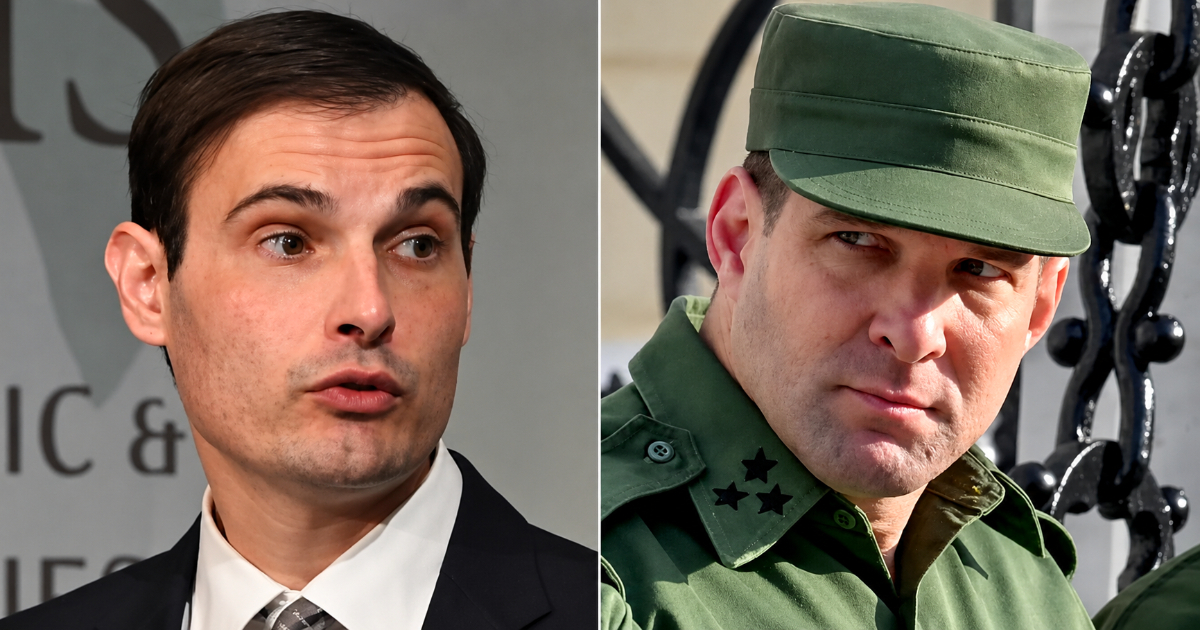
The departure of Jeremy Lewin from the U.S. State Department leaves a question mark over the future of the discussions between Washington and Havana.
The young advisor to Marco Rubio was one of the key figures in the contacts with Raúl Guillermo Rodríguez Castro, known as «El Cangrejo», the grandson of Raúl Castro and a de facto representative of the family nucleus that maintains a decisive influence in Cuban power.
According to a report by Axios, Lewin, 29 years old, leaves the Trump administration to join the private sector. His departure is said to be due to personal and professional plans, with no indications of disagreements with Rubio or a direct connection to the stagnation of negotiations.
But his departure comes at a significant moment: after months of negotiations without substantial agreements and when the United States seems to be combining a willingness to engage in dialogue with an increasingly coercive strategy to extract concessions from the regime.
Two negotiators with access to power
Lewin was not a career diplomat nor a traditional specialist in Cuba. A lawyer educated at Dartmouth and Harvard, he entered the Administration through the DOGE government cuts program, driven by Elon Musk, and quickly rose to become one of Rubio's trusted collaborators.
In April, he led a U.S. delegation alongside the experienced diplomat Michael Kozak that met in Havana with El Cangrejo. His involvement was not coincidental: Axios attributes him with leading the bilateral talks and playing a prominent role in the enforcement of sanctions against the regime, including the military conglomerate GAESA.
The choice of the Cuban interlocutor is even more revealing. Rodríguez Castro is a colonel in the Ministry of the Interior, the head of security for his grandfather and the son of the late General Luis Alberto Rodríguez López-Calleja, who headed GAESA. However, he does not hold a governmental position that grants him political representation to negotiate the country's future, nor does he have democratic legitimacy to do so.
Its authority comes from belonging to the Castro family and from its ties to the military and economic apparatus of the regime. Although leaders of the Communist Party have acknowledged that it acts by decision of the highest leadership, this appointment highlights the patrimonial nature of a system in which effective power transcends the formal institutions of the State.
Washington seems to have accepted this reality: to negotiate with those who make decisions in Cuba, it has turned to the Castro family's inner circle, even though their authority does not stem from the will of the people.
The contradiction is evident: the United States seeks democratic transformations through conversations with representatives of the very power structure that resists these changes.
A stalled negotiation and increasing pressure
The contacts, initiated in early 2026, began to include proposals for energy cooperation, investments, and potential economic reforms. However, as revealed by The Atlantic in October, the talks stalled when Washington demanded the departure of Miguel Díaz-Canel and Havana refused to accept that condition.
The regime has reiterated that it will not negotiate its political system, the guiding role of the Communist Party, nor the holding of multiparty elections. It shows a willingness to discuss certain economic reforms, but without relinquishing its monopoly on power.
This limit also conflicts with U.S. legislation. The Helms-Burton Act links the suspension of the embargo to the establishment of a transitional government that meets requirements such as the release of political prisoners, the legalization of political activity, and a commitment to hold free elections. Its definitive lifting requires a democratically elected government.
Therefore, an economic agreement that leaves the regime's structure intact would not be sufficient to lift the fundamental restrictions of the embargo, although Washington retains the flexibility to negotiate specific measures.
In light of that blockade, the Trump administration has intensified its pressure signals. Financial sanctions, warnings directed at the military leadership, and the recent calls from Rubio and the CIA to discreetly collaborate with U.S. intelligence services point to a search for cracks within the power structure.
President Donald Trump has also repeatedly used the threat of a military presence in front of Cuba, without explicitly ruling out other options. However, there is no public evidence of a decision to intervene militarily or to carry out an operation to capture Cuban leaders.
Rubio himself stated this Monday that Cuba needs a "very drastic change" and that its situation is different from that of Venezuela, where Washington reached economic agreements with the government of Delcy Rodríguez after the capture of Nicolás Maduro.
Who will take Lewin's place?
The advisor's departure does not necessarily mean the end of the dialogue. Kozak—an experienced American diplomat who led the U.S. Interests Section in Havana from 1996 to 1999—directly participated in the discussions. Rubio maintains political leadership of the strategy, and there are other communication channels, including those established by intelligence services.
It has also not been announced who will take on Lewin's responsibilities or whether Washington will change its negotiating framework. Last Friday, Trump spoke again about a possible agreement with Cuba and even mentioned that he would personally send Rubio to finalize it.
The underlying issue, however, goes beyond the replacement of an official. After months of unproductive contacts, Washington keeps the door to negotiation open while increasing pressure on a leadership that refuses to accept substantial political changes.
The question is whether Rubio will continue to pursue an agreement with Raúl Castro's circle or if the resistance of that elite will ultimately shift the focus to other interlocutors and pressure mechanisms.
For now, the main obstacle does not seem to be who represents Washington, but rather the refusal of those in power in Cuba to accept changes that could put an end to their own privileges and control over the State.
Related videos:
Filed under: