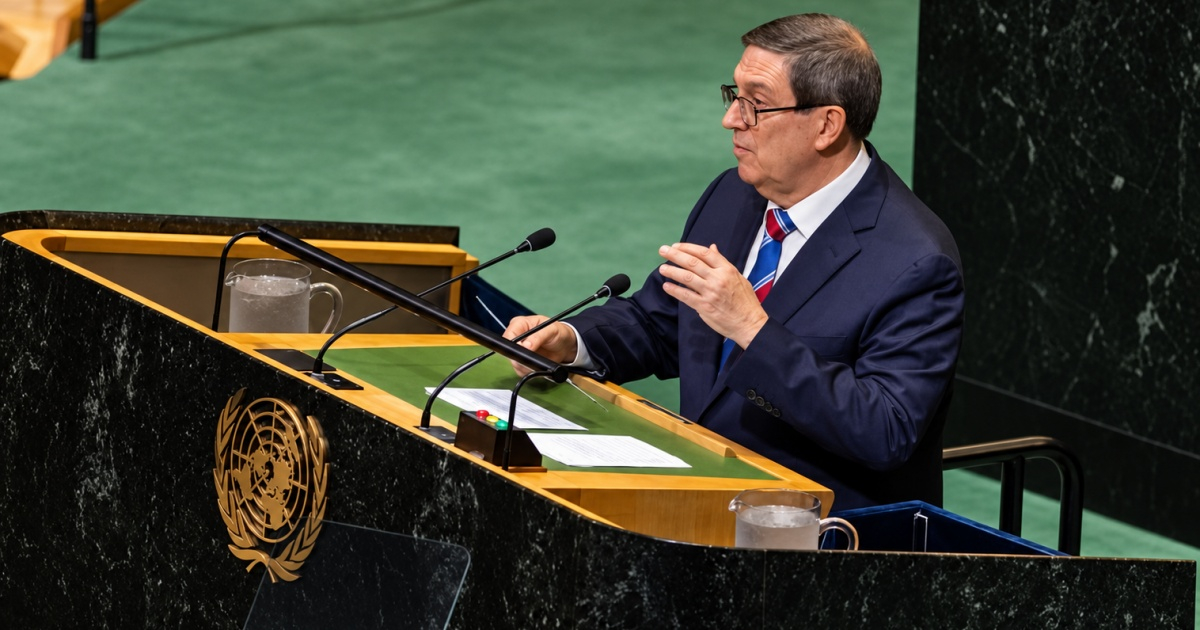
Italy explained why it abstained for the first time in 34 years in the UN General Assembly vote regarding the U.S. embargo on Cuba.
The government of Giorgia Meloni justified its change of position due to the lack of political and economic reforms on the island, restrictions on freedoms, the situation of political prisoners, and Havana's stance regarding the Russian invasion of Ukraine.
In an official statement published on Wednesday, the Italian Ministry of Foreign Affairs, known as the Farnesina, asserted that it is necessary to accelerate changes in Cuba and directly held the authorities in Havana responsible for the crisis the country is facing.
“Reforms are not coming; the decisions of the Cuban authorities are the cause of the current crisis,” stated the ministry in one of the most emphatic declarations of its statement.
The Italian abstention ended a prolonged series of favorable votes for the Cuban resolution. According to the Italian press, Rome had not abstained since 1994 and had consecutively supported the initiative since 1995.
Italy points to the Cuban government as responsible for the crisis
The Farnesina acknowledged that the economic embargo imposed by the United States "has negative economic and humanitarian consequences for the Cuban people," and considered that its lifting could promote greater economic openness on the island.
However, he emphasized that lifting U.S. sanctions would not in itself resolve Cuba's structural issues, which he also attributed to the decisions made by its authorities.
"The lack of political and economic freedoms, the structural weaknesses, and the long-standing inefficiencies of the economic system have significantly contributed to the current crisis," stated the Italian government.
Roma insisted that the country needs deep transformations and urged Cuban authorities to adopt concrete measures to improve the living conditions of the population.
"Substantial reforms in the political, economic, social, and judicial spheres are urgently needed from the Cuban authorities to alleviate the suffering of the Cuban people," the statement indicated.
La Farnesina also requested the rapid implementation of the 176 economic and social measures announced in June by the Cuban Government, a package that includes initiatives related to economic activity and the participation of the private sector.
The Italian statement clearly outlines a distinction in its diplomatic position: Rome considers the U.S. embargo detrimental to the population, but it maintains that the internal decisions of the Cuban government also hold fundamental responsibility in the crisis.
Roma demands the release of all political prisoners
The statement dedicated a significant portion to the situation of human rights in Cuba, with particular focus on the consequences of the anti-government protests on July 11, 2021.
"Italy remains deeply concerned about the human rights situation in Cuba, especially following the events of July 2021," stated the Farnesina.
He also reiterated his call to the Cuban government to “release all political prisoners,” a demand that he specifically included among the reasons for his stance before the United Nations.
The Italian request for release adds to its demands for political and judicial reforms, which the ministry deems necessary to alleviate the suffering of the Cuban population.
Italy criticizes Cuba's position on the Russian invasion of Ukraine
Havana's foreign policy is also among the reasons presented by Rome to justify its abstention.
“We regret that Cuba's position on Russia's illegal aggression against Ukraine remains incompatible with the principles of the United Nations Charter”, the foreign ministry stated.
He recalled that Cuba voted against a resolution of the UN General Assembly on February 24, 2026, which promoted a ceasefire and lasting peace in Ukraine.
The reference to that vote shows that the Italian decision was not solely tied to the internal economic and political situation in Cuba, but also to its positions on international issues.
Italy and the European Union maintain million-dollar aid programs for Cuba
Despite its abstention, the Italian government reaffirmed its support for the Cuban people and assured that it will continue to provide humanitarian assistance.
La Farnesina reported that the European Union increased its humanitarian aid to Cuba in 2026 to 16 million euros, primarily allocated for healthcare, emergency food, and access to water and energy.
Italy currently maintains 12 development cooperation initiatives on the island, with an approximate value of 30 million euros, in addition to another 32 million corresponding to delegated cooperation programs from the European Union.
The Ministry of Foreign Affairs also outlined new interventions planned for 2026, including a contribution of 250,000 euros to the World Food Program to support the nutrition of vulnerable groups.
This initiative is complemented by a rural development and food security project worth 3.5 million euros, executed in collaboration with the Lavazza Foundation, as well as other emergency aid.
According to the official statement, these programs continue despite Rome's shift in diplomatic stance at the United Nations.
Cooperation with Cuban doctors in Calabria continues
The Italian decision also aligns with the continuation of a health cooperation program with Cuba in the Calabria region, where local authorities have turned to Cuban professionals to address the shortage of doctors.
According to the newspaper Il Fatto Quotidiano, the agreement includes the addition of nearly 500 Cuban doctors and has been extended until the end of 2027. Hundreds of specialists are working in hospitals in the region.
The program has faced scrutiny over the economic conditions of hiring those professionals.
Thirteen European countries abstained in a vote characterized by diplomatic change
Italy was not the only European country that withdrew its support for the Cuban resolution. The Farnesina confirmed that it abstained along with other allied nations such as Germany, the Netherlands, Poland, Greece, Bulgaria, Romania, Estonia, Latvia, and Croatia. Albania, Montenegro, and Moldova also abstained.
The resolution was passed with 130 votes in favor, 17 against, and 25 abstentions, compared to the 165 supports, seven opposing votes, and 12 abstentions recorded in 2025.
The result represents a reduction of 35 favorable votes in one year and reflects a significant shift in diplomatic support for the initiative put forward by the regime in Havana.
Of the 17 votes against this year's resolution, seven came from European countries: Bosnia-Herzegovina, Czechia, Hungary, Lithuania, North Macedonia, Slovenia, and Ukraine.
Related videos:
Filed under: