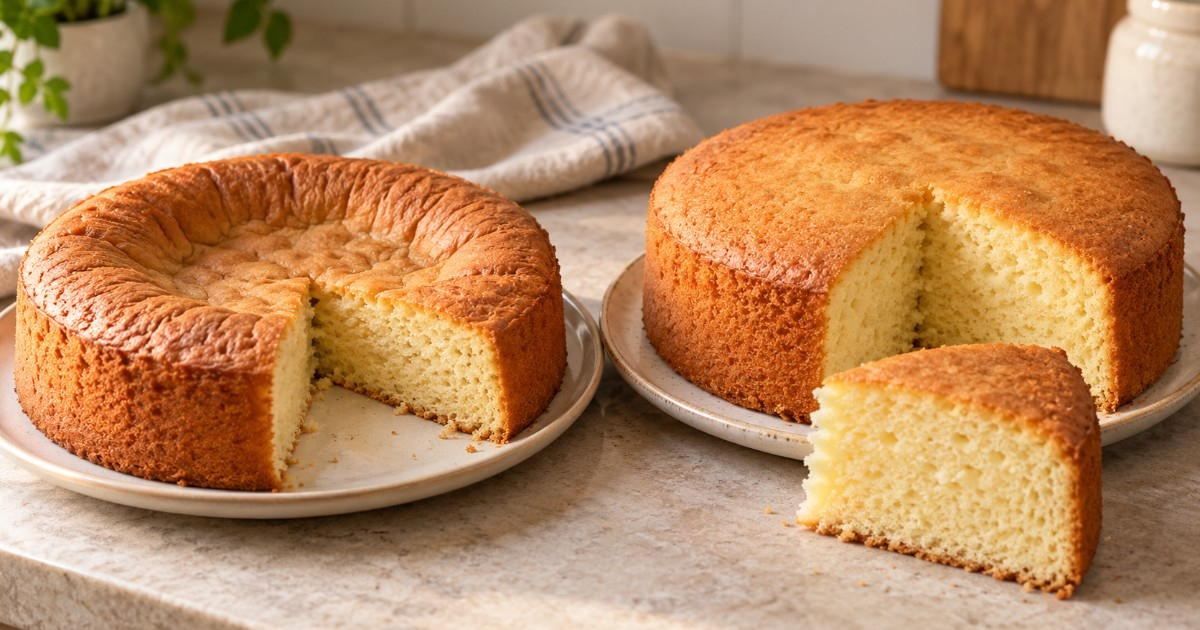
A sponge cake that rises in the oven and sinks upon leaving may have been undercooked or contain too much baking powder. If it barely rose and ended up dense, it’s worth checking the batter and how the flour was incorporated. To identify the issue, it's important to observe when it lost volume and how the center looked when cut.
If it barely rises, check how you incorporated the air
In a sponge cake made with beaten eggs, part of the lightness depends on the air incorporated during that preparation. The King Arthur Baking mixing methods guide distinguishes between cakes that are made by beating the eggs and those that start by mixing butter and sugar. Each recipe requires its specific procedure: altering the order can change the texture.
In the Cuban panetela with whipped egg whites, the egg whites are beaten separately and incorporated at the end with a spatula. There are two distinct moments: first, volume is created, and then care is taken to preserve it. If the egg whites are almost liquid when added, that initial work is lacking; if the mixture is vigorously beaten after combining them, some of the achieved air will be lost.
When incorporating the egg whites, use gentle folding motions, reaching the bottom of the bowl, until there are no unblended areas left. Delicacy means not leaving loose flour or lumps of egg white. Preserving the air and achieving a uniform mixture must happen simultaneously.
If it rises and then sinks, check the cooking
A golden surface can conceal a center that is still not set. King Arthur explains, in analyzing why cakes sink, that taking the mixture out before its structure has set allows it to look good for a moment before collapsing as it cools. A moist and gummy center forces a reevaluation of this point.
Check several signals near the end of the expected cooking time. The toothpick inserted in the center should come out clean, free of any raw batter, and the surface should spring back after a gentle press. If the pan was greased, the edges beginning to pull away are another clue. The cooking check guide recommends combining these indicators: the toothpick test alone can be misleading.
If the fingerprint remains or if a wet mixture comes out, keep baking and check again. The minutes in a recipe are a guideline, but they do not replace checking the center.
More baking powder does not mean more fluffiness
Adding an extra teaspoon to ensure that the cake rises can have the opposite effect: excessive rising followed by sinking. Measure the indicated amount and check that the product is current and properly identified before attributing the problem to the oven.
Baking soda and baking powder cannot be substituted in equal amounts. As explained by King Arthur in their comparison of both ingredients, baking soda requires an acidic component in the mixture to react; baking powder already includes both acidic and basic components. A substitution demands adjusting the formula. If the recipe calls for baking powder, use that ingredient and avoid improvising the equivalence.
Check the flour and the size of the mold
A dry and hard crumb presents a different problem than a moist center. Among the causes of dry cakes, King Arthur notes excessive flour: a heaping or packed cup contains more than a cup filled without compacting. If the recipe provides measurements in grams, a scale allows for reproducing that amount with greater accuracy.
Use the designated mold as well. With the same amount of batter, a wider mold results in a thinner layer that cooks faster; keeping the original cooking time may dry it out. Note the measurements of the mold when a cake turns out well: changing containers also alters the cooking conditions.
Check the oven and let it cool before removing it from the mold
Preheat to the temperature specified in the recipe and avoid opening the door repeatedly during the rise. If the result is consistently off despite measuring and mixing the same way, an oven thermometer can help you check if the actual temperature matches the selected one. Do not compensate for a moist center by increasing the heat without first checking the time and the pan.
When removing it, follow the resting time specified in the recipe before unmolding. In CiberCuba's panetela, it is allowed to sit for a few minutes in the mold and is then finished cooling on a rack. Unmolding it right after baking can cause it to break; keeping it whole during that initial resting period makes it easier to distinguish between a break when handling it and a true sinking in the center.
Related videos:
Filed under: