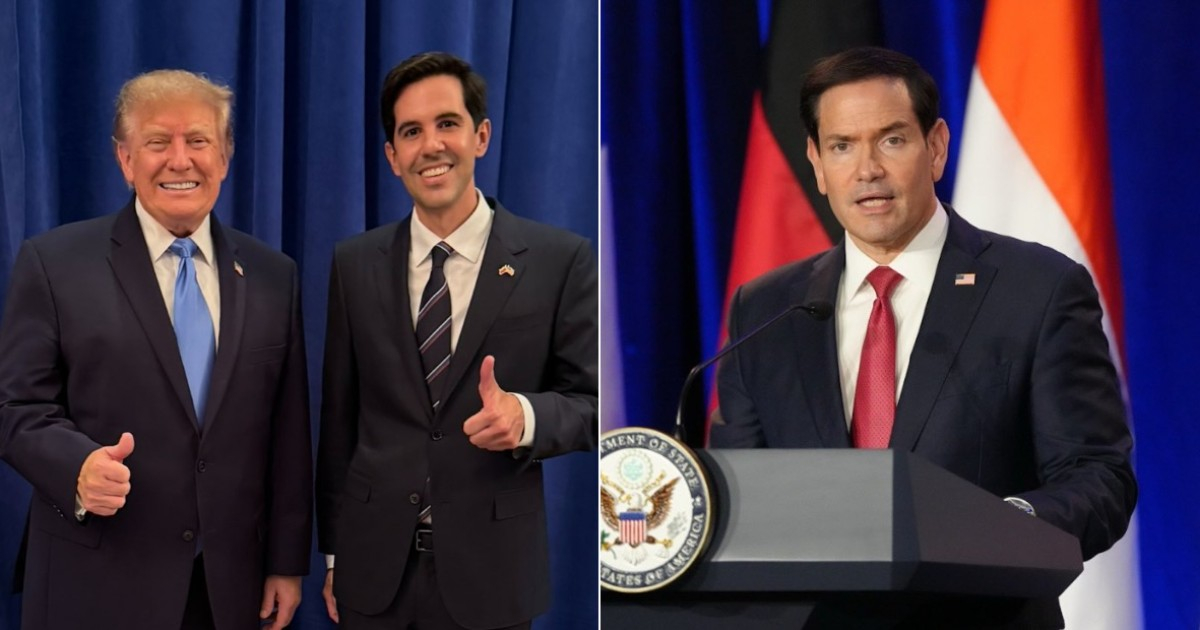
Marco Rubio is meeting this Monday with the new Venezuelan Foreign Minister, Oliver Blanco, at the Department of State headquarters in Washington, in the first meeting between the heads of diplomacy of both countries since Washington and Caracas restored diplomatic relations following the capture of Nicolás Maduro in January of this year.
The meeting, included in the official public agenda of the Department of State, was scheduled for 10:00 local time (15:00 GMT), just four days after the interim president Delcy Rodríguez appointed Blanco to lead the Venezuelan Foreign Ministry, replacing Félix Plasencia.
Blanco, aged 34, takes the position with an unusual profile for Chavista diplomacy: he was trained within the ranks of the opposition, was a member of Acción Democrática, and served as campaign chief for diplomat Diego Arria in the opposition primaries of 2012.
Rodríguez appointed him as Deputy Minister of Foreign Affairs for Europe and North America in February of this year, just weeks after taking office as acting president, and promoted him to First Deputy Minister at the end of July.
Plasencia, who held the Chancellery for just three months, moved on to lead the Directorate of International Affairs of the Presidency with the aim of managing the recovery of Venezuelan gold held at the Bank of England.
The Friday before the meeting, Blanco had already held a meeting with John Barrett, the chargé d'affaires at the U.S. embassy in Caracas, who congratulated him on his appointment and expressed his desire to advance the "three-phase plan" that Washington outlined for Venezuela following Maduro's fall.
Upon learning of his appointment, Blanco stated: "Our challenge is to contribute to a more prosperous, democratic, pluralistic, and inclusive Venezuela, where we can understand and respect each other, where no one feels excluded, and where, ultimately, we can move forward and succeed together as one team."
Rodríguez, for his part, justified the appointment with an opening message: "I have decided to appoint Oliver Blanco as chancellor of the Bolivarian Republic of Venezuela. I hope this strengthened team continues to advance in the changes and the geopolitical recovery of Venezuela in areas of cooperation and friendship with all countries."
The meeting this Monday is part of an accelerated rapprochement process between Washington and Caracas throughout 2026, which included an in-person meeting between Trump and Rodríguez in New York in September —the first between leaders of both countries in more than eleven years— and a historic oil agreement in which Venezuela granted the American company North American Blue Energy Partners access to 65 billion barrels of proven reserves in 17 strategic fields.
The Trump administration also supports a negotiated roadmap between chavismo and an opposition bloc led by Dinorah Figuera, which includes renewing the Supreme Court of Justice and the National Electoral Council, and for Rodríguez to declare the Presidency vacant in 2027 in order to call for elections within six months.
The return to Venezuela of the opposition leader and Nobel Peace Prize winner María Corina Machado on October 25, facilitated according to Rubio by direct negotiations between Washington and Venezuelan authorities, constituted the most recent immediate precedent for this diplomatic meeting.
The Venezuelan turn has had direct consequences for Cuba: Venezuela cut the fuel shipments to the island following the capture of Maduro and the tightening of U.S. measures, deepening an energy crisis that the Minister of Energy, Vicente de la O Levy, described last May as the total depletion of oil reserves.
Related videos:
Filed under: