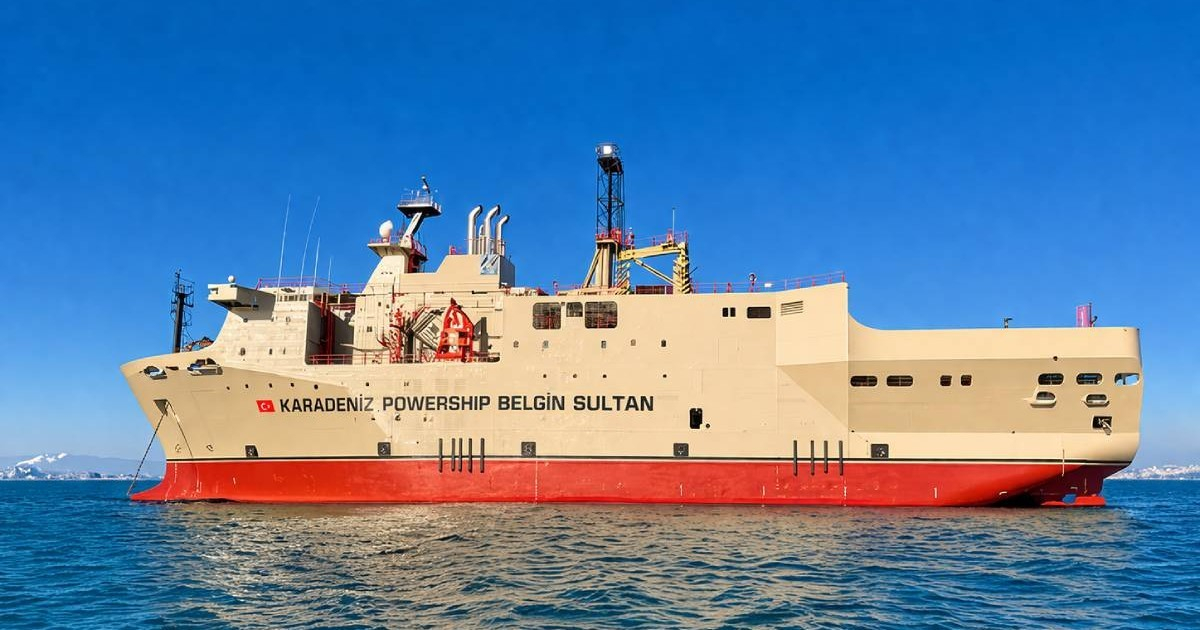
The floating power plant Erol Bey, operated by the Turkish company Karpowership, permanently left the port of Havana this Monday around 2:30 PM local time, as confirmed by the EFE agency. With its departure, Cuba loses 63 megawatts of installed capacity at the worst possible time: the country has experienced eight total collapses of its electrical system in 2026 and suffers power outages exceeding 20 hours daily in Havana.
Cuban authorities had not officially confirmed the departure of the vessel by the time this information was reported, repeating the pattern of silence that has characterized each previous withdrawal of the Turkish tugboats.
With the departure of the Erol Bey, the Belgin Sultán remains the only Turkish floating power plant in the capital. In April, the Ministry of Energy and Mines had confirmed that both units combined had an installed capacity of 124 MW. Now that figure has been reduced to less than half.
The moment could not be more critical. This very Monday, the Electric Union projected an impact of 1,922 MW during the peak night hours, with only 958 MW available against a demand of 2,850 MW. In some provinces, outages have lasted up to three consecutive days without interruption.
The story of the Turkish floating power plants in Cuba is one of unfulfilled promises and gradual withdrawals. Karpowership began operations on the island in 2019 with an initial contract for three units. The fleet reached its peak with eight vessels contributing over 400 MW to the National Electric System, operating in the bays of Mariel and Havana. Since then, the reduction has been constant.
In August 2025, the Suheyla Sultan —of 240 MW— officially left the Port of Havana for "commercial reasons," although sources close to the process attributed it to the Cuban government's unpaid debts. Weeks later, the Minister of Energy and Mines, Vicente de la O Levy, publicly acknowledged that Cuba was only able to pay for two barges —the Belgin Sultán and the Erol Bey— and stated: "we may have inefficiency, but more than 95% of the real cause is the lack of financing."
The Erol Bey resumed electricity generation for a few weeks in April, following the arrival at the end of March of the Russian tanker Anatoli Kolodkin with 740,000 barrels of crude oil. Without sustained fuel, its contribution to the system was marginal and temporary.
The departure of the Erol Bey occurs without the regime having explained the reasons, although the question of possible unpaid debts to Karpowership looms over the situation: the company has previously withdrawn due to debts owed by the Cuban government. In December 2024, De la O Levy himself had warned the National Assembly that the barges could leave if Cuba was unable to make its payments.
The deterioration of the electrical system is not confined to floating plants. The land-based thermoelectric power stations, which are responsible for nearly 40% of national generation, were mostly built during the 1960s and 1970s. This Monday, several units in Santa Cruz, Felton, and Renté were still out of service, with thermal limitations reaching 607 MW.
In October, the Cienfuegos Electric Company recognized circuits with between 70 and 89 continuous hours without electricity, while the highest recorded impact on October 30 was 2,039 MW.
Cuba has thus gone from eight Turkish barges to just one since they began operations in 2019, with the regime providing no official explanation regarding the departure of the Erol Bey or how it plans to compensate for the loss of a power plant with 63 MW of installed capacity amid a crisis that the government itself has described as "extremely tense."
Related videos:
Filed under: