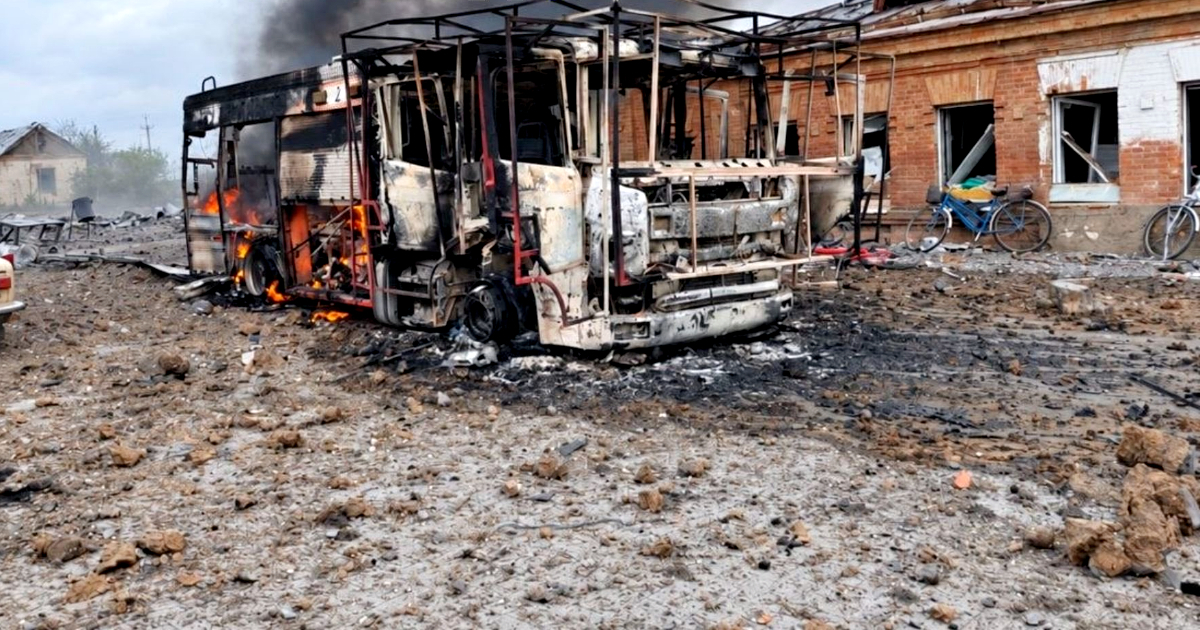
At least 33 people have died and another 50 are missing following the Russian bombing with nine bombs on a school repurposed as a humanitarian center in Komyshuvakha, a locality in the Zaporizhzhia region in southeastern Ukraine.
According to information published by CNN, President Volodimir Zelenski described the attack, which occurred on Monday, as “one of the deadliest of this war.”
The building no longer served as a school —the civilian population had been leaving the area as the front approached— and local authorities were using it as an administrative center and distribution point for humanitarian aid.
The reinforced basement where civilians took refuge had been built in 2025 with funding from the European Union to allow classes to continue during the war, but the power of the bombs collapsed the concrete structure and unleashed a fire.
The regional governor Mykhailo Semikin explained that Russia used KAB-500 bombs in the first wave and FAB-3000 in the second. "To put this into perspective, this is a three-ton aerial bomb that contains nearly 1.5 tons of explosive material; these weapons are primarily designed to destroy heavy concrete fortifications and bunkers," he stated on Ukrainian national television.
The attack followed the "double blow" pattern documented in multiple Russian offensives: a first wave lures emergency services, and a second turns them into victims. At least two rescuers —Denys Konovalenko and Oleksiy Sushchevsky, both 44 years old— died while responding to the site after the first impact.
Four police officers also lost their lives: Mykhailo Buzhenko, Mykola Balanda, Mykhailo Romanov, and Dmytro Besedin. "They were helping local residents to take shelter in an underground school. A treacherous follow-up attack caught everyone trying to escape," stated the National Police of Ukraine.
The distribution of humanitarian aid had been publicly announced in advance, which led the UN Human Rights Monitoring Mission to directly question Russia's actions.
Her director, Danielle Bell, stated that "either the Russian armed forces were aware that a humanitarian distribution was in progress, or they did not take the most basic steps to find out what was happening in this village they planned to attack. In any case, this attack seems to have violated the most fundamental principles of international humanitarian law."
The bombing of Komyshuvakha occurred hours before Russia launched a massive offensive against Ukrainian energy infrastructure with 289 drones, 17 ballistic missiles, and 59 cruise missiles targeting ten regions of the country.
Three of those drones targeted a critical substation for the Khmelnytskyi nuclear power plant; Ukrainian Energy Minister Denys Shmyhal alerted the International Atomic Energy Agency and warned that such actions "threaten the nuclear safety of all Europe."
Zelenski linked the moment chosen by Moscow to the U.S. legislative elections held this Tuesday. "It is very revealing that all of this is happening on the day of the U.S. legislative elections. The Russians believe that America will not notice this signal. But that terror must be recognized and stopped," he stated.
The attacks occur amidst a fragile diplomatic effort spearheaded by the Trump administration.
The U.S. envoy Steve Witkoff recently met with Zelenski in Oslo and then with Russian President Vladimir Putin in St. Petersburg, paving the way for planned trilateral technical negotiations in Abu Dhabi on November 10 and 11.
Meanwhile, Melania Trump mediated a localized ceasefire in the occupied city of Oleshky, which allowed for the evacuation of nearly 800 people, and the White House announced that on Thursday, it will gather representatives from Russia and Ukraine in Washington, calling it "an extraordinary moment in American history."
However, the scale of the attacks on Monday and this Tuesday highlights the gap between negotiation efforts and the reality on the ground, where recent months have been particularly brutal for the Ukrainian civilian population.
Related videos:
Filed under: