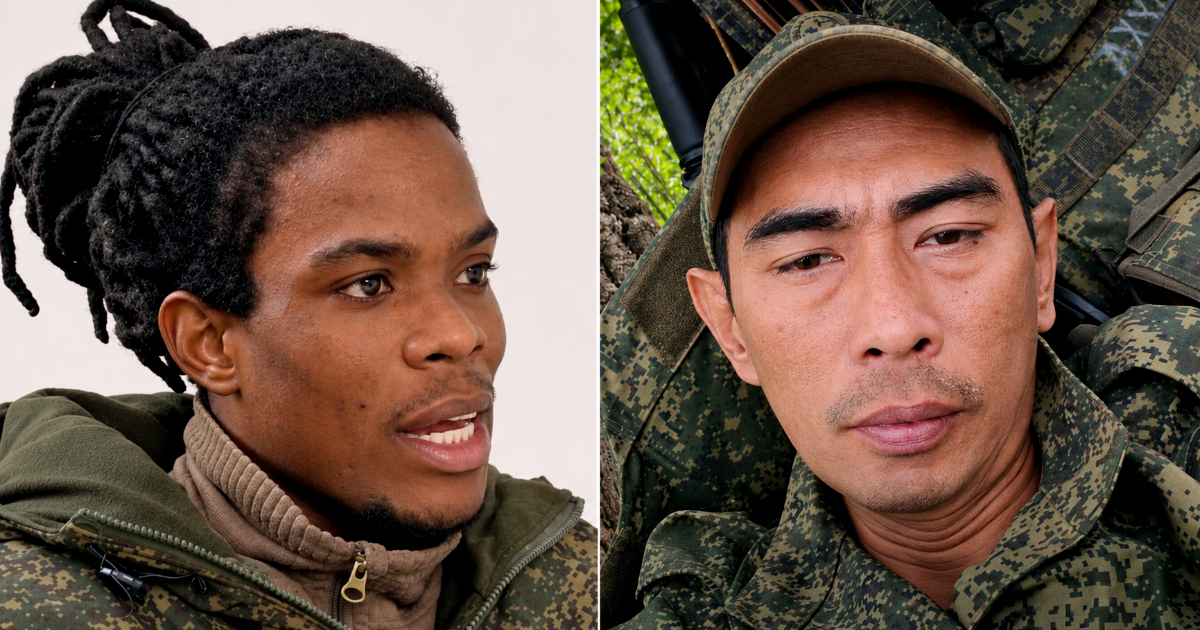
The government of Indonesia has initiated diplomatic efforts with Ukraine to address the situation of its citizens recruited by the Russian Army, an initiative that once again highlights the contrast between the actions of several countries affected by this phenomenon and the silence of the Cuban authorities regarding the fate of thousands of compatriots involved in the war.
The management was announced by the official Ukrainian project I Want to Live (Хочу Жить), which reported a meeting between the Indonesian ambassador to Ukraine, Arief Muhammad Basalamah, and Dmytro Usov, the secretary of the agency responsible for coordinating the treatment of prisoners of war.
During the meeting, Ukrainian authorities provided information on Indonesian citizens recruited by Russia and addressed the situation of one of them who remains imprisoned. Kiev expressed its willingness to allow a consular visit, while the diplomat assured that his government would pay attention to the issue.
The initiative arose after Quiero Vivir identified 292 Indonesian citizens incorporated into Russian forces, of which 283 are believed to have signed contracts during the first nine months of 2026. The organization warned that its records are incomplete and that the actual number could be higher.
Indonesia had already requested information from Moscow regarding its nationals who have been recruited. The new meeting opens a direct channel with Ukraine to also address those who have been taken prisoner.
Kenya and Peru have also acted
Indonesia is not the first country to take steps to protect its citizens involved in the Russian war.
In April, CiberCuba reported that Kenia had repatriated dozens of nationals, investigated the networks responsible for their recruitment, closed over 600 employment agencies, and announced measures to facilitate the return of those who remained on the front lines.
Kenyan authorities publicly acknowledged the magnitude of the problem, although they warned that participating without authorization in foreign armed conflicts could constitute a crime.
Peru has also demanded explanations from Russia regarding its dead and missing citizens. Its diplomacy has taken steps to obtain information and facilitate returns, while the authorities have released data on the identified cases.
The actions of these governments do not imply that they approve the incorporation of their citizens into the Russian Army. On the contrary, they show that investigating possible crimes and exercising consular protection are compatible responsibilities.
And what about the Cubans captured by Ukraine?
The contrast is particularly significant in the case of Cuba, one of the countries with the highest number of citizens identified among the Russian ranks.
During an address at the United Nations on October 19th, the Deputy Permanent Representative of Ukraine, Volodimir Pavlichenko, stated that Kiev had documented over 1,000 contracts of Cubans with the Russian Army between 2023 and 2025, although he cautioned that this figure did not reflect the entirety of the phenomenon.
CiberCuba has documented numerous cases of Cubans who have died, gone missing, and been captured by Ukrainian forces, as well as reports from relatives who are unaware of the fate of their loved ones or do not receive information about their remains and potential financial compensations.
Some prisoners have reported that they were sent to the front under false pretenses, threats of deportation, or unfulfilled job promises. An investigation by Amnesty International, published in September, collected testimonies from Cubans who may have been victims of human trafficking.
Ukraine has clarified that foreigners incorporated into the regular Russian forces receive the protections afforded to prisoners of war, regardless of their nationality.
In November 2025, a Ukrainian legislator proposed a humanitarian initiative to facilitate the release of captured Cubans and the handover of the remains of fallen fighters, linking it to the release of political prisoners in Cuba.
However, Havana has not publicly reported any efforts equivalent to those undertaken by Indonesia, Kenya, or Peru, nor has it presented verifiable results regarding consular visits to prisoners, repatriations of combatants, recovery of corpses, or claims for compensation for their families.
The lack of public information does not rule out discreet diplomatic contacts, but does highlight a lack of transparency regarding the assistance that the Cuban State provides to its citizens affected by the war.
The responsibility that Havana does not clarify
The Cuban regime has denied any institutional involvement in recruitment for Russia and claims to have acted against trafficking networks.
In September 2023, it was announced that 17 individuals linked to these operations were detained, but no comprehensive public report has been provided regarding the scope of the phenomenon and the measures taken.
It has also not explained how many Cubans remain in combat, how many have died, how many are missing, or what assistance their families receive.
The experience of Indonesia shows that a government can reach out to Ukraine to inquire about its nationals without supporting the war or justifying their enlistment. Kenya and Peru, moreover, have demonstrated that it is possible to demand information from Russia and take actions to facilitate returns.
In Cuba, meanwhile, families continue to face uncertainty about the fate of their loved ones.
The question is no longer just how so many Cubans ended up fighting for Russia, but why their own government is not reporting on efforts to bring them back, recover their remains, or guarantee their families the assistance that other states are providing to their citizens.
Related videos:
Filed under: