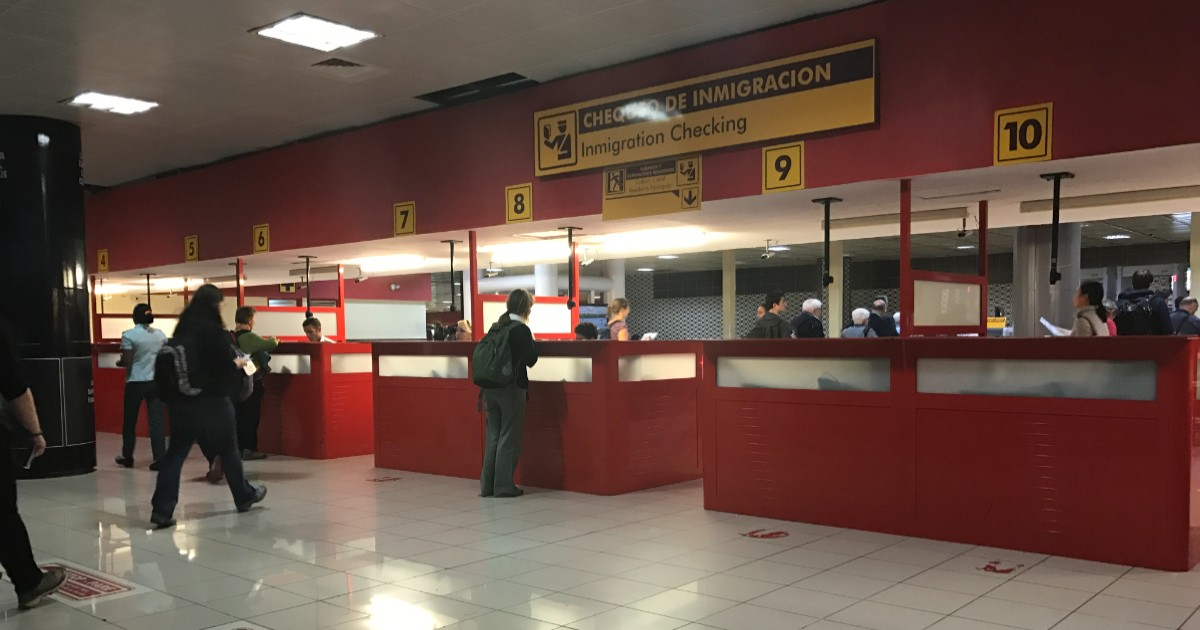
The Cuban regime established economic penalties ranging from 30,000 to 100,000 pesos for Cuban citizens who cross the country's border presenting a foreign passport instead of a Cuban one. This measure is outlined in the , published in Official Gazette number 39 on May 5, 2026, and effective from November 1, 2026.
Article 82, section a) of that law classifies as an offense the conduct of "the Cuban citizen who enters or exits the national territory using citizenship other than Cuban," and punishes it with a fine ranging from 300 to 500 quotas. Article 84 sets the value of each quota: "it cannot be less than one hundred pesos or more than two hundred pesos." This combination results in a range from 30,000 pesos—300 quotas at the minimum value—to 100,000 pesos—500 quotas at the maximum value.
The regulation does not penalize holding a foreign passport, but rather the specific act of using it to enter or exit Cuba while retaining Cuban citizenship. Article 14 of the same law states that "acquiring another citizenship does not imply the loss of Cuban citizenship" and that Cuban citizens "have the obligation to identify themselves with this status upon entry, during their stay, transit, and upon exiting the national territory."
The requirement to use a Cuban passport to cross the border is not new: it was already established by the old Migration Law 1312 of 1976. However, that regulation only imposed a general fine of up to 100 pesos for generic violations of its provisions, without specifically addressing the use of another nationality at the border. What Law 172/2024 introduces is a specific classification and a drastically higher penalty for that particular behavior.
The sanctions regime goes beyond crossing borders. Article 83 classifies serious offenses —punishable with fines ranging from 500 to 1,000 quotas, equivalent to between 50,000 and 200,000 pesos— for behaviors such as using foreign citizenship to carry out legally effective acts within Cuba, entering into sham marriages to obtain Cuban citizenship, or using false documents. Article 15 adds that "acts performed by Cuban citizens using another citizenship to have effects within national territory are null and void, without the need to initiate any process of nullification."
In the case of reoffending, the fine may reach double the maximum limit established for serious offenses, which amounts to up to 400,000 pesos if the maximum fee value is applied. If the offender does not pay the fine within 30 calendar days following the notification, the amount is doubled; if they also fail to pay within the subsequent 30 days after that doubling, the authorities may initiate criminal proceedings.
Sanctions will be imposed by chiefs, inspectors, and citizenship specialists from the Directorate of Identification, Migration, Foreign Affairs, and Citizenship of the Ministry of the Interior, who have seven days from the time they become aware of the violation to take action. However, there is an escape clause: Article 84 allows the authority to refrain from imposing a sanction when the facts "do not have significant harmful consequences" and the offender's background is favorable.
This law is part of a package of immigration reforms that also includes Law 171 on Migration and Law 173 on Foreigners, approved by the National Assembly on July 19, 2024. At the same time, the regime set the cost of renouncing Cuban citizenship at $1,000 through Resolution 37/2026 of the Ministry of Foreign Affairs, effective from October 1, 2026, making this process one of the most expensive in the Cuban consular system.
Related videos:
Filed under: