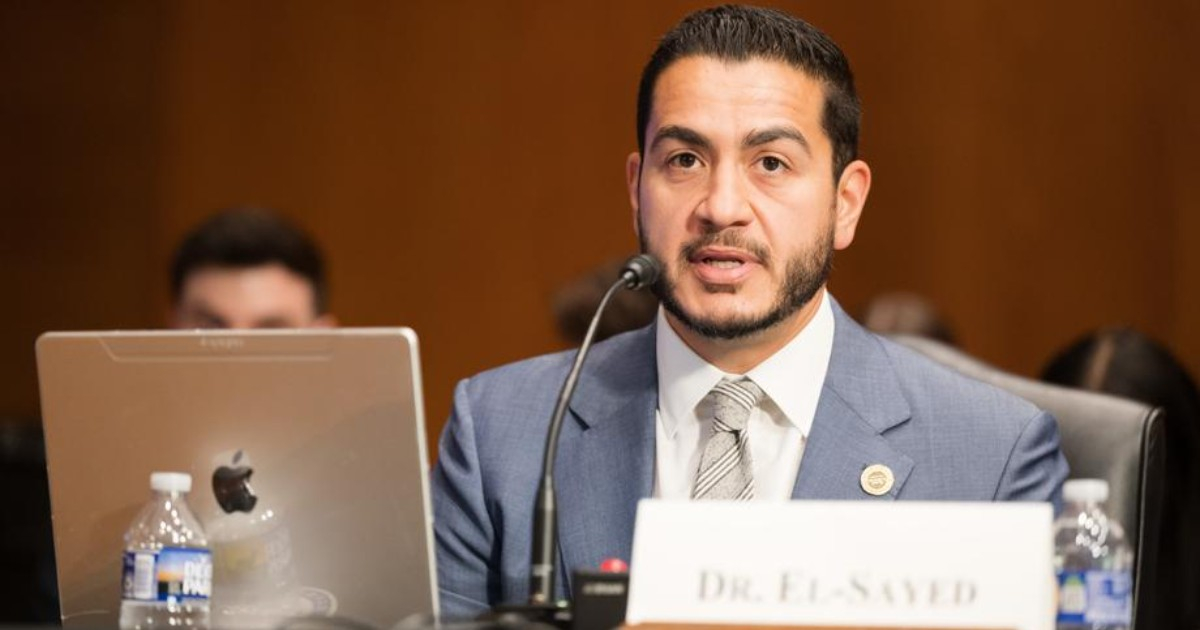
The Democrat Abdul El-Sayed defeated the Republican Mike Rogers in the federal Senate elections for Michigan and will be the first Muslim elected to serve in the U.S. Senate. Associated Press projected his victory at 2:27 a.m. on Wednesday, November 4, Eastern Time, following the voting on Tuesday, November 3. Reuters and CBS News also reported his triumph.
El-Sayed, 42 years old, will retain for the Democratic Party the seat vacated by Senator Gary Peters, who decided not to run for re-election. The Michigan race was one of the most closely monitored in the midterm elections because Republicans aimed to capture a seat that Democrats have held for decades. The outcome corresponds to a poll projection, pending completion and certification of the results by the authorities.
Who is Abdul El-Sayed, the first Muslim elected to the Senate?
El-Sayed is a doctor, the son of Egyptian immigrants, and a former public health official in Detroit. In 2018, he ran in the Democratic primary for governor of Michigan, but lost. Eight years later, he managed to win a federal election without having previously held an elected office, according to the report by the Associated Press published by Michigan Public.
Her election represents a historic precedent for religious representation in Washington. Although there have been Muslim lawmakers in the House of Representatives, no Muslim has ever been elected to the United States Senate. El-Sayed will take her seat when the new Congress convenes in January 2027.
The defeat of Mike Rogers and Trump's support
Rogers, a former Republican congressman and ex-FBI agent, entered the race with the support of Donald Trump and the national apparatus of his party. He had lost another Senate race in 2024, and this time he tried to take advantage of the internal divisions among the Democrats and the progressive nature of his rival. He was unable to wrest the seat from Peters.
During the campaign, El-Sayed advocated for reducing costs for families, limiting the influence of corporate money in elections, and promoting Medicare for All, a proposal for universal healthcare funded by public resources. In contrast, Rogers sought to portray him as a candidate too radical for Michigan. Reuters reported that the Republican spread allegations of supposed ties between El-Sayed and Islamic extremism, which were not supported by evidence; El-Sayed rejected those accusations.
The democratic divide that characterized the campaign
Before facing Rogers, El-Sayed had to prevail in a fiercely contested Democratic primary against Congresswoman Haley Stevens, who was backed by party figures such as Governor Gretchen Whitmer and outgoing Senator Gary Peters. According to NPR, in a report reproduced by Michigan Public, El-Sayed defeated Stevens by approximately one percentage point.
The fracture persisted until the last days: Stevens announced that he supported the Republican Rogers on November 1, after expressing disagreements with his former rival regarding Israel and concerns from segments of the Jewish community. El-Sayed opposed U.S. military aid to Israel and was particularly critical of its actions in Gaza, positions that created tensions within the Democratic coalition. Despite this scenario, he managed to prevail in the general election.
Michigan and the New Balance of Power in Washington
The result in Michigan reinforced a favorable election night for the Democratic Party. CiberCuba reported on the victories that led the Democrats to regain projected control of the Senate in states like Texas, Kansas, South Carolina, North Carolina, Ohio, and Iowa. Unlike those shifts, El-Sayed's victory keeps Michigan under Democratic representation.
The victory did not come entirely as a surprise: CiberCuba had already reported polls indicating an advantage for El-Sayed over Rogers in the days leading up to the voting. The polls, however, were not election results, and the outcome could only be determined after the tally on Tuesday.
The arrival of El-Sayed to the Senate represents a victory for the progressive Democratic sector and opens an unprecedented era of Muslim representation in the U.S. Senate. Readers can follow the progress of the counts and other contests in the .
Related videos:
Filed under: