On the eve of the start of the Strategic Exercise Moncada 2026, the Ministry of Revolutionary Armed Forces (MINFAR) published on its official account on X a quote from Fidel Castro stating that conventional armies are "absolutely powerless" when confronted with peasant irregular warfare on its natural terrain.
The message, tagged with the hashtag #Moncada2026, accompanied an image of two snipers in ghillie suits lying on the grass in shooting position, in what appears to be a military training exercise.
The phrase comes from the Second Declaration of Havana, pronounced by Castro on February 4, 1962. The full text of that passage adds that conventional armies "lose 10 men for every revolutionary fighter that falls, and demoralization quickly spreads among them as they face an invisible and invincible enemy."
The regime recovered this quote just when Cuba was starting the Moncada Exercise 2026, a two-day mobilization involving the FAR, MININT, militias, reservists, and civilian structures throughout the territory, under the official slogan "The War of All the People: Guarantee of Victory."
The publication is part of a sustained propaganda escalation throughout 2026, in which the regime has systematically resorted to the rhetoric of asymmetric warfare to respond to U.S. military pressure.
In May, the MINFAR spread the slogan “For Cuba, there is no alternative, victory or death.” In October, Cuban authorities claimed that there was an army ready to defend sovereignty “to the last drop of blood.” The hashtag #PuebloUniformado encapsulates the doctrine that presents the civilian population as an active component of defense, blurring the line between combatants and non-combatants.
This rhetoric contrasts with the military reality of the Island. The FAR has between 45,000 and 50,000 active personnel, aging Soviet equipment and a combat aviation fleet with between zero and 20 possibly operational aircraft. In light of this situation, the doctrine of irregular warfare and popular sacrifice serve as symbolic deterrents against a conventional gap that the regime itself cannot fill.
On the U.S. side, the warnings have been direct. Secretary of War Pete Hegseth visited Guantánamo in June and pointed out that it would be "reckless" for Cuba to acquire weapons systems capable of threatening the naval base or U.S. territory.
Two months later, from the destroyer USS Gridley during the PANAMAX exercises, Hegseth stated that Cuba was "on notice" and that all options, including military ones, remained on the table.
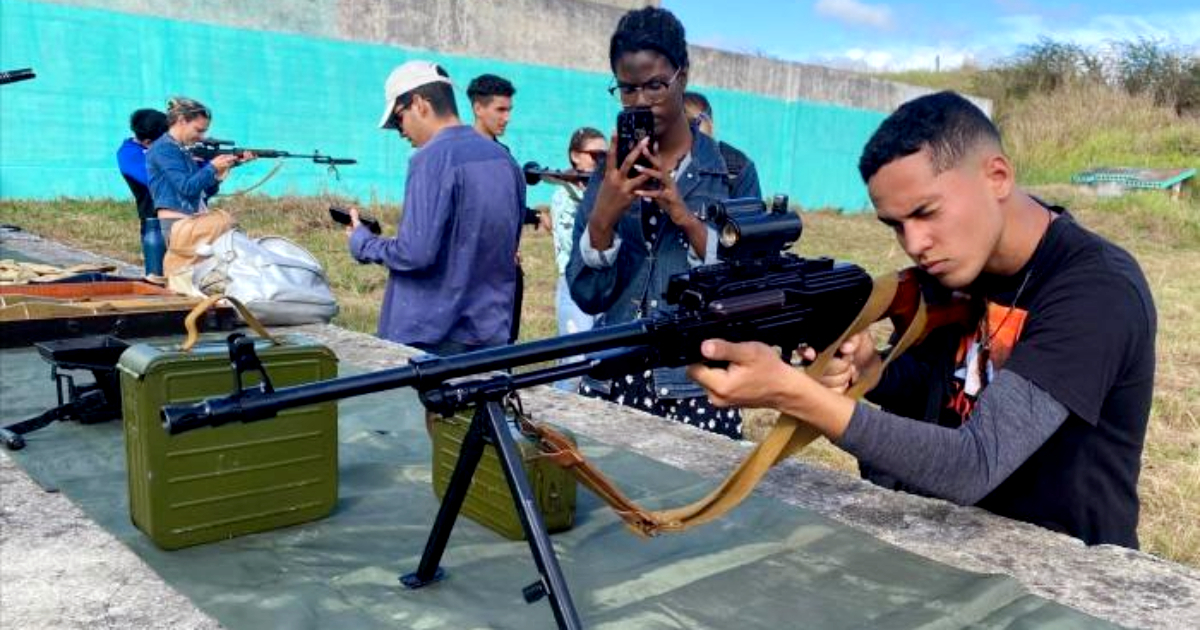
The Cuban regime declared the "Year of Preparation for Defense" at the beginning of the year, with weekly exercises that include shooting, drone handling, anti-tank mines, and mobilization of reservists. At the end of October, in Alquízar, Artemisa, shooters were trained to take down drones during a National Defense Day event.
The Moncada Exercise 2026 will culminate on National Defense Day, November 6, a date on which the regime plans to showcase the results of months of civil and military mobilization under the formula that Castro stated more than six decades ago: guerrilla warfare as a response to the adversary's conventional superiority.
Related videos:
Filed under: