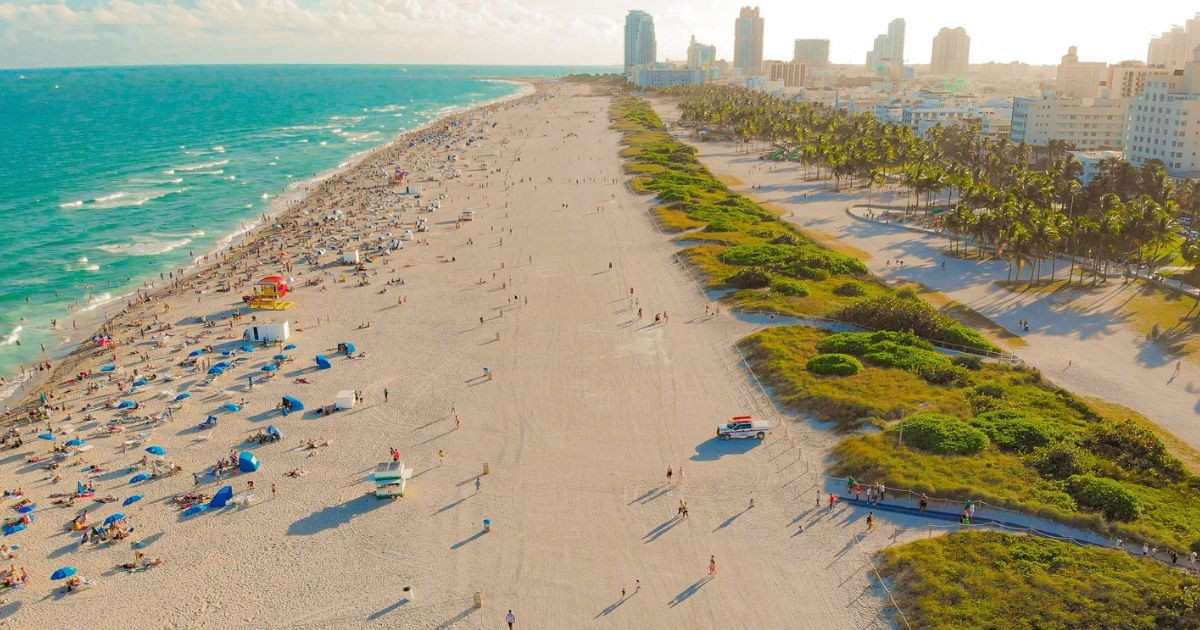
The beaches of Miami Beach, one of the most recognized tourist destinations in southern Florida, achieved first place in a national recognition that honors the restoration and conservation of the coastlines of the United States, after surpassing nine other finalists in a public vote.
The Miami Beach City Hall reported this Thursday that its beaches received the Best of the Best Restored Beach Award, awarded by the American Shore and Beach Preservation Association (ASBPA).
The distinction recognizes decades of work aimed at recovering sand lost to erosion, conserving dunes, and protecting the coastline from storms and rising sea levels.
The association, which brings together more than 1,000 members, including coastal communities from across the country, announced the results in October as part of its centennial celebrations.
Miami Beach finished ahead of nine other finalists in a competition that received more than 2,800 votes nationwide.
The ranking published by the organization placed Seabrook, South Carolina, in second place, and Rosewood Beach, Illinois, in third. Delray Beach, also in Florida, reached the seventh position.
The mayor of Miami Beach, Steven Meiner, emphasized that the recognition is the result of a sustained effort by several generations of authorities and specialists.
"This award honors the decades of work by our municipal staff, our county and federal partners, and the leaders who preceded us in protecting this coast," he expressed.
Meiner also emphasized that the beaches serve a purpose that goes far beyond attracting visitors: "Our beaches and dunes are more than a tourist attraction. They are our first line of defense against storms and rising sea levels."
Miami Beach boasts approximately 7.1 miles of beaches and dunes, equivalent to 11.4 kilometers, which serve as a natural barrier against waves and severe weather events.
The history of its coastal recovery dates back several decades. According to the municipal statement, of the 100 coastal projects considered in the competition, Miami Beach had the oldest sand replenishment project, which was successfully completed in 1985.
That project allowed for the recovery of coastal areas affected by erosion and promoted a regional program for coastal and hurricane protection that continues to this day.
Subsequent interventions have included the periodic addition of sand in degraded sections, with the collaboration of the City Council, Miami-Dade County, the United States Army Corps of Engineers, and other state and federal institutions.
Nicole Elko, Executive Director of ASBPA, described Miami Beach as a national benchmark for demonstrating that large-scale beach restoration can reverse environmental damage, provide storm protection, and contribute to the economic recovery of coastal communities.
However, the conservation of these areas requires ongoing work. Amy Knowles, Director of Environment and Sustainability and Head of Resilience for Miami Beach, explained that sand is naturally displaced by the effects of waves, currents, wind, and storms.
For that reason, the authorities must continuously monitor the condition of the coastline and carry out new interventions when necessary. The efforts also include the preservation of native vegetation and the habitats where sea turtles and other species nest.
In September, the city received state approval to update its beachfront management plan for the next ten years, with an estimated budget of 541 million dollars.
The program includes measures for environmental protection, dune management, erosion control, beach maintenance, and improvements in accessibility. According to municipal data, the beaches and dunes help protect properties with an assessed value of over 62.4 billion dollars from storm surges and rising sea levels.
The recognition comes in a year when other coastal destinations in Florida have also stood out in national rankings, albeit under different criteria.
In February, four beaches in Florida ranked among the top ten in the United States at the 2026 Tripadvisor Awards: Clearwater Beach, in second place; Siesta Beach, in sixth; St. Andrews State Park, in eighth; and Honeymoon Island State Park, in tenth.
Unlike the award recently received by Miami Beach, that ranking was based on the opinions and experiences of travelers, taking into account aspects such as scenery, facilities, and tourist services.
In May, three more beaches from Florida stood out in the annual ranking by expert Stephen Leatherman, known as Dr. Beach. St. Andrews State Park claimed the second spot, Caladesi Island State Park took third place, and Delnor-Wiggins Pass State Park was sixth.
The recovery of these spaces has also become important following the damage caused by previous hurricanes. Caladesi Island and Delnor-Wiggins Pass, for example, were affected by hurricanes Helene and Milton in 2024 and required restoration work before reopening to the public.
Related videos:
Filed under: