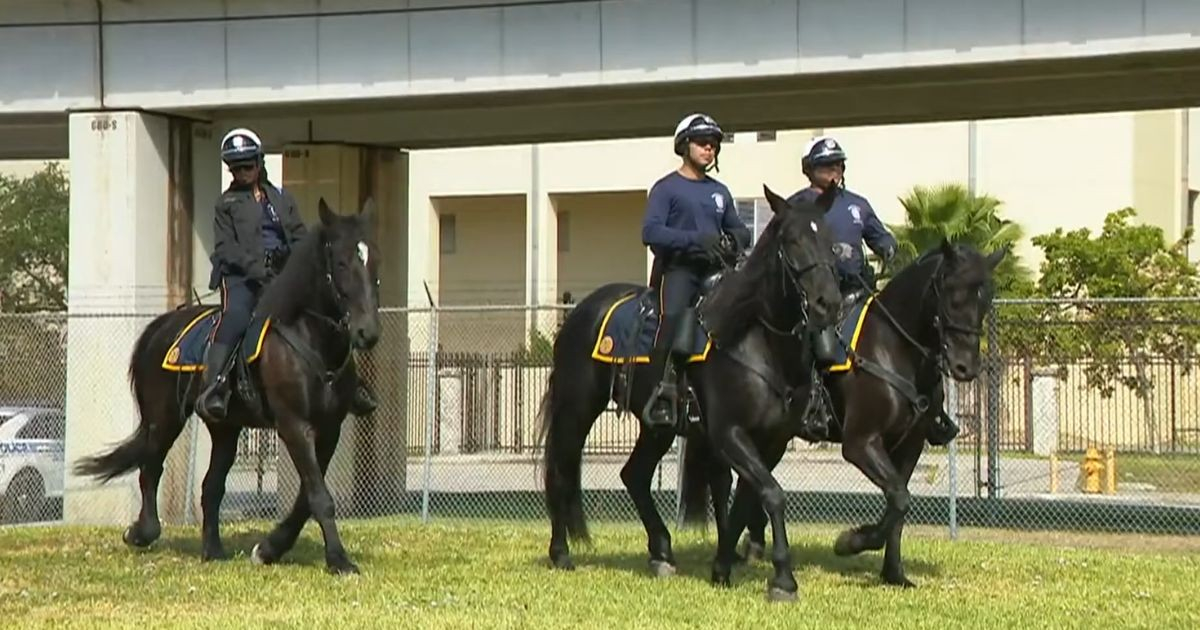
Miami Beach is considering reintroducing mounted police patrols to monitor the busiest areas of the city, a proposal put forth by Mayor Steven Meiner which has sparked a dispute with Commissioner David Suárez, who deems it a “vanity project” and questions both its costs and the treatment the animals would receive.
According to reported by WSVN this Wednesday, Meiner and the chief of Miami Beach Police, Wayne Jones, want to establish a mounted unit that could begin operations in 2028, provided they secure the necessary funding and the proposal receives the appropriate approval.
The project would have an estimated initial cost of 500,000 dollars, which the authorities hope to cover through private donations.
The mayor argues that the initiative would save resources, although it is still unclear how its long-term operating costs would be financed.
Jones defended the economic viability of the plan with a strong statement: "What if I told you that, during the first year of operation, it would not cost the city of Miami Beach or its residents anything at all?"
The proposal has encountered resistance within the Municipal Commission itself.
“We cannot support vanity projects for the Police and the mayor, such as the mounted patrols in Miami Beach. It certainly seems like a vanity project,” stated Commissioner David Suárez.
Suárez questioned why the city is dedicating efforts to an initiative like this when, in his opinion, it should focus on reducing the tax burden on residents.
«We have just approved Amendment 3. We need tax cuts. We cannot afford these vanity projects,» argued the official.
The commissioner also expressed concerns about the cleanliness of the streets, the high temperatures, and the conditions in which the horses would be working.
"Can you imagine the cleaning problem we're going to have? Horse droppings everywhere? And it's really hot in Miami Beach. The humidity is extremely high. It seems like it would be animal abuse for those horses," he stated.
Meiner rejected that proposal and asserted that the use of animals for police work does not necessarily entail cruelty.
"There is no animal cruelty here," the mayor responded, noting that numerous recognized police forces use mounted units to carry out surveillance and maintain order during large gatherings.
The municipal leader believes that horses would provide operational advantages to the agents, especially when they need to observe what happens among large groups of people.
As an example, he mentioned Ocean Drive, one of the most visited avenues in Miami Beach and a frequent backdrop for events, celebrations, and large gatherings of tourists.
"Imagine large crowds. There are thousands of people on Ocean Drive, for example. Now you have an officer ten feet up," Meiner explained, referring to the visibility that would allow for mounted patrols.
The mayor also stated that these units could serve to bring the police closer to residents and visitors, in addition to reinforcing crowd control operations.
The initiative does not start from scratch. The Finance and Economic Resilience Committee of Miami Beach reviewed the project on October 28 and recommended forwarding it favorably to the City Commission for consideration during the budgeting process for fiscal year 2028.
In that meeting, initial costs ranged from 400,000 to 500,000 dollars and annual operating expenses were estimated at around 100,000 dollars.
Donations could alleviate the financial burden on the city, but they still do not constitute a guarantee of permanent funding.
Mounted police surveillance already exists in other areas of South Florida. The Miami Police Department, the Miami-Dade Sheriff's Office, and the Coral Gables Police have mounted units that carry out patrol, security, and crowd control duties.
Miami Beach also has a history. Its officers used horses during the 1930s, but the program was interrupted during World War II.
The mounted patrols later returned and were present for much of the eighties and the early nineties.
The interest in reviving that model emerges in a city that has applied special measures for years to control large gatherings of visitors, especially during spring break.
In March 2025, Miami Beach strengthened its security operations during spring break, known as Spring Break, with more uniformed and undercover officers, beach access controls, traffic restrictions, and higher fines.
The measures included restrictions on movement along Ocean Drive, the installation of barricades to separate pedestrians from vehicles, sobriety checkpoints, and limitations on the sale of alcohol in the entertainment district.
The operations were in response to records of violence and disturbances from previous years. In March 2023, Miami Beach imposed a curfew after two consecutive nights of shootings near Ocean Drive, which resulted in two fatalities and several injuries.
Also in 2022, authorities declared a state of emergency and imposed nighttime restrictions due to violent incidents and large gatherings of visitors during spring break.
Related videos:
Filed under: