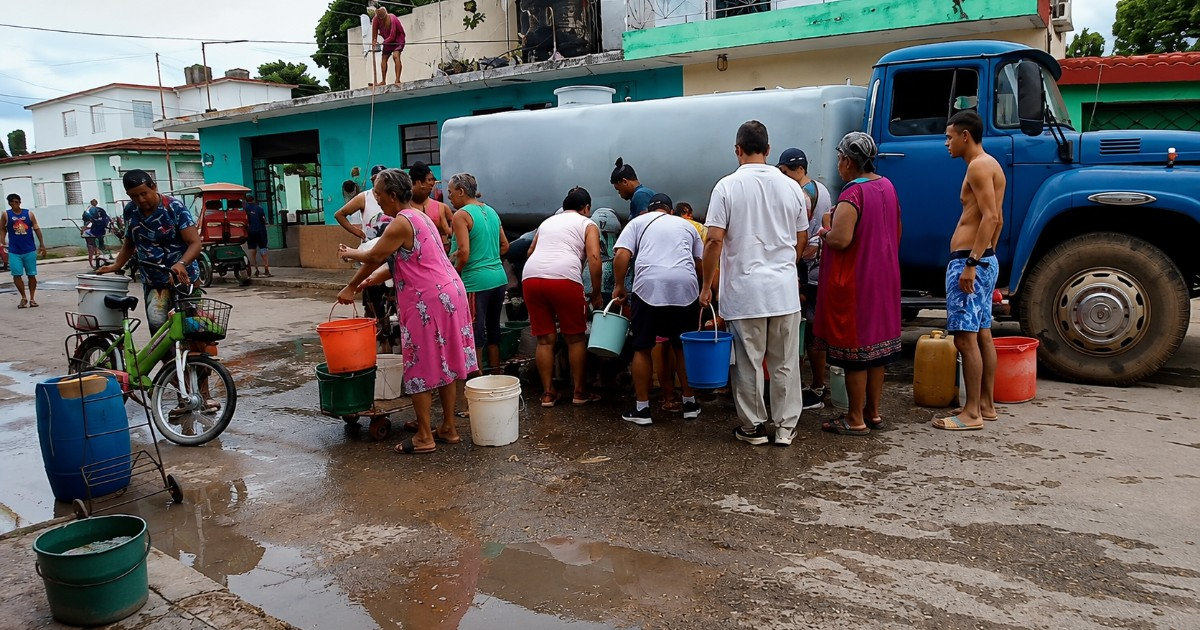
Up to two years without receiving water through the pipes. This is the situation reported by residents of Santiago de Cuba and Havana during the radio program Criterio Compartido, hosted by Miguel Díaz-Canel, where testimonies emerged regarding the prolonged shortages and the lack of responses from the institutions responsible for the service.
In Santiago de Cuba, a resident of the Vista Hermosa neighborhood stated that their community has gone two years without receiving water through the supply networks. According to their explanation, the neighbors have filed complaints with various government entities and the aqueduct system, yet they have not achieved a solution.
The citizen also expressed suspicions regarding the actions of the personnel responsible for operating the valves that regulate water distribution, although those accusations were not confirmed during the program.
A similar situation was reported from the community of Las Margaritas, belonging to Santa María del Rosario in Havana, where residents claim they have been without supply through the pipes for nearly two years.
The neighbor who filed the complaint explained that there are many elderly people living in the neighborhood, particularly vulnerable to the challenges of obtaining, transporting, and storing water.
It also reported that the authorities have known about the problem for some time, but the residents continue to receive neither a satisfactory explanation nor a solution.
Díaz-Canel acknowledges institutional shortcomings and promises to follow up
During the broadcast on November 4, Díaz-Canel acknowledged the seriousness of the shortages and admitted that not all difficulties can be attributed to material issues.
"The problem of water in the country is real, serious, and complex; it cannot be solved with just a speech or a single measure," he stated.
The leader attributed part of the crisis to the deterioration of hydraulic networks, lack of investments, power outages, and difficulties in obtaining fuel. However, he also criticized the actions of officials who do not address citizens' complaints.
"Because where there is negligence, where there is indifference, where there is the role of an official who does not attend to the population, there is no blockade that matters, nor is there any justification for a blockade that holds."
Regarding the complaint filed from Santiago de Cuba, Díaz-Canel indicated that it would be forwarded to the provincial authorities for further action.
The complaints arise amidst a crisis that, according to figures presented by the National Institute of Hydraulic Resources, affected 2,681,770 residents due to interruptions in supply from networks.
The president of that organization, Antonio Rodríguez, acknowledged that the country is going through "one of the most difficult times regarding water supply nationwide in recent times."
For the communities that reported nearly two years of shortages, the program ended without a specific date for restoring the service.
Related videos:
Filed under: