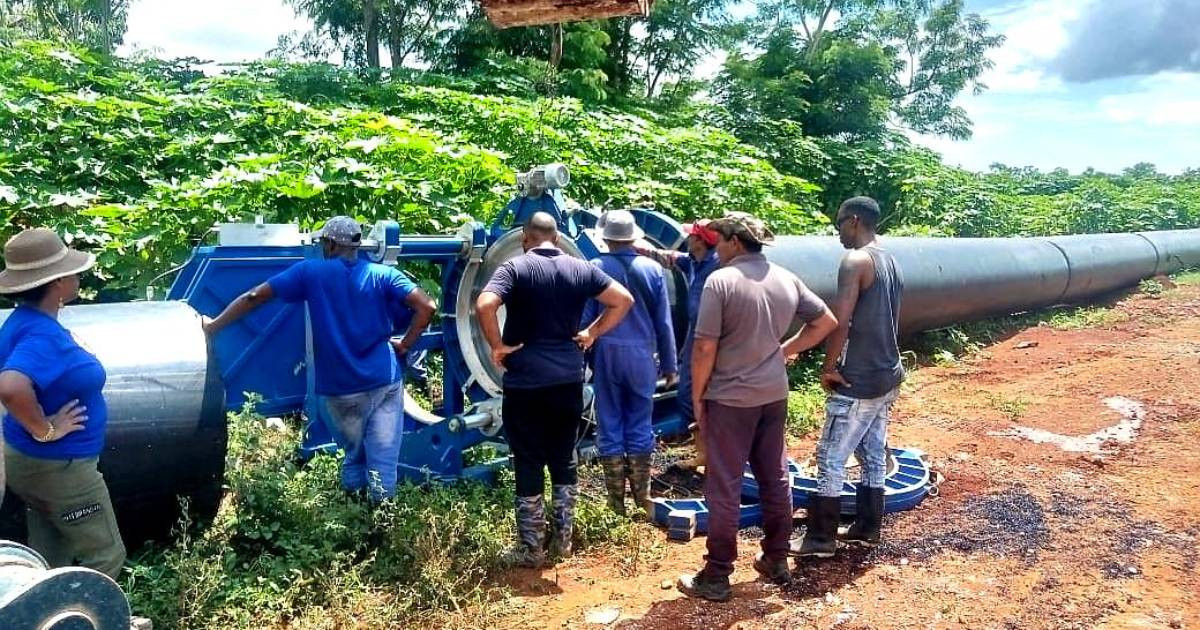
The water crisis in Havana is not solely due to blackouts, equipment failures, and the deterioration of pipes. Cuban authorities acknowledged that there are illegal valve manipulations that alter the distribution of supply and harm entire communities.
During the radio program "Criterio Compartido", broadcast on Wednesday, November 4th, the director of Aguas de La Habana, Yosvany Rubí Bazail, revealed that measures are being taken against two individuals due to irregularities detected in Arroyo Naranjo.
"In the case, for example, of Arroyo Naranjo, we are already processing two individuals for the illegal operation of valves," the official stated in front of Miguel Díaz-Canel.
Rubí explained the importance of these devices in the distribution of water: "The valve locally turns into a pumping station, because when you open it, it supplies water to an entire sector."
He warned that the intervention of unauthorized individuals may disrupt supply cycles and affect other consumers. However, he did not specify the identities of those involved nor clarify whether they are facing an administrative or criminal procedure.
Reports of corruption and favoritism in water distribution
The journalist Bárbara Betancourt raised during the program that citizen reports about the manipulation of valves could conceal corrupt practices.
"Because when they talk about the manipulation of the valves, it seems like a euphemism, because many people know that behind a manipulation there is something, something happens," he noted, referring to the differences in supply between buildings and nearby communities.
Díaz-Canel acknowledged that the water crisis in Cuba is a serious issue, "which has structural roots, due to networks that have been in use for decades, investments that haven't been able to be made to the extent needed, and pending maintenance." He also considered that two factors worsen the situation: the embargo and the energy crisis.
In his intervention, he mentioned a communication received from the neighborhood La Coronela, where residents reported alleged water diversions to other areas due to the irregular actions of individuals responsible for operating the valves.
The official acknowledged that the supply difficulties include issues related to institutional management, in addition to material limitations. In Mantilla, a resident reported that she had been experiencing supply issues for over six months without receiving any responses from the institutions.
According to Díaz-Canel, the investigation identified two affected valves: one "fully open" and another manipulated by members of the community. One of the malfunctions had a technical solution that could be implemented within hours.
"Look at the cost of silence, what could have been resolved in hours, how long it takes due to institutional silence," the leader questioned.
Rubí also reported that in Havana there are more than 3,000 valves, the monitoring of which requires, she said, the cooperation of residents to detect irregular operations.
The revelation occurs amidst a deep supply crisis. According to official figures presented during the program on November 3rd, around 2,681,770 inhabitants were affected by issues related to network supply, including 536,000 in Havana.
The president of the National Institute of Hydraulic Resources, Antonio Rodríguez, attributed 66% of the issues to electrical problems and 25% to failures in pumping equipment. To these difficulties, irregularities acknowledged by the officials responsible for the aqueduct are now added.
Cases of clandestine connections to the network and bribery payments have been documented in several provinces. Employees in the sector have reportedly charged as much as 50,000 Cuban pesos for illegal connections, and between 10,000 and 15,000 pesos for diverted water trucks.
Related videos:
Filed under: