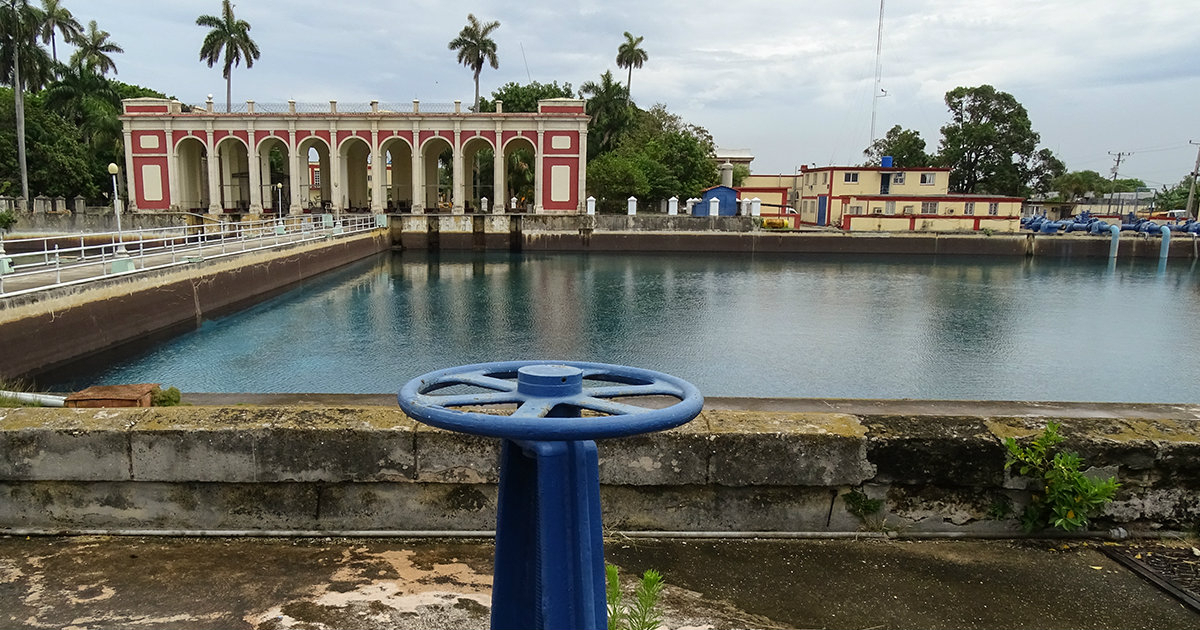
The Cuban regime announced that the 10 photovoltaic solar parks planned to ensure water pumping in Havana would be completed by August 2027, although officials indicated they would try to expedite that timeline.
The announcement was made during the fourth radio program "Criterio Compartido", hosted by Miguel Díaz-Canel from the Radio Rebelde Studios on Wednesday.
Antonio Rodríguez Rodríguez, president of the National Institute of Hydraulic Resources (INRH), announced that preparations are underway for solar panel installations with a combined capacity of 200 megawatts, which will include energy storage systems, exclusively intended for the three main supply sources of the capital.
“Construction on these solar parks is already underway, with a completion date set for August of next year. An extraordinary effort is being made to see how this timeline can be shortened. This would enable us to ensure energy supply for the three essential sources of the capital if the Electroenergetic System fails,” Rodríguez said.
The new timeline sets the completion of the solar parks for August 2027, after authorities suggested in September that water pumping would begin to operate independently from the electrical grid during the first months of that year.
The official added that the INRH is working on projects for eighteen additional sources, which are responsible for ensuring 80% of the water supply in the capital.
The stated objective is to gradually disconnect the pumping of water in the capital from the National Electric System (SEN), whose instability exacerbates supply interruptions, along with equipment failures and the deterioration of hydraulic infrastructure.
The INRH reported that at dawn on Tuesday, 2,681,770 people were experiencing disruptions in water supply networks across the country, of which approximately 536,000 were concentrated in Havana.
Sixty-six percent of those national disruptions are attributed to a lack of electricity, and twenty-five percent to breakdowns in pumping equipment, highlighting the extent to which the collapse of the electrical system affects the hydraulic system.
Díaz-Canel acknowledged that "the problem of water in the country is real, serious, and complex; it cannot be resolved with just a speech or a single measure," and admitted that it has "structural roots, networks that have been exploited for decades, and investments that we have not been able to make on the scale that was needed."
The national solar energy pumping plan includes 1,312 units in its first phase. According to the released data, 866 had arrived in the country, 853 were in operation, and the remaining 446 are expected to arrive before the end of December.
The dependence on the National Electric System (SEN) is the central issue according to Cuban authorities. More than 85% of the country's pumping stations operate on electricity from the national grid, and these stations require continuous power supply for between 10 and 12 hours to function.
Water has been the most common topic in all episodes of the radio program since its launch: 17 calls in the first episode, nine in the second, and four in the third. Díaz-Canel noted that this statistic "already gives us a thermometer of the sensitivity of our people and also a warning signal for the institutions."
The leader emphasized that addressing citizens' complaints cannot depend on their "media visibility," although the very nature of the program—where incoming calls lead to visits and actions—suggests that public pressure remains the main driving force of institutional response in Cuba.
In September, the UN estimated that the actual number of Cubans affected by the water crisis could reach 3.5 million people, a figure that contrasts sharply with the solutions the regime projects for mid-2027.
Related videos:
Filed under: