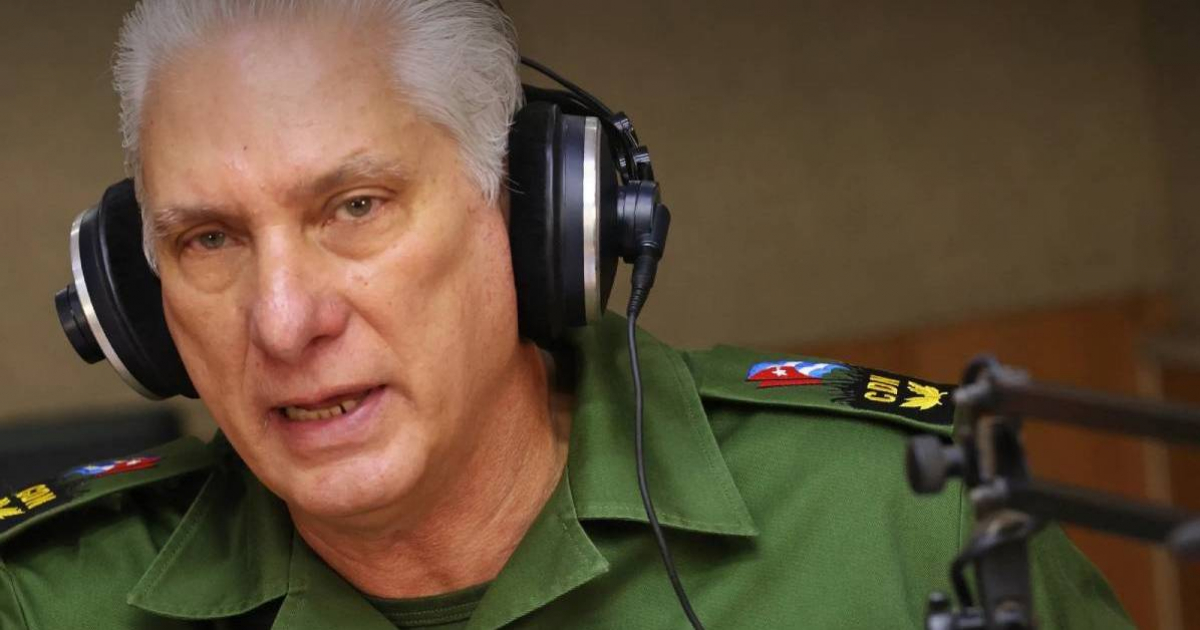
The leader Miguel Díaz-Canel acknowledged this Wednesday that millions of Cubans are experiencing interruptions in the water supply and that the issue will not have an immediate solution.
His statements were made in the radio program Criterio Compartido, where he asserted that the water crisis in Cuba is "real, serious, and complex." He warned that the solution will require large-scale investments, a prolonged timeframe, and that "it cannot be resolved with just a speech or a single measure."
"It is a problem that has structural roots, networks that have been exploited for decades, investments that we have not been able to make on the scale that was needed, maintenance that needed to be done, and two factors that are exacerbating it today," he said.
The factors referred to are the U.S. embargo and the energy crisis. He also pointed fingers at his own officials by criticizing "the negligence, indolence, and lack of coordination" of local authorities in some areas.
Antonio Rodríguez Rodríguez, president of the National Institute of Hydraulic Resources (INRH), specified that 2,681,770 people were experiencing interruptions in the supply through networks across the country as of the morning of Tuesday, November 3rd.
The most revealing data provided by the official is the direct link to the blackouts. 66% of the disruptions are due to the lack of electricity to operate the pumping stations, and another 25% is attributed to breakdowns in the equipment itself. These two factors account for 91% of the recorded issues.
Havana has the highest number of affected individuals, with approximately 536,000 people lacking regular access to the service. Following are Santiago de Cuba, Holguín, Matanzas, Artemisa, and Pinar del Río, each with around 200,000 affected individuals.
In numerous areas, Cuban families go weeks and even months without receiving water through household networks, forcing them to rely on private tanker trucks at exorbitant prices.
In Pinar del Río, a water truck can cost more than 15,000 pesos—almost five times the minimum monthly salary—a figure that the state-run newspaper Guerrillero described as "excessive and abusive." In Havana, the prices of private water trucks range between 18,000 and 50,000 pesos.
In May 2026, the INRH already acknowledged 2.7 million affected individuals, and the UN Office for the Coordination of Humanitarian Affairs estimated in September that the actual number could reach 3.5 million.
Between 2022 and 2024, the Cuban state allocated approximately 95,801 million pesos to tourism compared to just 5,934 million to water supply programs.
The INRH announced that 853 pumping units are already operational within the energy matrix change plan, and that ten solar parks totaling 200 megawatts will be dedicated to the three main sources in Havana, with completion expected by August 2027. However, the authorities did not specify when the outages will significantly decrease.
Cubans abroad launched this week the solidarity campaign "Safe Water for Cuba", driven by the Humanitarian Aid Network, to send purification tablets, filters, and ozonators to the Zamora neighborhood in Marianao, where residents have been collecting rainwater for drinking and cooking for over six months.
Related videos:
Filed under: