
Related videos:
In Cuba, turning on the tap is an act of faith: in numerous provinces, the arrival of water depends on factors that are beyond the control of the residents.
In many communities, families rely solely on tankers and drastically limit their domestic consumption.
The amounts allocated by the government rarely meet basic needs, and official works continue to be partial and precarious, according to the Food Monitor Program (FMP), an organization that monitors food security on the island.
Technical precariousness is compounded by corruption: in various neighborhoods, cases have been documented of employees from the Water and Sewerage company making illegal connections in exchange for sums that can exceed 50 thousand Cuban pesos, equivalent to more than 100 U.S. dollars.
A black market for drinking water has also been detected: trucks diverted to other communities, where residents pay between 10,000 and 15,000 pesos to buy the service, PVC tanks resold—originally intended for vulnerable cases—and clandestine pipes connected to the main network.
All of these practices ultimately harm those most affected by the crisis, emphasized the organization, which, while not mentioning specific locations, pointed out that this situation is experienced throughout the entire country.
The drilling of private wells has become an increasingly common alternative, although it is only accessible to those who can afford between 60,000 and 90,000 Cuban pesos per project.
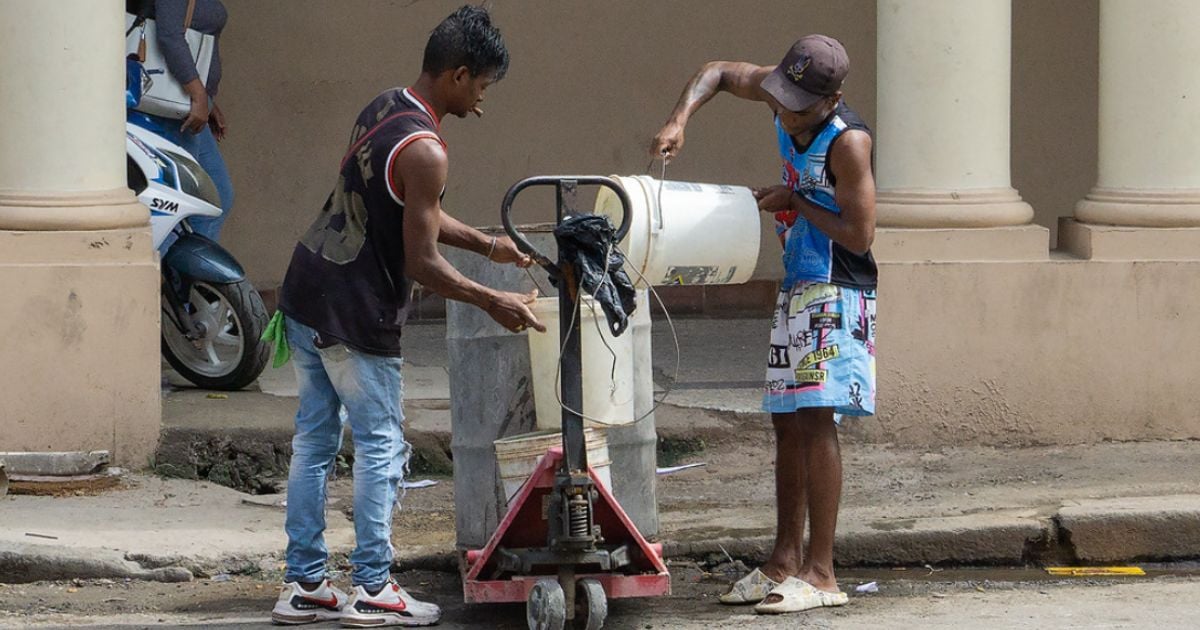
In contrast, families with fewer resources resort to rudimentary methods to collect water.
Inequality is deepening even within the same locality: some households have pumping systems and cisterns—often illegal—while others rely on recycled containers and buckets that they carry daily.
The consequences of the improvisation are visible in the open streets, the accumulated debris, and the disrupted traffic. Residents report that the roads have not been repaired and that the leaks reappear shortly after the work is completed.
In some places, minor accidents have been reported during community interventions carried out without technical guidance and involving women, the elderly, and children.
Despite this, the authorities present these works as examples of the "revolutionary spirit" and the "unity of the people."
On other occasions, families that can afford turbines or water pumps improvise what are known as "thieves," which connect to the hydraulic network and siphon off the precious liquid when it arrives weakly, leaving the rest of the neighbors without service.
The official discourse attributes the crisis to a lack of resources and the overall economic difficulties of the country.
However, the testimonies gathered by FMP indicate that the problem is structural and is characterized by corruption and the unequal distribution of basic resources.
The entities responsible for water distribution are public, but in practice, they operate like small private businesses, where some leaders and workers profit from the needs of the population.
Social unrest is evident. People appreciate the minimal progress, but they know it doesn't address the root of the problem. Distrust in official promises grows with each unfinished project.
In Camagüey, residents of the Modelo neighborhood claim they have not received water since 2019. To survive, they have had to dig ditches and extend hoses from other areas, also relying on regular payments to water truck services, with costs exceeding the incomes of many households.
The situation has become unsustainable, especially for the elderly and those with limited mobility, who report total abandonment by the authorities.
The problem is not isolated. In Bayamo, two trucks involved in the illegal sale of water were detained. The vehicles were assigned to state supply, but were diverted to operate as part of a black market that directly affects the most vulnerable sectors.
According to the complaint, those involved charged between 5,000 and 10,000 pesos per service, while the communities received not a drop.
These irregularities extend to other provinces. In Matanzas, residents describe access to water as a “great scam”.
They must pay every two weeks prices around 3,000 pesos per tank, amidst prolonged outages and a complete lack of transparency regarding the management of the valve system and the fuel.
In several municipalities, residents report shady dealings among operators, where the distribution of water becomes a profit source for a few and an unbearable burden for the majority.
Filed under: