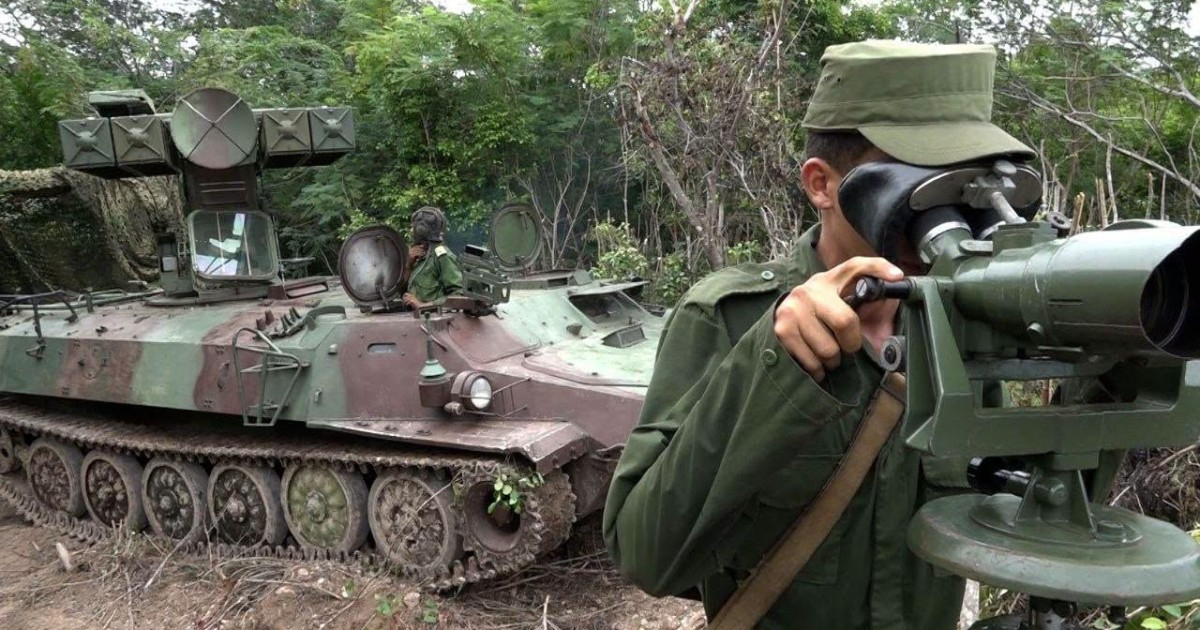
The U.S. Department of State designated two Chinese companies this Thursday for supplying military components and equipment to the Ministry of Revolutionary Armed Forces of Cuba (MINFAR), in a new round of sanctions that collectively affect eight entities, two individuals, and five vessels identified as blocked property, according to the official statement from the Department of State.
The two designated Chinese companies are China National Electronic Import and Export Company (CEIEC), a state-owned exporter of defense electronics and security systems, and Beijing H&C Technologies Co., Ltd., a subsidiary of China Electronics Technology Group Corporation International based in the Xicheng district of Beijing. Both acted as suppliers to the Cuban military through the Cuban company Sociedad Mercantil Duna S.A., which had already been sanctioned on August 6 for facilitating the import of arms from China and Russia to MINFAR.
CEIEC is not unknown to U.S. authorities. In November 2020, the Department of the Treasury sanctioned it for supporting the then-government of Nicolás Maduro in Venezuela with digital surveillance technology — described at that time as a marketed version of the "Great Firewall" from China — to restrict internet access and persecute opponents. Its redesignation now by the Department of State reveals a sustained pattern of support for authoritarian regimes allied with Beijing in the Western Hemisphere.
The designation of Beijing H&C Technologies marks the first time that a subsidiary of China Electronics Technology Group Corporation International has been sanctioned in relation to Cuba.
In addition to the two Chinese companies, the sanctions target oil transport networks linked to the regime. Guillermo Faustino Rodríguez López-Calleja and four shipping companies were designated: CAROIL Transport Marine Ltd (Cyprus), TENTACOOL Commercial Inc (Panama), Internacional Marítima S.A., and PETROMARCA, both based in Cuba. The five blocked ships are the Esperanza, the Gloria C, the Maria Cristina, the Emilia, and the Lourdes.
The State Department also sanctioned Any Rodríguez Lastres, daughter of the president of the military conglomerate GAESA, Ania Guillermina Lastres Morera, who had already been designated previously. Rodríguez Lastres served as the commercial director of the Mariel Container Terminal S.A. The statement notes that those close to the regime and their relatives "continue to profit from the control that the dictatorship exerts over the island's economy, through opaque networks linked to GAESA."
Two Cuban state entities from the technology sector were also included on the list: CUBAELECTRÓNICA, an importer of supplies for the electronic industry, and TECNOSIME, dedicated to commercial activities and technical services that generate revenue for the State.
At the same time, the Office of Foreign Assets Control (OFAC) of the Treasury issued a determination that expands the potential scope of the measures: from now on, any foreign individual operating in the Cuban sectors of manufacturing, technology, electronics, and maritime activities may be subject to sanctions. The State Department clarified that the measure "targets the regime and those who facilitate it, not the Cuban people," and that humanitarian trade—such as food, medicines, and medical devices—remains authorized.
All designations were made under Executive Order 14404, signed by President Trump on May 1, 2026, which authorizes sanctions against individuals linked to repression in Cuba and threats to U.S. national security. This action is part of a scaled campaign against the regime's oil and military networks that Washington has intensified throughout 2026, supported by the State Department report “Cuba: The Capital of 21st Century Communism”, published in July, which documents how China operates three of the 18 Cuban signals intelligence facilities and describes that presence as an "acute risk" to the operational military security of the U.S.
Related videos:
Filed under: