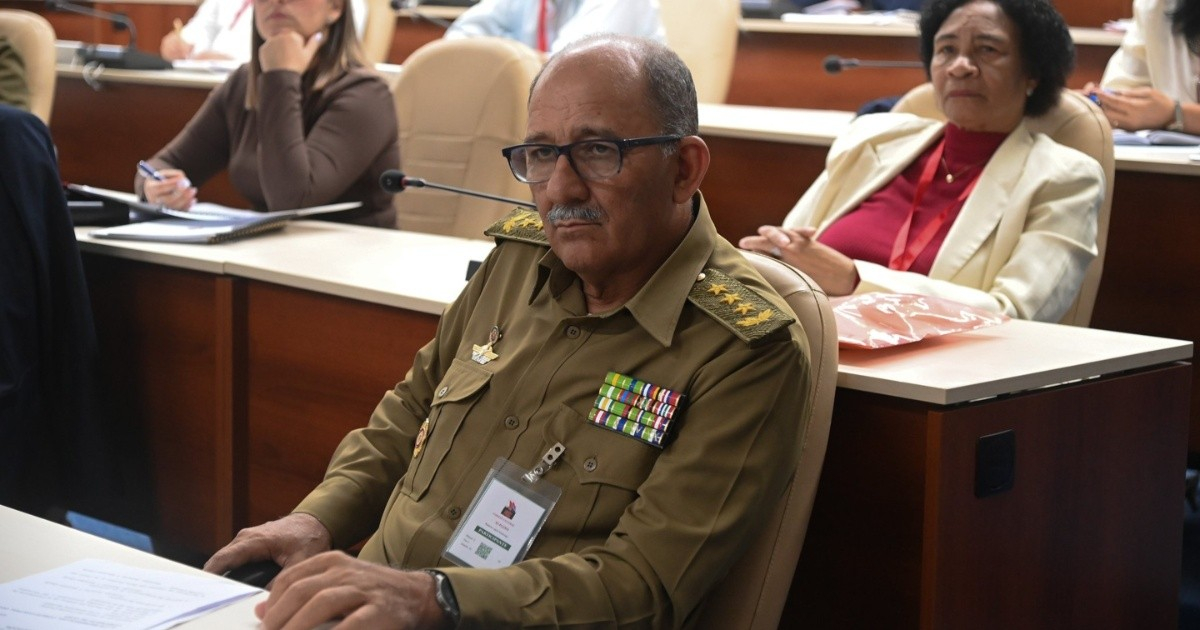
General Roberto Legrá Sotolongo, the first deputy minister of the Revolutionary Armed Forces and head of the General Staff of Cuba, issued a direct threat against the United States this Thursday during the Moncada 2026 Strategic Exercise: “We will defend house by house, neighborhood by neighborhood, area by area, until we defeat the Yankee who tries to take over Cuba.”
The statements come as the Cuban population endures one of the worst energy collapses of the year: on the same day, the National Electric System reported a mere 1,000 MW of availability against a demand of 2,350 MW, with a projected shortfall of up to 1,770 MW during peak hours, according to data from the Electric Union.
The Ministry of the Revolutionary Armed Forces (MINFAR) also released a video with an even more forceful message: “In this country, the enemy will not have a single square meter where they can feel safe, where they are not threatened by a mine or fall into an ambush that will annihilate them.”
Both statements are conditional and pertain to a hypothetical scenario: Washington has not announced any military operation against Cuba, and the general's warnings should be interpreted as political positioning and defensive preparation, not as a sign of an imminent conflict.
The most striking contrast is provided by the recent trajectory of Legrá Sotolongo: on May 29th, the same general met with the chief of U.S. Southern Command, General Francis L. Donovan, at the perimeter of the Guantánamo naval base, in a meeting described as positive by both parties and characterized as one of the highest-level military contacts between the two countries in recent years.
Five months later, the same official issues threats of war "house by house" against the country with which he had just negotiated.
Legrá Sotolongo has also accumulated two designations of U.S. sanctions: the first, in August 2021 under the Global Magnitsky Act for his role in repressing the protests of July 11; the second, in August 2026 under Executive Order 14404, for facilitating the acquisition of Russian weapon systems and military cooperation with Russia, China, and Iran.
The general has also been a member of the Political Bureau of the Communist Party of Cuba since December 2025, placing him among the officials with the greatest real power within the dictatorship.
The Moncada 2026 maneuvers, held on Wednesday and this Thursday, mobilize the FAR, MININT, militias, reservists, and civilian structures under the doctrine of the "War of All the People," conceived by Fidel Castro in the 1980s as a response to the conventional superiority of the U.S. The exercise concludes on Friday with National Defense Day.
The bellicose rhetoric from the military leadership coincides with a new escalation of pressure from Washington. This Thursday, the State Department announced sanctions against two Chinese companies —CEIEC and Beijing H&C Technologies— for supplying military equipment to Cuba through the intermediary Duna S.A., as well as entities linked to GAESA and five vessels.
The bilateral context is extremely tense. In August, Secretary of War Pete Hegseth warned from the USS Gridley destroyer that "all options, including military ones, are on the table." In October, Trump raised the possibility of bringing warships closer to Cuban shores during a rally in Fort Myers, Florida.
While the military leadership rehearses its war rhetoric, Cuba mobilizes its forces amid blackouts that in some areas have exceeded 52 consecutive hours without electricity, food shortages, and the recent departure of the Turkish floating power plant Erol Bey, which further reduced the installed capacity of the national electrical system.
Related videos:
Filed under: