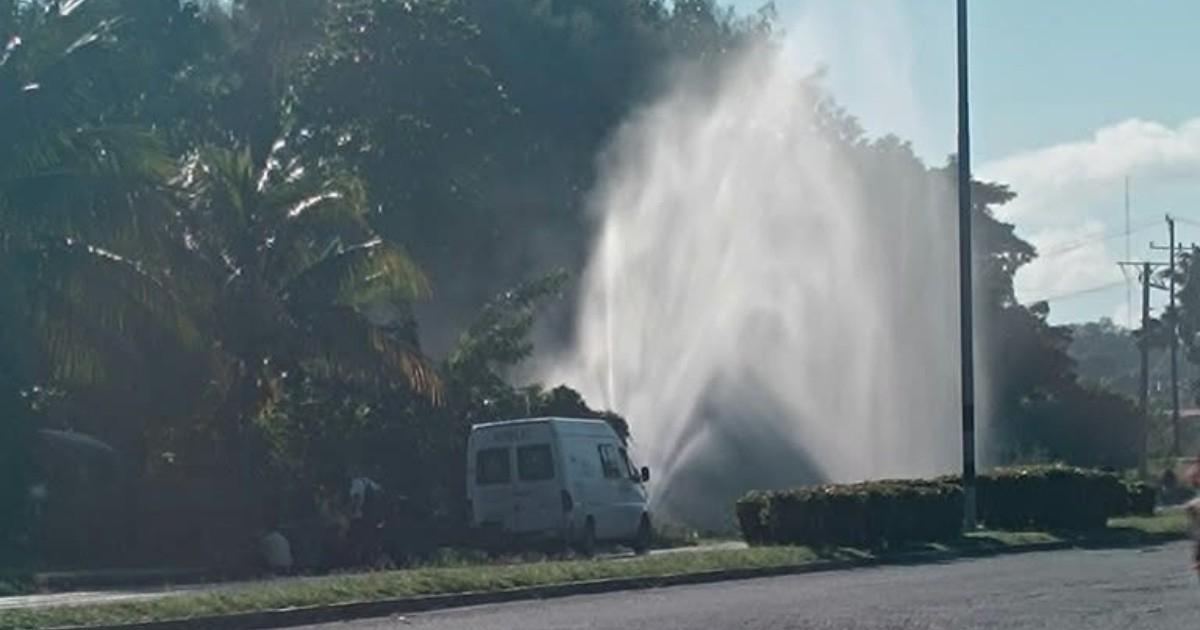
A vehicle from the Geominera del Centro company lost control of its steering, overturned, and broke a pipe from the Santa Clara Ring Road, resulting in what the Hydraulic Resources authorities described as "a large-scale leak" near the Social Workers' school.
According to the official report released by the provincial broadcaster CMHW this Friday on Facebook, the impact from the vehicle damaged the pipeline at a location that authorities described as "difficult to access," although local residents challenged that characterization on social media: "Difficult to access and it's right next to the road?" one of them wrote.
The authorities of the National Institute of Hydraulic Resources (INRH) reported that the breakdown causes a partial disruption of service in the neighborhoods of Virginia, Dobarganes, Subplanta, El Carmen, La Riviera, and other nearby areas, where the water will arrive with reduced pressure. At the time of the report, resources were being gathered for specialized brigades from Electromechanics and other companies to intervene and repair the break.
Residents who commented on the CMHW post indicated that it passed through the area at seven in the morning and at eleven, and that the water leak remained the same. Another neighbor raised an alert about a second leak on the road to Sakenaf, where the supply line connecting to the Defense school is situated. "In Camacho, we have been 74 days without water and no one is speaking up," wrote a resident of the neighborhood.
The incident adds to a structural water crisis that has been ongoing for months in the capital of Villa Clara. This very Friday, the Minerva-Ochoíta system — the main source of supply for numerous neighborhoods in the city — was operating with only three of its eight pumping units, due to the failure of a soft starter in the electrical panel.
To alleviate that parallel situation, teams from the Aqueduct and the Hydraulic Works Repair Company carried out maintenance work on valves located on Circunvalación, Subplanta, and near the old Coca-Cola factory, with the aim of transferring water from the Palmarito and Agabama systems to the neighborhoods dependent on Minerva-Ochoíta over the weekend.
In May 2026, residents of Santa Catalina, Capiro, Los Moros, and Camacho reported distribution cycles exceeding 30 days, with some cases going as long as 90 days without receiving water. On a national level, the Cuban government itself acknowledged in 2024 the existence of between 2,500 and 3,000 active leaks in the network, facing challenges in repairs due to a lack of parts and raw materials.
Related videos:
Filed under: