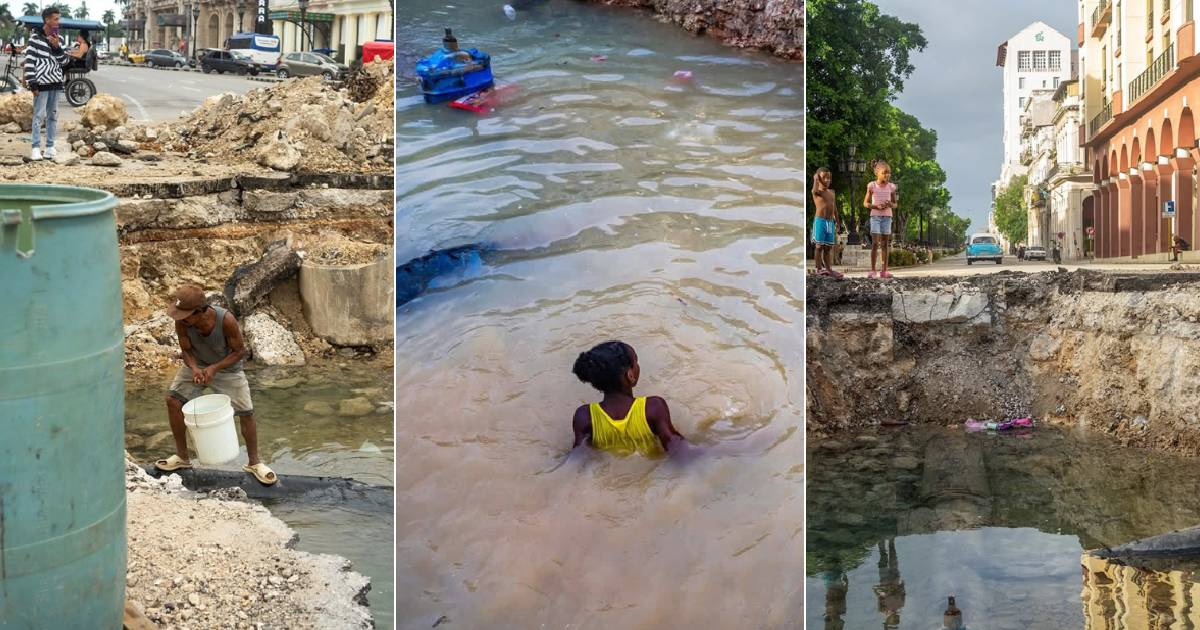
A large excavation filled with standing water has been left open for weeks at the intersection of Prado and Neptuno streets in downtown Havana, where children have been seen bathing and playing unsupervised in the hole.
The photographer Alina Sardiñas explained this Thursday on Facebook that she arrived at the location to photograph people collecting water from a pipe or spigot that emerges from the middle of the excavation. Some came with large tanks and filled their containers by the bucketful; some intended the water for consumption, while others sold it.
"Everyone makes do as best they can. We have reached the point where chaos also provides," wrote Sardiñas, who described how the arrival of children briefly transformed the scene of decay into a space of fun.
The photographer recounted that while documenting those collecting water, several children appeared who discovered a kind of beach, lake, or river in the enormous pit in the middle of the city. In her images, children can be seen playing next to the excavation and swimming in the water collected inside it.
Sardiñas recalled a photograph of children in Syria playing inside a flooded crater after a bombing. The image came to mind as he gazed at the scene in Havana, although he pointed out a difference between the two scenarios: in Prado and Neptuno, the disaster stems from the deterioration of infrastructure and the poor management of a system that, as he wrote, condemns the population to suffering.
"I thought that for children, there is almost always a way to evade the terrible, the bombardment, the mismanagement of a type of system that condemns a people to suffering," he expressed.
The photographs show an excavation between two and three meters deep, with exposed pipes, debris, and accumulated water. The hole remains unmarked and without safety barriers, just a few meters from the Parque Central hotel and the Central Park, at one of the most well-known intersections in the capital.
The writer and journalist Jorge de Mello also reported on the situation on Facebook and described the decay as yet another example of the deterioration of Havana. "A while ago, Havana stopped resembling the elegant capital of Cuba that we all knew; now it resembles any city in Haiti," he wrote.
A witness who passed by the area expressed her outrage over a pipe that, she said, was leaking water. Sardiñas herself responded to De Mello, stating that the country is experiencing a regression and the situation is particularly tough.
The excavation also reflects the contradiction of a city where the scarcity of water compels residents to make use of any available source, even when it appears amid deteriorated infrastructure.
The problem is part of a broader crisis affecting the Havana hydraulic network. Built between 1908 and 1914 for a city with around 600,000 inhabitants, it currently serves nearly two million people and consists of approximately 1,755 kilometers of pipes deemed obsolete.
The main pipelines have accumulated between 60 and 70 years of use without adequate rehabilitation, while more than 40% of the water pumped is lost before reaching homes due to leaks.
In October, a sinkhole similar to this appeared in the Cerro municipality, with accumulated water, displaced grates, and broken asphalt. In August, a breakdown in a 78-inch pipe from the Cuenca Sur left several municipalities in Havana without water supply.
The Neptuno street also accumulates complaints about the deterioration of its conditions. In June, a video showed the street practically blocked by trash and debris, while this Friday, residents alerted about piles of waste, worms, and rodents in that same artery of Centro Habana.
The president Miguel Díaz-Canel acknowledged that the water crisis in Cuba is "real, serious, and complex" and that it cannot be resolved "with just a speech or a single measure." The government announced new rehabilitation works and , but without providing specific timelines for the heart of the capital.
At the beginning of November, 2,681,770 people across the country were experiencing interruptions in their water supply, including approximately 536,000 in Havana, according to data from the National Institute of Hydraulic Resources.
Related videos:
Filed under: