
Related videos:
An official statement regarding technical reviews in the Minerva Ochoíta system published this Saturday immediately sparked numerous citizen criticisms, describing an ongoing water supply crisis in multiple neighborhoods of the city of Santa Clara, in the province of Villa Clara.
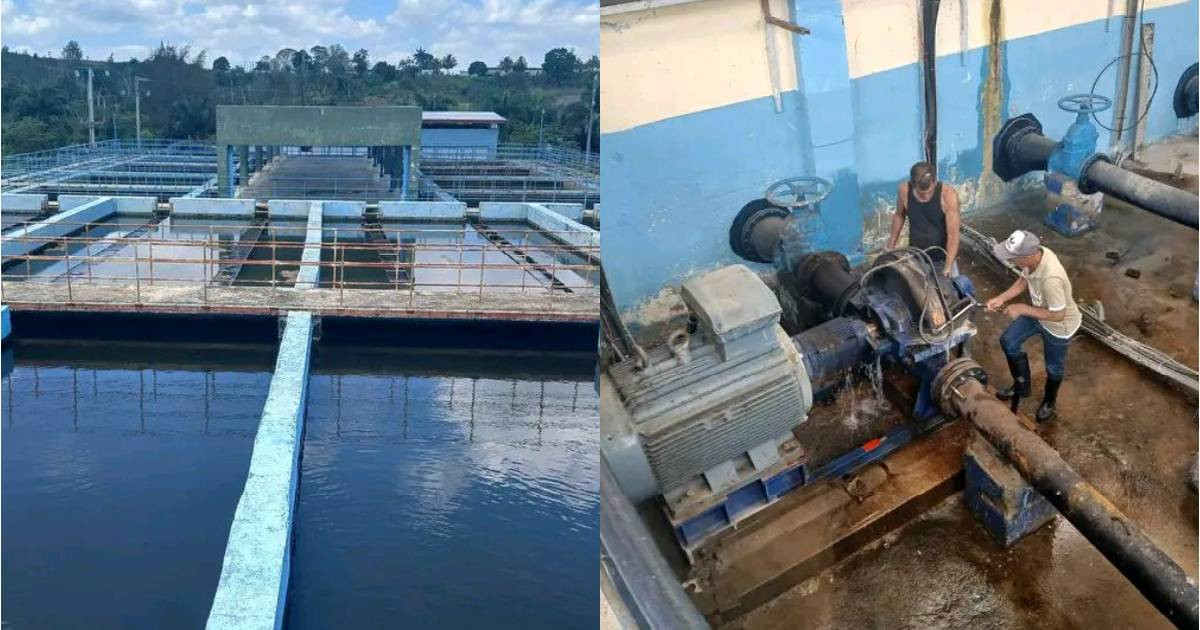
The brief statement, posted by the Santaclareño Facebook page, sought to present the situation of the Minerva Ochoíta system as a routine technical review, pointing out "dissatisfactions" in the upper area of the Capiro neighborhood and announcing work on one of its pumps.
But rather than being confined to a specific area, the testimonies point to a widespread crisis affecting numerous neighborhoods in the capital of Villa Clara.
Residents from several neighborhoods reported an acute crisis in water supply, with distribution cycles exceeding 30 days and, in some cases, reaching up to 90 days, according to testimonies.
The main focus of the complaints is the Minerva-Ochoita system, which serves as the backbone of supply for a large part of the city, providing resources to the neighborhoods of Santa Catalina, Capiro, Los Moros, Camacho, Escambray (Doble Vida), and Universidad, among others.
"Not just El Capiro, but almost all neighborhoods, which make up more than half of Santa Clara, have cycles longer than 30 days," denounced Gretter Cabrera, a resident of the city.
Luis Alonso, a resident of 2nd Street between H and J in Santa Catalina, specified that six buildings—numbers 31, 32, 33, 34, 38, and 40—have been without supply for 31 days since April 1st.
They retain the water so that a group of people can supply themselves at all times with their own turbines, denying access to others. The cistern is a common good, and it has been turned into the private property of a few. This is the level of corruption that exists in this place, wrote Alonso.
Yanet Rodríguez Molina, from the upper part of Santa Catalina, stated that her area has gone five cycles without receiving water and that the EXPRESO system is not working, nor are support trucks arriving.
"If the system operates without quality due to the pumps, and despite this, they leave it on for five or six days in the same area to see if magically the water arrives, nothing reasonable is being done. What is the solution?" he asked.
The Universidad neighborhood reports more than two consecutive months without water. "They say the pumps are working, but where is the water? Please have some awareness and honesty in what you say," demanded Nuris Suárez.
The most noted paradox by the neighbors is that the crisis worsened precisely after the modernization of the system. At the end of 2024, the authorities installed new pumps with great fanfare, but the improvement never materialized.
"It seems incredible that before modernizing these pumps, there were never any issues with pumping, and it turns out that despite the fact that the installed pumps are new, we never have service and the cycle keeps getting longer each day," wrote Naima Martínez López from the Escambray neighborhood (Doble Vida).
Ibraim Ruiz was more straightforward in admitting that he had "doubts about the proper functioning and management of water in Santa Clara."
The aqueduct's responses are also unconvincing. Oscar Coca Bernal recounted that, after many days without water, the company explained to him that "it was a poorly handled valve," and added: "they clean up with the complaints from the population."
Neighbors of the Camacho neighborhood are also demanding solutions due to the lack of water, reminding that among those affected are elderly individuals, bedridden patients, and children.
"I get palpitations every time I read something about Minerva Ochoita; how long will the neighborhoods that depend on this system remain thirsty? The fact is that they have never fulfilled the water supply cycles," summarized Zenia Rodríguez, with a statement that encapsulates the frustration of thousands of residents in Santa Clara.
The situation in Santa Clara is not an isolated case. In Matanzas, more than 300,000 people lack stability in their water supply, and in Cienfuegos, residents report contaminated water mixed with mud due to the deterioration of the pipelines.
In Havana, desperation drove some residents to set trash bins on fire to attract firefighters and get water from their trucks.
Data from the Food Monitor Program from mid-2025 indicates that 43% of Cubans received water every three days or more, and over 3.1 million people (30% of the population) face total or partial lack of service, a crisis that the organization qualifies as a chronic humanitarian emergency.
The supply problems in Santa Clara are neither new nor recent. In January 2023, a breakdown of pumping equipment left over 86,000 people without water in the city, and in June 2024, desperation led Villa Clara residents to block a road in protest for the same reason.
Filed under: