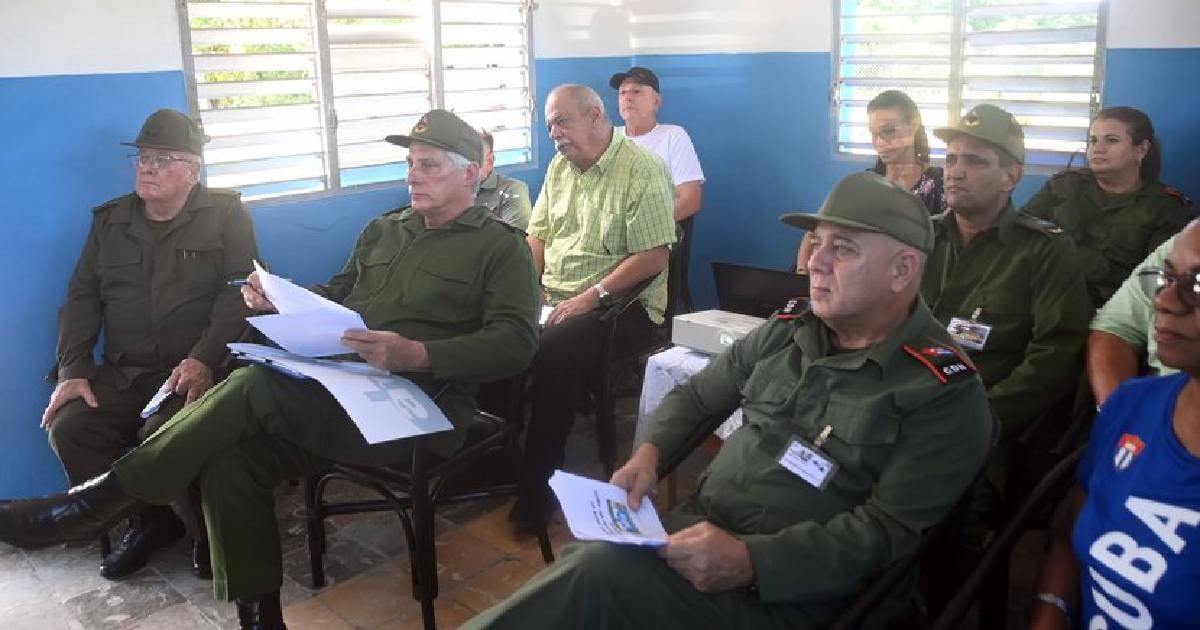
The ruler Miguel Díaz-Canel visited the Cuatro Caminos supply fountain on Thursday, in the Cotorro municipality of Havana, where the government promises improvements after acknowledging that two out of the seven wells in the facility remain out of service.
The inspection, reported by the official site of the Presidency of Cuba, is part of the Comprehensive Water Supply Assurance Program in Havana, launched in August and subsequently extended to include the analysis of other provinces.
This is another visit by Díaz-Canel to hydraulic facilities in the capital since August. During this period, he also toured the supply sources of Paso Seco, Cuenca Sur, El Gato, and Cosculluela, without any noticeable improvement in the situation for many Havana residents.
José Antonio Hernández Álvarez, president of the Superior Organization of Business Management (OSDE) Water and Sanitation, explained that Cuatro Caminos has undergone a major rehabilitation from a civil perspective and that electrical improvements are being implemented to stabilize the service.
The executive specified that work is underway on a transformer to incorporate two wells that are currently out of service, as well as the construction of an exclusive section of power line that will connect the seven wells of the facility to the same circuit.
Five of them operate within the prioritized circuit. When only those remain operational, the municipalities of Habana del Este and Guanabacoa experience disruptions in supply. Hernández assured that the works will lead to greater stability and a significant improvement in the service.
During the visit, Díaz-Canel emphasized that officials must be present in areas where there are discontent among the population to provide explanations and "communicate with honesty and with their chests out." He also inquired about the situation in Santiago de Cuba and the municipality of Manzanillo in Granma, stressing the need to expand photovoltaic sources.
In the meeting, the Vice Prime Minister Inés María Chapman Waugh, the Minister of Energy and Mines Vicente de la O Levy, the President of the National Institute of Hydraulic Resources (INRH) Antonio Rodríguez Rodríguez, and the Governor of Havana, Yanet Hernández Pérez, among other officials, participated.
The visit came after Díaz-Canel publicly acknowledged that the water crisis in Cuba is "real, serious, and complex" and that it cannot be resolved "with just a speech or a single measure," during the fourth radio program "Criterio Compartido," aired on Wednesday by Radio Rebelde.
The magnitude of the problem was reflected in the data provided by the INRH. By dawn on Monday, 2,681,770 people were affected by interruptions in the water supply through networks across the country. Of these, approximately 536,000 were in Havana. Sixty-six percent of the disruptions were attributed to electrical issues, while 25% were due to equipment breakdowns.
In that same radio space, the director of Aguas de La Habana, Yosvany Rubí Bazail, revealed that two individuals were undergoing criminal proceedings for the illegal manipulation of valves in Arroyo Naranjo, marking the first public judicial process related to the current water crisis.
While the authorities are increasing supervision visits and announcing investments, citizens have launched solidarity campaigns to send filters and water purification tablets to families in need, in neighborhoods where some areas have been without drinking water for over six months.
As part of the announced solutions, the government plans to complete 10 solar photovoltaic parks, with a total capacity of 200 MW, intended for the three main supply sources of Havana. The deadline to finish these installations is set for August 2027.
Related videos:
Filed under: