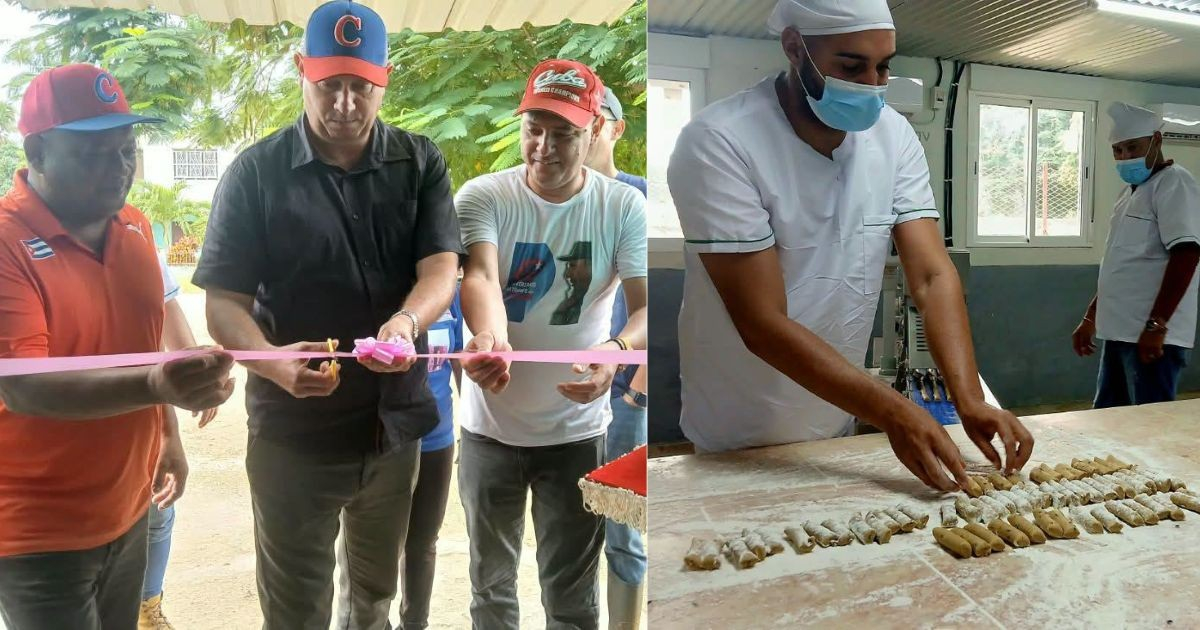
The Cuban regime has a new reason to celebrate: in the municipality of Chambas, province of Ciego de Ávila, a dairy farm and a food processing center were inaugurated, aimed at producing croquettes, sausages, ground meat, and other assortments.
The announcement, published this Friday by Julio Gómez Casanova, the first secretary of the Communist Party in the province, was accompanied by flags, a ribbon-cutting ceremony, and all the pomp that such a monumental achievement deserves.
According to Gomez Casanova's post, seemingly based on information from the Radio Surco broadcaster, the facilities "are part of the actions implemented by the municipal agro-industrial company through the Economic and Social Transformations (TES)" and with them "the goal is to diversify and expand food offerings for the population, strengthening local production and bringing products closer to the people."
Beautiful words. It's a pity that reality has a habit of not reading official statements.
The TES are the package of 176 measures approved by the Cuban government in June of this year to try to revive a terminally ill economy; of these, the vast majority are directly or indirectly related to agriculture.
A day before the inauguration, as reported by Radio Surco itself, officials were monitoring the implementation of those same measures in agricultural entities in Ciego de Ávila. Everything was thoroughly verified, everything was well checked, everything was officially inaugurated.
The problem is that Ciego de Ávila has a dairy history that does not inspire optimism. In June of this year, the dairy industry in that province was receiving only between 4,800 and 5,000 liters daily compared to the 33,700 liters expected in the plan — approximately 15% of what was planned —.
On a national scale, milk production fell by 58% between 2018 and 2023, and the cattle herd lost more than 900,000 heads since 2019. But well, now they have a new dairy farm in Chambas, so everything is sorted.
Cuban citizens quickly responded with sharp irony. "Price of croquettes? 2,500 each?" asked one internet user. "Are we going to have milk for everyone?" inquired another, to which a third one replied, "There's none for medical diets, imagine for everyone."
Someone suggested creating "a list to see how many retirees can buy ground meat and sausages," and another voice broadened the scope of those excluded: "Don't say retirees; it includes active workers as well." The most striking conclusion came without any hesitation: "The prices when they reach the consumer are unattainable."
The doubts are based on arithmetic. The minimum wage in Cuba is 3,210 pesos per month, which is equivalent to just over three dollars at the informal exchange rate, while basic food requirements range between 50,000 and 90,000 pesos per month according to independent estimates. Cubans are already substituting rice for yuca due to the inability to afford a basic diet.
The distrust in prices is compounded by a lack of confidence in the product itself. In August 2025, it was reported that in a packaging unit in Havana, the croquette mixture was placed directly on the floor and damaged croquettes were reused due to power outages, mixing them with new dough to mask the bad odors.
A user summed it up with dark humor: "Those croquettes will either send you to the bathroom or to the hospital."
While the regime inaugurates facilities with triumphant hashtags, a survey by the Food Monitor Program and Cuido60 presented in May 2026 revealed that 33.9% of Cuban households had at least one member who went to bed hungry in the previous 30 days.
"Another achievement, blah blah blah, just lies," wrote a Cuban in the comments. It's hard to argue against that.
Related videos:
Filed under: