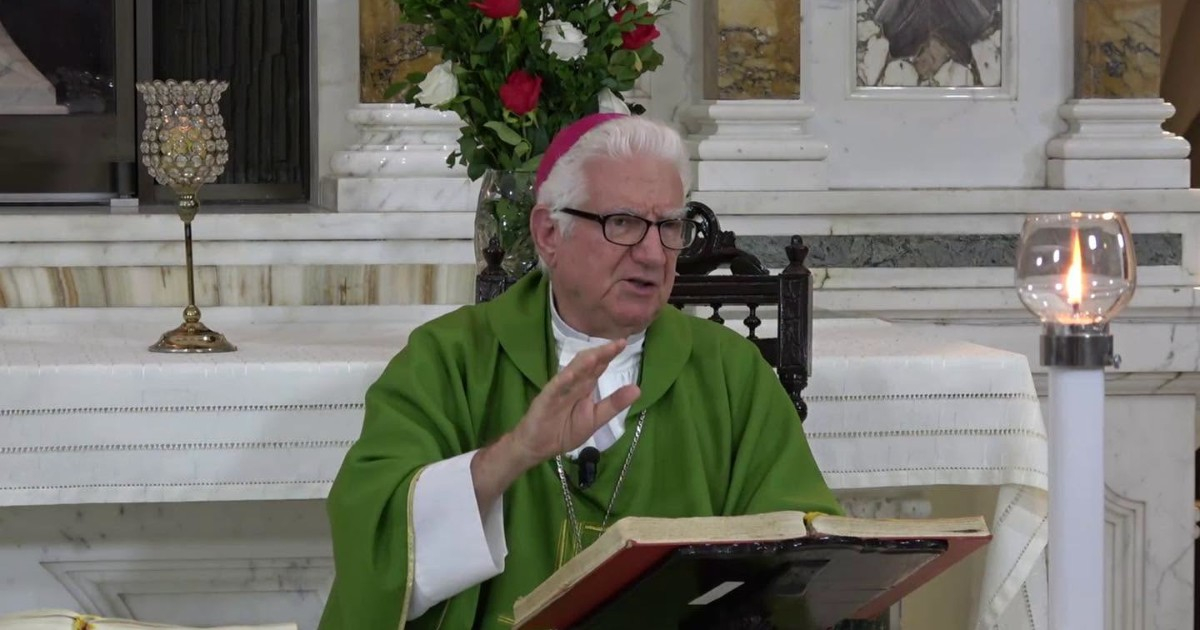
Monsignor Dionisio García Ibáñez, outgoing archbishop of Santiago de Cuba, urged this Sunday to seek the truth, reflect on the meaning of existence, and not be swayed by the actions of others, during a homily in which he emphasized the importance of thinking for oneself.
“We must seek the truth, we must question life; we cannot just live for the sake of living”, the clergyman asserted during the mass held at the Basilica Sanctuary of Our Lady of Charity of El Cobre.
The prelate devoted a good portion of his reflections to explaining the relationship between wisdom, reason, and the Christian faith, and he advocated for the necessity for each person to question why they live, what they do with their existence, and what their destiny is.
While commenting on the biblical readings, he recalled that human beings have the capacity to discover reality, formulate questions, and seek answers, rather than simply accepting what happens around them.
“Who is the one that finds? The one who seeks”, García stated, before delivering the phrase that encapsulated one of the main messages of his speech.
The clergyman also referred to a well-known popular saying to question the habit of following others without stopping to think.
“Where is Vicente going? Where the people go”, he recalled, and warned against that way of behaving.
"Because the Lord has given us reason, He has given us intelligence, He has given us will, He has given us love to seek and live according to love," he explained.
In that same passage, he emphasized that “we cannot say the world lives this way and I live this way”, as he believes that each individual must examine their decisions and take responsibility for their own life.
To illustrate his message, he used the evangelical parable of the wise and foolish virgins, in which some prepared to receive the bridegroom while others neglected their responsibilities and ended up being left outside the celebration.
García presented that teaching as an invitation to remain vigilant, seek wisdom, and not let time pass without reflecting on the purpose of existence.
His words take on special significance in a Cuba where civil society, regardless of their religious beliefs, is constantly exposed to the political propaganda of the regime.
He also spoke about death and the Christian hope in resurrection. While recalling a mass he had celebrated in a cemetery during the commemoration of the faithful departed, he stated that those who believe in Christ do not view life as ending with death.
"Our life cannot be the cold darkness of a grave," he expressed, urging the faithful to maintain hope even in the face of difficulties.
The statements come just one day after Pope Leo XIV accepted his resignation from the pastoral leadership of the Metropolitan Archdiocese of Santiago de Cuba.
The decision, announced on Saturday, includes the appointment of Monsignor Juan Gabriel Díaz Ruiz, until then the Bishop of Matanzas, as the new Metropolitan Archbishop of Santiago de Cuba.
García, 81 years old, had submitted his resignation in 2020, when he turned 75, the age established by canon law for bishops to offer their resignation.
However, he remained at the helm of the archdiocese, which he had been leading since February 2007, until the pontiff's decision.
During his final months leading the Santiago Church, the religious leader had delivered much more direct messages about the national reality.
In May, he stated from the sanctuary of El Cobre that "Cuba needs to change" and called for measures capable of transforming the living conditions of the population.
"We know that we have to change. At the beginning of the mass, I said that we all have to change, and Cuba has to change, and there must be measures that change the situation in the country," he stated.
More recently, on October 11, he described the difficulties faced by Cuban families with a phrase: “We are not well, we don’t know how to get out of this”.
In that homily, he mentioned the shortage of medications, insufficient salaries, difficulties in obtaining food, and the suffering caused by diseases such as dengue and chikungunya.
It also referred to those who, amidst precarious conditions, are forced to search for food in the trash.
Related videos:
Filed under: