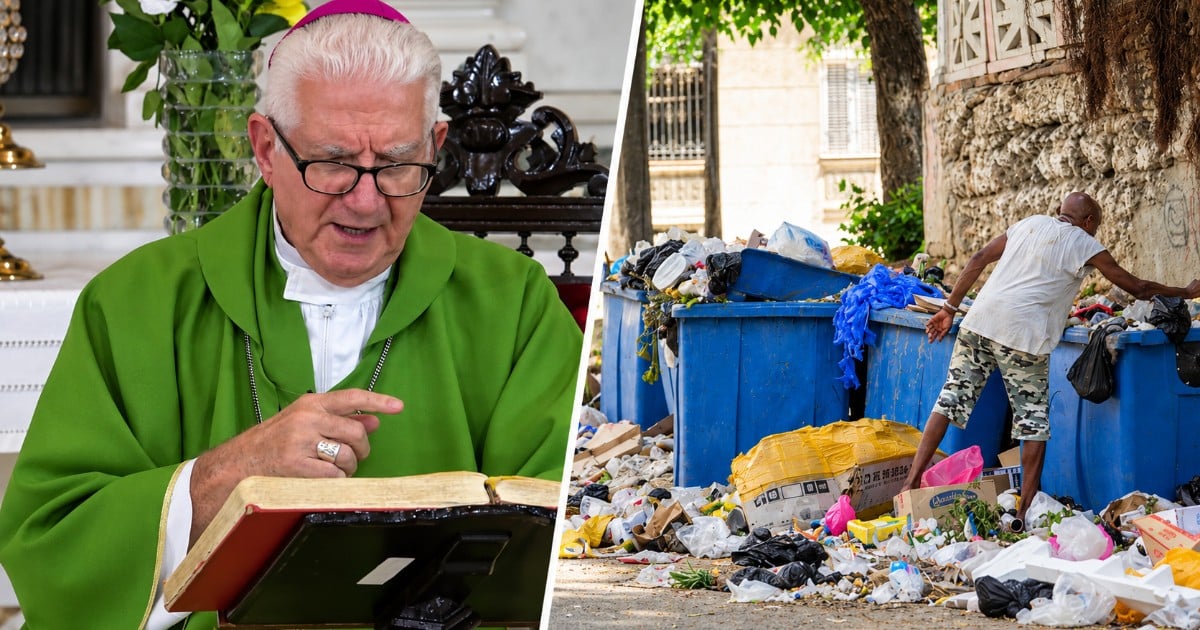
The Archbishop of Santiago de Cuba, Monsignor Dionisio García Ibáñez, described this Sunday, October 11, the harsh living conditions on the island and summarized the uncertainty of many families with one phrase: “We are in a bad situation, we don't know how to get out of this”.
During his homily at the Basilica Sanctuary of Our Lady of Charity in El Cobre, the prelate spoke about the shortage of medicines, insufficient salaries, the difficulties in obtaining basic necessities, and the suffering caused by diseases such as dengue and chikungunya.
When reflecting on the message of hope found in the biblical readings, he even mentioned "those who are scavenging for food in the trash." For the archbishop, faith should provide support specifically to those who are experiencing such hardships, rather than distancing them from the reality they live in.
Eight total outages of the SEN and extreme blackouts in 2026
The statements come after a year of serious electrical problems. The CiberCuba Blackout Observatory, which organizes reports from the Electric Union (UNE) and other entities in the sector, counts eight total disconnections of the National Electric Power System (SEN) in 2026. The most recent occurred on September 18, when a failure in high-voltage lines caused another collapse of the national grid.
Power outages due to lack of generation have also been persistent. An analysis by CiberCuba of the official reports between September 3 and October 2 found that 23 out of the 28 days with comparable data exceeded 2,000 megawatts (MW) of actual maximum impact, meaning the electricity demand that the system could not meet.
The eastern region, where the archbishop delivered his homily, experienced another significant interruption just one day prior. On Saturday, October 10, a fault in the Nuevitas-Las Tunas transmission line caused a partial disconnection that affected Las Tunas, Holguín, Granma, Santiago de Cuba, and Guantánamo. The UNE later announced the restoration of regional interconnection.
For this Sunday, October 11, the SEN tracking reported an official forecast of 1,775 MW of maximum impact due to a generation deficit, highlighting that restoring the interconnection does not mean an end to blackouts.
Insufficient salaries and inflation: the economic crisis behind the archbishop's words
Revenues constitute another part of the problem. The Cuban government set the in July 2026. The average salary of the civil state sector was 6,930 CUP per month in 2025, according to figures from the National Office of Statistics and Information (ONEI). Both indicators correspond to different concepts and periods, but they help to gauge the available income in many households.
The loss of purchasing power continues with the rising cost of basic products. According to the official statistics from ONEI, the year-on-year inflation reached 25.19% in August 2026, and food and non-alcoholic beverages accounted for 72.77% of the monthly increase in the consumer price index.
An example of the contrast between salaries and prices was documented in Trinidad, Sancti Spíritus, where a carton of 30 eggs was sold for 4,500 CUP in mid-September: more than the minimum wage for an entire month. This is a price observed in a specific place and time, not a uniform rate for the country.
The crisis is also reflected in national production. The Cuban Economy Studies Center at the University of Havana estimated that the economy contracted by about 5% in 2025, marking its third consecutive year of decline. Its researchers pointed out energy problems and pending productive reforms as factors hindering recovery.
In his homily, García Ibáñez urged the faithful to face difficulties without resignation and to seek justice and peace. His religious appeal was directed both to those living in Cuba and to Cubans outside the island, united by concern for the suffering of their fellow countrymen.
Related videos:
Filed under: