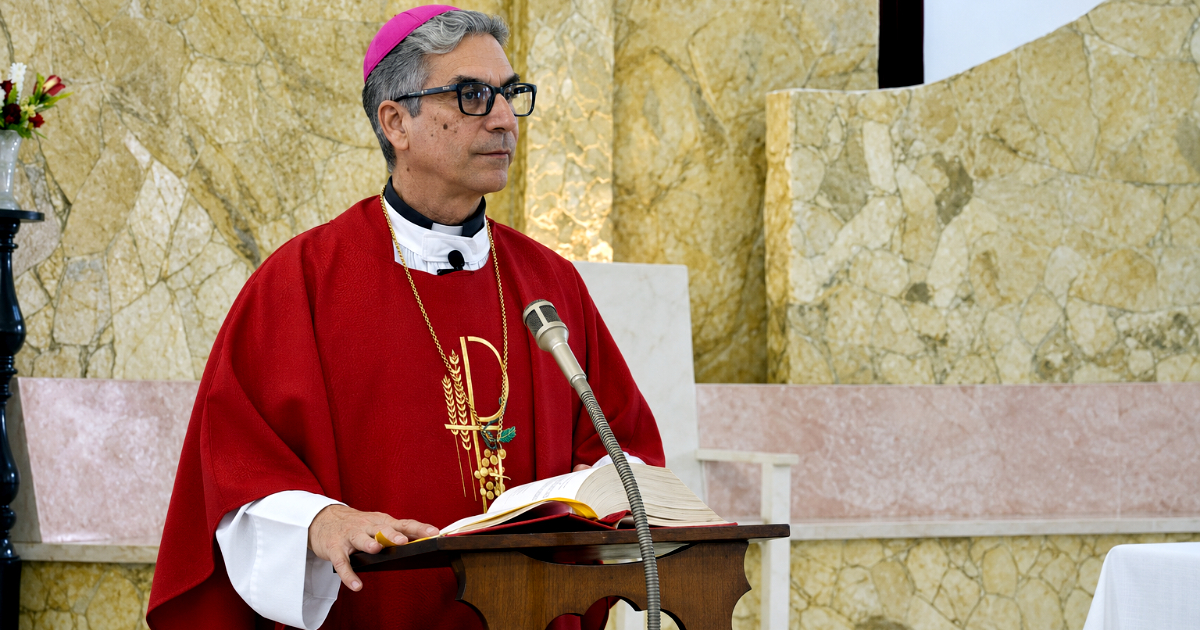
Pope Leo XIV appointed Monsignor Juan Gabriel Díaz Ruiz as the new metropolitan archbishop of Santiago de Cuba this Saturday, as officially announced by the Holy See.
The pontiff simultaneously accepted the resignation of Monsignor Dionisio Guillermo García Ibáñez, who led that archdiocese for nearly two decades.
The change comes just four weeks after García Ibáñez delivered one of his most poignant homilies on the Cuban crisis, in which he summarized the country's situation with a phrase that spread across social media: «We are in a bad situation, and we don't know how to get out of this».
García Ibáñez, 81 years old, had submitted his resignation in 2020 upon reaching the 75 years mandated by canon law, but he continued to lead the archdiocese until this papal decision. Benedicto XVI appointed him in February 2007 to head the oldest metropolitan see in Cuba, founded in 1522.
Throughout 2026, the outgoing archbishop intensified his criticisms of the regime at a pace that unsettled the authorities.
In May he demanded that "Cuba has to change"; in July he acknowledged the widespread exhaustion with the words, "There are so many people asking for help. And the help is not enough."
In September, he called for «urgent structural transformations» and stated that «no people deserves this situation». His homilies never directly mentioned the government, but his message was clear.
This tension between the clergy and the regime is not confined to Santiago.
The priest Alberto Reyes Pías described the Church as the "uncomfortable neighbor" that the authorities have been unable to silence; State Security summoned and interrogated him in January 2026 and threatened him with prosecution in May. The Conference of Catholic Bishops of Cuba, for its part, warned earlier this year that the country needs "increasingly urgent" changes and alerted about the risk of "social chaos."
Díaz Ruiz was born on November 14, 1960, in Céspedes, in the Archdiocese of Camagüey. Before embracing religious life, he studied Civil Engineering at the University of Camagüey. He pursued Philosophy and Theology at the San Basilio Magno and San Carlos and San Ambrosio seminaries, and obtained a degree in Sacred Scripture from the Pontifical Biblical Institute in Rome.
He was ordained a priest on August 5, 1989. Pope Francis appointed him bishop of Ciego de Ávila in July 2017 and transferred him to the Diocese of Matanzas in April 2022. At the time of his appointment as archbishop, he was serving as vice president of the Conference of Catholic Bishops of Cuba.
The congratulations from the U.S. Embassy and humanitarian assistance
The United States Embassy in Cuba congratulated Díaz Ruiz this Sunday and revealed that last week it had met with him, with María de los Ángeles Castelo, coordinator of Cáritas Matanzas, and with volunteers from the organization. "We hope to continue working together to bring this help to those who need it most," the diplomatic mission stated.
The meeting is part of the largest U.S. humanitarian assistance program for Cuba in decades: 100 million dollars announced in May 2026, of which 60 million is channeled through Cáritas Cuba, Catholic Relief Services, and the network of the Catholic Church, without mediation from the Cuban government.
Since July 2026, shipments have reached multiple provinces —Havana, Matanzas, Pinar del Río, Cienfuegos, Camagüey, and Ciego de Ávila— distributing food and hygiene modules to vulnerable families selected directly by Caritas.
Díaz Ruiz, as the bishop of Matanzas, was already directly involved in that distribution before taking on his new position in the eastern archdiocese.
The appointment also comes at a time of crossed diplomatic gestures: in October 2026, the regime formally invited Pope Leo XIV to visit Cuba, while the Holy See maintains open channels with Havana following the acceptance of García Ibáñez's resignation and the appointment of his successor.
Related videos:
Filed under: