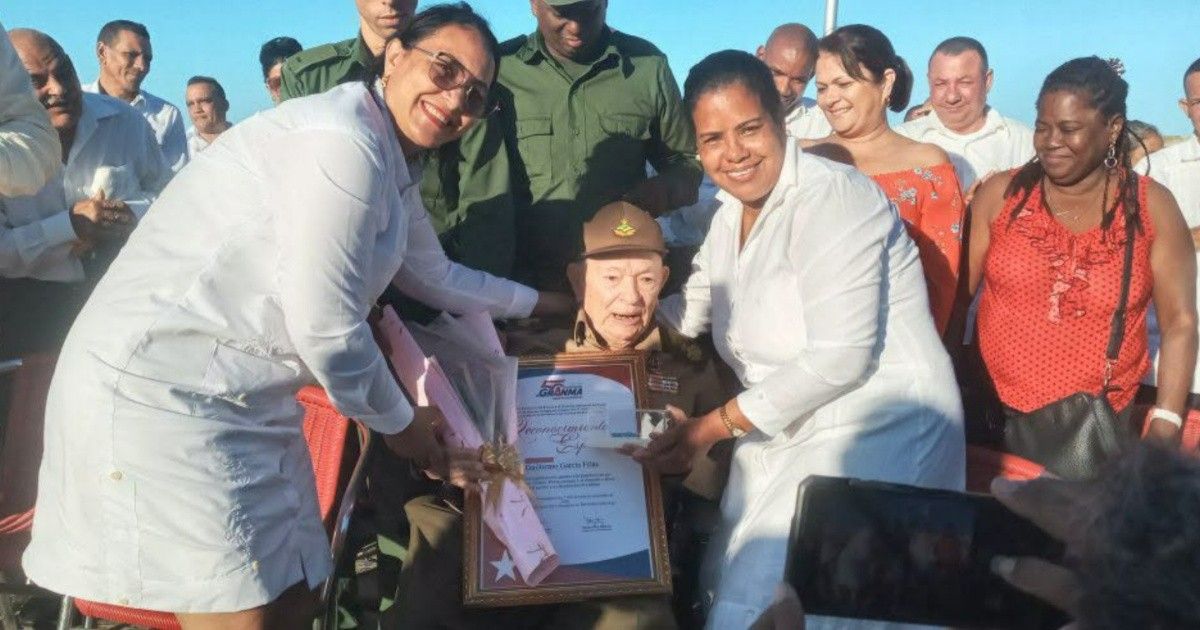
The Commander of the Revolution Guillermo García Frías, aged 98, was presented this Saturday as the central figure of the commemorative events for the 50th anniversary of the creation of the five eastern provinces of Cuba, held at the La Demajagua Museum Park, in the province of Granma.
The images shared by Radio Ciudad Monumento and by Yudelkis Ortiz, the first secretary of the Communist Party in Granma, on social media show a visibly deteriorated man sitting throughout the ceremony in an olive green military uniform and a military cap. Frías appears in a wheelchair, assisted by support staff while receiving greetings from those present.
During the event, García Frías received a replica of the badge of Carlos Manuel de Céspedes and an acknowledgment from the official newspaper Granma. Ortiz's publication described his attendance in reverential terms: "We had the honor of having the presence of the Commander of the Revolution Guillermo García Frías, who esteemed and added incalculable value to this sublime and special significance."
The commemoration recalls the ceremony of November 7, 1976, when Fidel Castro presided over the establishment of Las Tunas, Holguín, Granma, Santiago de Cuba, and Guantánamo as independent provinces at that same historical site, as part of a political-administrative reorganization that increased the number of Cuban provinces from six to fourteen.
The appearance of García Frías reflects a recurring pattern of the regime: showcasing the last survivors of the so-called "historical generation" as symbols of legitimacy and revolutionary continuity, despite their obvious physical decline. His most commented public reappearance was in April 2025, when at the age of 97 he inaugurated an assisted reproduction laboratory for livestock in Camagüey. In July of this year, he was seen at the National Assembly with a personal assistant and a hearing aid.
With the death of Ramiro Valdés on June 21st at the age of 94, the circle of historical figures from the Castro regime has dwindled to just a handful of elderly individuals: Raúl Castro, 95 years old; José Ramón Machado Ventura, 96; and García Frías himself, the oldest of them all at 98.
The event in La Demajagua also included the recognition of founders and personalities from the five eastern provinces, as well as the unveiling of a commemorative postage stamp. The site was chosen for its symbolic significance: it was here that Carlos Manuel de Céspedes issued the Grito de Yara on October 10, 1868, marking the start of the first Cuban war of independence.
García Frías, who joined the Rebel Army after the arrival of the Granma yacht in December 1956 as the first farmer to join Fidel Castro's forces, has been directing the Flora and Fauna Business Group since 1993, which manages more than 80 protected areas on the island. In September, this entity was criticized for the neglect of the protected area Sierra del Chorrillo in Najasa, Camagüey, where, according to a complaint on social media, "practically nobody is working anymore."
Related videos:
Filed under: