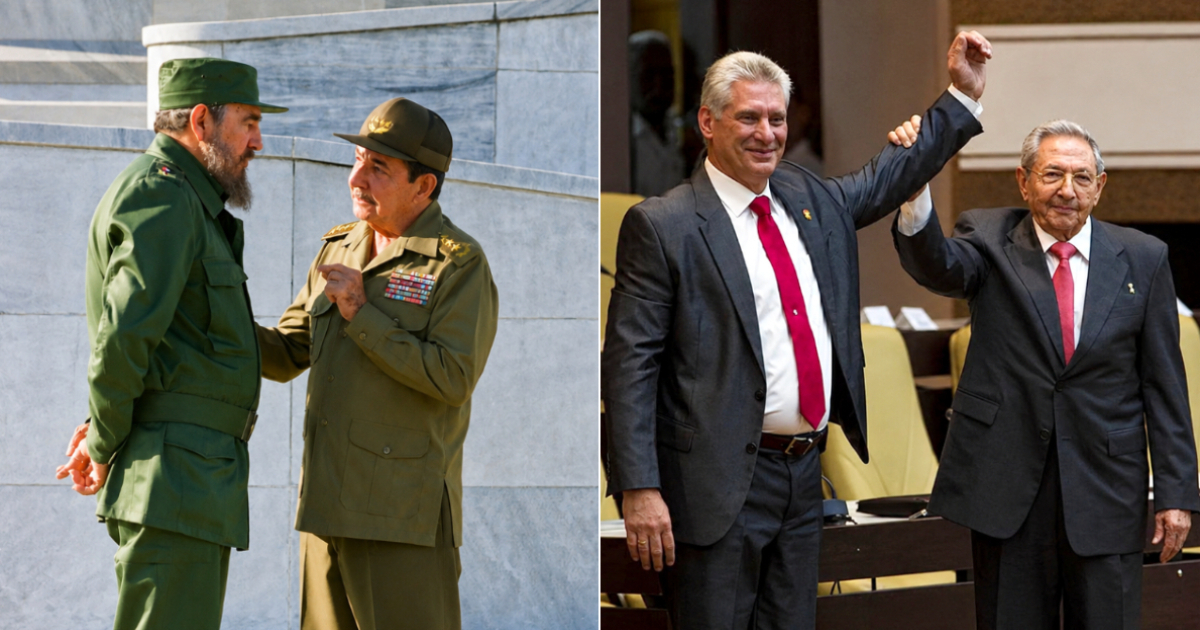
«Continue with one foot in the stirrup. Command!». With these words, Miguel Díaz-Canel addressed Raúl Castro in May 2026, during an official campaign supporting the former leader, who was about to turn 95 years old.
The phrase may appear to be a simple expression of admiration for his predecessor. However, when spoken by someone who simultaneously holds the presidency of the Republic and the first secretary position of the Communist Party of Cuba (PCC), it contains a political contradiction: the highest institutional leader of the country publicly invites a man retired from his positions to continue giving orders.
It was not an isolated incident. In September, the official propaganda once again presented Raúl as a fighter "with a foot in the stirrup". And this Monday, while congratulating José Ramón Machado Ventura on his 96th birthday, Díaz-Canel stated that the veteran leader was still "active on the front line".
The so-called "continuity" seems intent on proving that its founders are still in charge, even after having formally succeeded them.
The insistence raises a question that transcends the rhetoric of tributes: where does Díaz-Canel's political authority come from, and what legitimacy can his government claim when the leaders who spearheaded the so-called "Cuban revolution" have completely disappeared?
Inheriting power does not mean inheriting authority
Fidel Castro built his leadership around the revolutionary victory, personal charisma, and the progressive concentration of political power. Raúl added to that legacy his involvement in the guerrilla struggle, his command over the Armed Forces, and decades of influence in the organization of the state and the prominence of the military in the economy.
Both claimed a legitimacy of origin linked to the defeat of the dictatorship of Fulgencio Batista and to the political transformation of 1959. This legitimacy was later used to justify the persistence of the one-party system, even when the country and its historical circumstances had changed radically.
Díaz-Canel does not share that foundational experience. His background is that of an official trained and promoted within the apparatus established by the Castros.
His rise to the presidency in 2018 and to the first secretaryship of the PCC in 2021 occurred through the institutional mechanisms of the regime itself. He took on the highest responsibilities of the State and the Party, but this transfer of positions did not necessarily imply the transfer of the personal authority accumulated by his predecessors.
The distinction is important. Power allows one to make decisions and enforce them; authority implies that those who receive these decisions acknowledge, for various reasons, someone's right to lead. Legitimacy refers to the justification of that right.
They are related realities, but not equivalent.
The "continuity" has institutionally resolved the succession of the Castros. What is more difficult to determine is the extent to which it has built its own legitimacy, independent of the historical authority of those who appointed it.
From there, the political significance of the tributes and messages directed at the last surviving members of the founding generation. They not only serve to remember their journey: they also help to position the current leadership as the bearer of a prior authority.
A Constitution that guarantees the permanence of power
The Cuban regime has another common argument to assert its legitimacy: the 2019 Constitution, approved in a referendum with the backing of 86.85% of those who voted, according to official results, equivalent to 78.30% of the electoral roll.
These figures represent an important part of the government narrative regarding popular support for the system.
However, the holding of a referendum does not, by itself, demonstrate that conditions for competition and political expression typical of a democracy existed.
The constitutional consultation of 2019 took place under the political monopoly of the PCC, without independent national media that could compete on equal footing with the official campaign.
The Inter-American Commission on Human Rights documented reports of intimidation, detentions, and assaults against activists who were promoting a negative vote.
The content of the Constitution itself reveals the limits of that consultation. Its article 3 establishes that sovereignty resides in the people, but article 4 declares the socialist system irrevocable —even going so far as to proclaim "the right to fight by all means, including armed struggle [...] against anyone who attempts to overthrow the political, social, and economic order established by this Constitution."
Following such a statement and legal aberration, Article 5 of the Constitution of the regime enshrines the Communist Party as the superior leading political force of society and the State.
Assuming that citizens could vote in favor of or against the Constitution—a hypothesis that the repressive reality of the regime situates within the realm of the systematic social coercion it exerts—what is certain is that they could not choose between alternative political systems nor establish mechanisms for multipartisan competition for power.
It is not about denying the millions of Cubans who voted in favor of the text—something as nonsensical as denying that Cuba is a dictatorship—but rather distinguishing that supposed support from a permanent democratic authorization to govern.
A favorable majority in a referendum held in 2019 does not equate to irrevocable consent from the citizens in 2026.
And even less so when the institutional system prevents a political alternative from legally contesting the government.
The transfer of power from Fidel to Raúl Castro and then from Raúl to Díaz-Canel was a succession within the same power structure, not a democratic alternation. The legality that regulates it comes from institutions designed to ensure the supremacy of the PCC.
This reality raises a fundamental issue: that a power constitutionally establishes the rules for its own continuity does not, in itself, resolve the problem of its legitimacy before the governed.
Cuba in 2026 and the consent of the governed
The political and social landscape of Cuba has changed significantly since the 2019 referendum.
The economic decline, blackouts, scarcity, mass emigration, and citizen protests have transformed the circumstances under which the regime asserts its authority.
The information landscape has also changed.
The development of independent media, the internet, and social networks allows many Cubans to compare the government narrative with testimonies, investigations, and information that do not come from official institutions.
The state retains a significant capacity for censorship, surveillance, and control over telecommunications, and access to the internet remains shaped by economic and political restrictions. However, it no longer has the almost absolute monopoly on information that characterized the early decades of Castro's rule.
This transformation is important for understanding the difficulties of maintaining a political narrative fundamentally based on the historical prestige of the so-called "revolution."
Independent surveys conducted in 2026 provide additional insights to the debate.
The Cuba Survey, disseminated by a coalition of over 36 media outlets, content creators, and civil society organizations, including CiberCuba, collected tens of thousands of responses both on and off the island.
Among the participants, approximately 92% expressed the highest degree of dissatisfaction with the government system, while 94% deemed a political change extremely urgent.
On a scale of five points, Díaz-Canel received an average rating of 1.1 and Raúl Castro 1.2.
These figures must be interpreted rigorously: the survey used a voluntary, non-probability sample, so its results cannot be presented as statistically representative of the entire Cuban population.
But they are not without significance. They document a very high level of rejection among thousands of people who participated in an independent survey, including a majority of residents in Cuba.
The information about Raúl Castro is particularly relevant to the issue of inherited legitimacy: among those surveyed, the low regard for the current leader is not accompanied by a favorable assessment of the historic leader he constantly invokes.
Another study, FOCO Cuba: Opinion, self-censorship, and civic action, conducted by Cubadata for Diario de Cuba between May and June 2026, surveyed 2,214 residents on the island with internet access.
60.4% of the participants considered a political change urgent, and 61.9% expressed fear of facing reprisals against themselves or their families. Additionally, 67.8% believed that citizens' responses would be different if they could express themselves without fear.
Although this study also has limitations in terms of representativeness, its results help to understand an essential difficulty in assessing consent in authoritarian systems: public obedience, silence, and the absence of protests are not sufficient proof of political support.
They also do not allow for an automatic deduction that all citizens who remain silent reject the government. What they demonstrate is that fear influences the expression of opinions and, therefore, the appearance of unanimity deserves critical examination.
In a country where organized opposition lacks legal means to compete for power and many citizens fear expressing their disagreements publicly, measuring political legitimacy requires more than just counting attendees at official demonstrations or reproducing statements of support for the PCC.
The external pressure and the limits of revolutionary discourse
The international context adds another dimension to the issue.
In October 2026, the Cuban regime faces a pressure campaign from the administration of Donald Trump, combining sanctions, economic restrictions, and political demands on the government of Havana.
Cuban authorities have acknowledged that they maintain channels of communication with Washington, although without formal negotiations, according to statements given to Reuters earlier this month.
The U.S. pressure provides the regime with arguments to reinforce its historical narrative of national resistance, sovereignty, and confrontation with an external enemy. The economic restrictions also have material consequences that should not be overlooked when assessing the Cuban crisis.
However, the existence of foreign pressures does not resolve the internal issues of political legitimacy.
Defending national sovereignty does not necessarily require the indefinite preservation of the same leaders, institutions, or party structures. It also does not turn citizens' demands for political freedom into expressions of subordination to foreign interests.
The sovereignty that the regime claims against Washington is precisely what the Cuban Constitution attributes to the people.
Tension arises when that sovereignty cannot be exercised through open political competition that allows for the replacement of those in power.
For this reason, the relations with the United States and the possibilities of negotiation or confrontation do not replace the central question: What mechanisms currently allow Cuban citizens to freely express their consent or withdraw their support for the political system?
When the last historical authority fades away
The death of Ramiro Valdés in June 2026, at the age of 94, once again highlighted that the founding generation of the regime is inexorably nearing its end.
Raúl Castro is 95 years old; Machado Ventura has just turned 96; Guillermo García Frías is 98. Their public presence has become increasingly ceremonial, although official institutions continue to recognize them as political figures.
"Continuity" has demonstrated its ability to preserve the fundamental structures of the system following the retirement of Fidel and Raúl Castro. The PCC maintains its political monopoly, while the Armed Forces, security agencies, and state institutions continue to be part of the power network.
The physical disappearance of historical figures does not necessarily mean the disappearance of those structures. A political organization can survive for a long time beyond its founders through institutions, succession mechanisms, networks of interests, and coercive capability.
But institutional survival should not be confused with democratic legitimacy.
Díaz-Canel can continue exercising the powers granted to him by the Cuban political system without receiving further orders from Raúl Castro. What he cannot automatically inherit is the supposed citizen recognition that his predecessors claimed for decades.
The official insistence on presenting veterans as still-active protagonists suggests that their historical authority continues to play a legitimizing role for the current leadership.
And there lies one of the most significant contradictions of the Castro succession: "continuity" is presented as proof that the regime can survive its founders, while it continues to rely on them to justify the authority of their successors.
Time will eventually resolve part of the problem. Raúl Castro, Machado Ventura, and the last survivors of that generation will fade from the political scene.
The question that will remain open is vastly different and much more important: what legitimacy can a system that has turned loyalty to its founders into one of its main credentials for governance claim when it continues to offer its citizens no democratic mechanisms to decide whether they wish to maintain it?
Because a generation can pass down responsibilities, institutions, loyalties, and even a specific conception of power. What it cannot transmit by inheritance is the consent of those who are called to obey it.
Related videos:
Filed under: