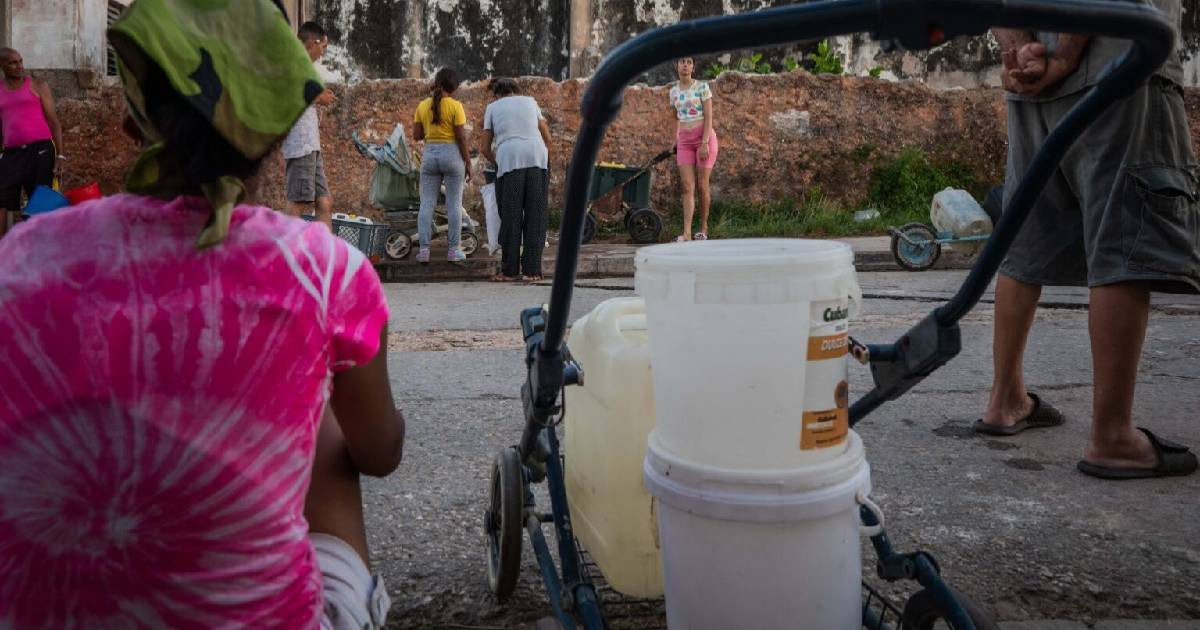
The First Deputy Prime Minister Inés María Chapman visited Matanzas to seek solutions to the water supply issues affecting 265,000 residents, according to a report this Sunday from the television center TV Yumurí.
Matanzas ranks second among Cuban provinces with the most people affected by the lack of regular access to water, behind only Artemisa. Authorities attribute the crisis to blackouts and the electricity generation deficit, which hinder the operation of pumping systems.
Chapman arrived accompanied by the director of the Electric Union, Rubén Campos Olmos, and executives from the National Institute of Hydraulic Resources. During a working meeting, she acknowledged that there are "many problems," but maintained that it is possible to restore the supply sources despite the country's economic situation.
"We must first identify the main sources at the provincial headquarters and in the municipalities," stated the official, who urged for an evaluation of the wells, the pumping systems, the condition of the generators, and the fuel needs. She also called for setting deadlines to restore each source.
He assured that in the province "there is water and called to use sources of surface water and to provide water by gravity to take advantage of the land level and the benefits of nature," as the source specified.
The government plan aims to gradually restore supply in the cities of Matanzas and Cárdenas, as well as in the remaining municipal heads. However, the announced measures depend on repairs and energy solutions for systems that cannot operate stably due to prolonged interruptions in the electricity supply.
In the provincial capital, the Bello, El Conde, Canímar, San Juan, La Julia, and Camilitos systems have a permanent energy backup. The Bello system has a capacity of 500 liters per second. Additionally, the recent connection of the pumping stations in Zona Media and Pedraja to an express power line has been completed, an intervention that improves service in the neighborhoods of Kilómetro, Los Mangos, and Simpson, reported the state television broadcaster.
The director of the Provincial Aqueduct and Sewerage Company, Guillermo Cue Lugo, reported that they are working on restoring the La Julia system through five wells, which would provide an additional 200 liters per second to the city. A new well is also being drilled in Bello to increase pumping capacity.
The situation in Cárdenas highlights another vulnerability of the service. About 24,000 people receive water from the old La Cueva aqueduct, which lacks a power backup. Chapman requested the installation of a generator to maintain pumping during the hours of operation of the national electrical system.
Unión de Reyes, Martí, Perico, Colón, Jovellanos, and Los Arabos are among the municipalities with the greatest difficulties. During the meeting, it was proposed to repair generators, relocate operational equipment to the most needy areas, connect pumps to dedicated power lines, and take advantage of renewable energy sources.
"The goal is to ensure that water pumping to the population does not stop," said Chapman, who emphasized the need for a comprehensive analysis of the supply sources, repumping systems, and distribution networks.
The visit to Matanzas took place after the vice prime minister conducted a similar effort in Pinar del Río, where approximately 170,000 people are experiencing difficulties with regular access to water, with 46 pumping units and six booster pumps out of service, in addition to power outages exceeding 16 hours daily.
A few days ago, the official newspaper El artemiseño revealed that nearly a third of the inhabitants of the municipality of Artemisa who rely on hydraulic networks do not have access to the service, describing the situation as "very complicated."
The crisis extends beyond the provincial level. The National Institute of Hydraulic Resources acknowledged that approximately 2.5 million Cubans have total or partial access issues to drinking water due to power outages.
The UN Office for the Coordination of Humanitarian Affairs recently estimated that the number could reach 3.5 million people.
Related videos:
Filed under: