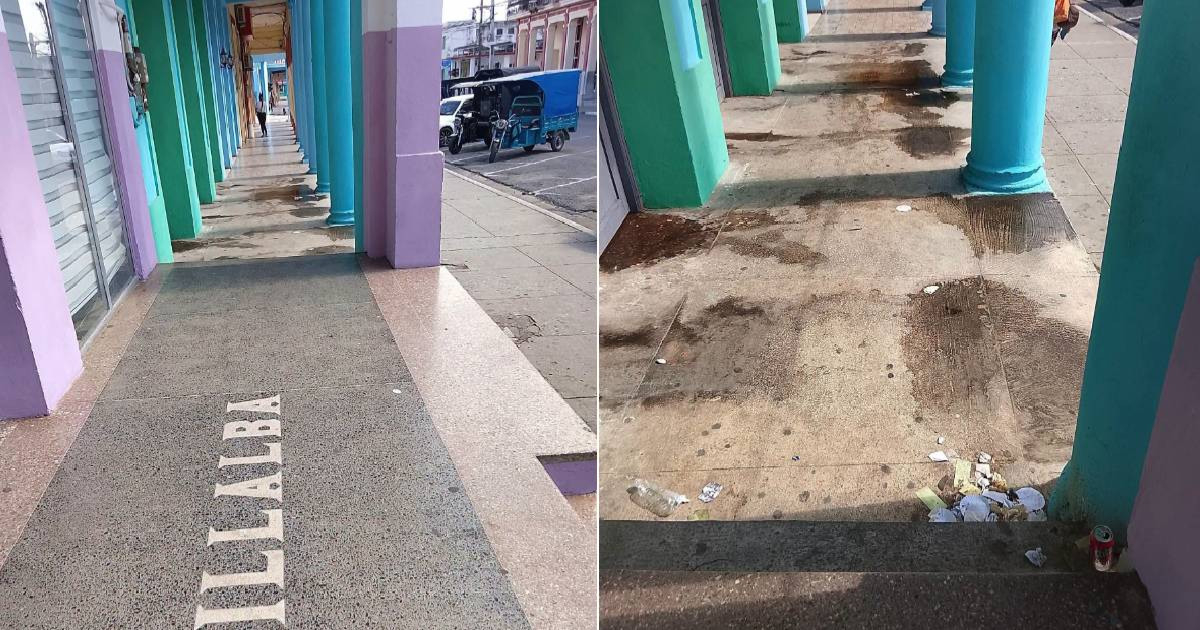
A strong smell of urine pervades several sections of Real Street in Pinar del Río, where the lack of public restrooms and the use of a closed space as an improvised toilet are impacting even the areas surrounding food establishments.
The report was published on Facebook by the announcer from the station Radio Guamá Ogilvie Serrano Rodríguez, who described what happened on Saturday shortly after noon. "Walking along that stretch of Real street today was practically an act of bravery," he wrote.
One of the most affected areas is the portal adjacent to the sales point of the hair salon Ilusión, a space that the National Institute of Sports, Physical Education, and Recreation (Inder) received to build the Sports Museum, a project that never came to fruition.
The establishment remains closed and, as one neighbor explained in the comments of the post, the public uses it as a toilet. "That foul stench of urine is from the entrance of the space that was given to Inder to build the Sports Museum, which in the end they were unable to do and has been shut down," he pointed out.
In the vicinity, there is a commercial establishment where sweets and other products intended for immediate consumption are sold. Serrano noted that the smell reaches inside the establishment every time the door is opened.
A citizen clarified that the workers maintain proper hygiene conditions inside the market and use air conditioning and closed doors, but they also suffer the consequences of outside pollution. "They are also affected by such indifferent individuals, but they are not responsible for what others do," he commented.
Several residents attributed part of the problem to the customers of the Bola 13 nightclub, located across from the entrance, who, according to their testimonies, urinate in the vicinity when leaving in the early morning hours. They also questioned the lack of police presence in that area.
The complaints extend beyond that area. Neighbors assure that the unpleasant odors reach different sections of Martí Street, from the malecón to Rosario, as well as the corner of the pharmacy on Recreo Street and the vicinity of the Globo hotel.
"The unpleasant smell that permeates almost the entire city is irresistible. This situation has not arisen overnight; it has been ongoing for months and months," reported another resident.
Among the mentioned causes is the disappearance of public restrooms, a lack that forces those moving through the city to seek alternatives. A resident recalled that there used to be sanitary facilities at Coppelia, the bus terminal, and Independence Park, but confirmed that the ones at the latter have been closed.
"Public restrooms do not exist in Cuba. There was a time when they cared about that, but it lasted as long as meringue at the door of a church," summarized a resident.
Health difficulties are compounded by the lack of water. On October 10, a local resident confirmed that the area had gone over two months without supply of this vital resource.
Authorities confirmed in early November that approximately 170,000 residents of Pinar del Río lacked regular access to drinking water, while several pumping stations remained out of service and blackouts exceeded 16 hours a day.
The epidemiological context adds concern to the complaints. By the end of August, the province was facing three active outbreaks of hepatitis A in the municipalities of Jagüey Cuyují, Los Palacios, and San Luis. The disease is transmitted through the fecal-oral route, primarily via the consumption of contaminated water or food.
Related videos:
Filed under: