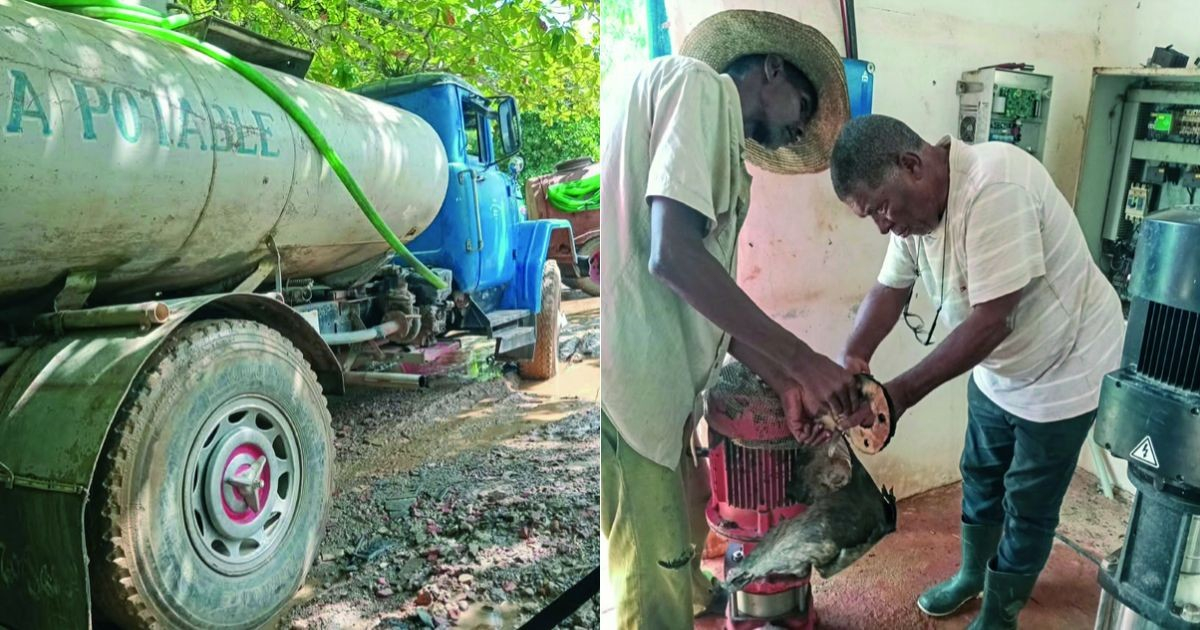
The director of the Provincial Water and Sewer Company of Pinar del Río, Robert Hechevarría Ramírez, acknowledged the seriousness of the water crisis affecting the province, where more than 169,700 residents are experiencing disrupted regular access to water, and private water trucks are sold at prices exceeding 15,000 pesos.
The data, provided this Sunday by the official newspaper Guerrillero in an interview with the official, illustrates a crisis that, according to Hechevarría Ramírez, is due to two mutually reinforcing factors: "the shortage of pumping equipment and issues with the electrical service."
The three main pipelines in the provincial capital are operating with severe deficiencies. The 20-inch line lacks two pumps; the 30-inch line—responsible for transporting water to the city's tank—is functioning at 50% capacity because it is missing three of its six units; and the 36-inch line also has two units absent. In total, there are 46 malfunctioning pumping units and six booster pumps in the well field, the executive stated.
Recently, an issue was added to that situation: a breakdown in the 36-inch pipeline in the Maceo Crossing area, which required it to be shut down, drained, and welded. The executive was emphatic: "In light of this combined scenario of energy limitations and equipment breakdowns or shortages, the continuous delivery of the service becomes materially impossible."
Some areas, according to press reports, have been without water through the pipes for over three months, which drives residents to turn to options that drain their household economy and are unattainable for most.
This was confirmed by the official, who referred to the "excessive and abusive price of the trucks, which roam the city, for amounts that exceed [...] 15,000 pesos."
With the minimum wage set at 3,210 pesos since July 2026, that figure equates to almost five monthly minimum wages. The provincial director admitted that "this situation [...] is obviously not foreign to the Company, as its own workers 'suffer' daily in their respective communities."
The First Deputy Prime Minister Inés María Chapman Waugh visited the province on October 24, accompanied by officials from the Electric Union and the National Institute of Hydraulic Resources. During that meeting, Chapman Waugh emphasized the need to implement a "comprehensive water-energy program," without specifying a concrete timeline.
Among the announced measures is the distribution of 20 tons of diesel for generator sets in all municipal capitals — initiated on Wednesday, October 28, by Consolación del Sur and the provincial capital — intended for the pumping stations of Ring 1, Calero 3, and 10 de Octubre. Efforts are also being made with a workshop in Mayabeque to repair at least one pumping unit for each of the 20 and 30-inch pipelines.
The executive also reported that the province has 77 solar pumping systems installed at water supply sources with less than 10 kilowatts of power: 67 are operating correctly, four are burned out, and six have issues with the controller boards. There is ongoing work to assess another 34 sources with power ranging from 10 to 30 kilowatts that could benefit from a shift to renewable energy in the medium term.
The situation in Pinar del Río is part of a national water crisis: the National Institute of Hydraulic Resources acknowledged on October 29 that 2.14 million Cubans were affected in their water supply, with power outages and equipment failures accounting for nearly 88% of the incidents.
The paradox encapsulated in the Pinar case was summed up by the conclusion of the report itself: it is one of the regions "with the highest delivery cycles in the country, despite having high-quality water in abundance from its sources."
Related videos:
Filed under: