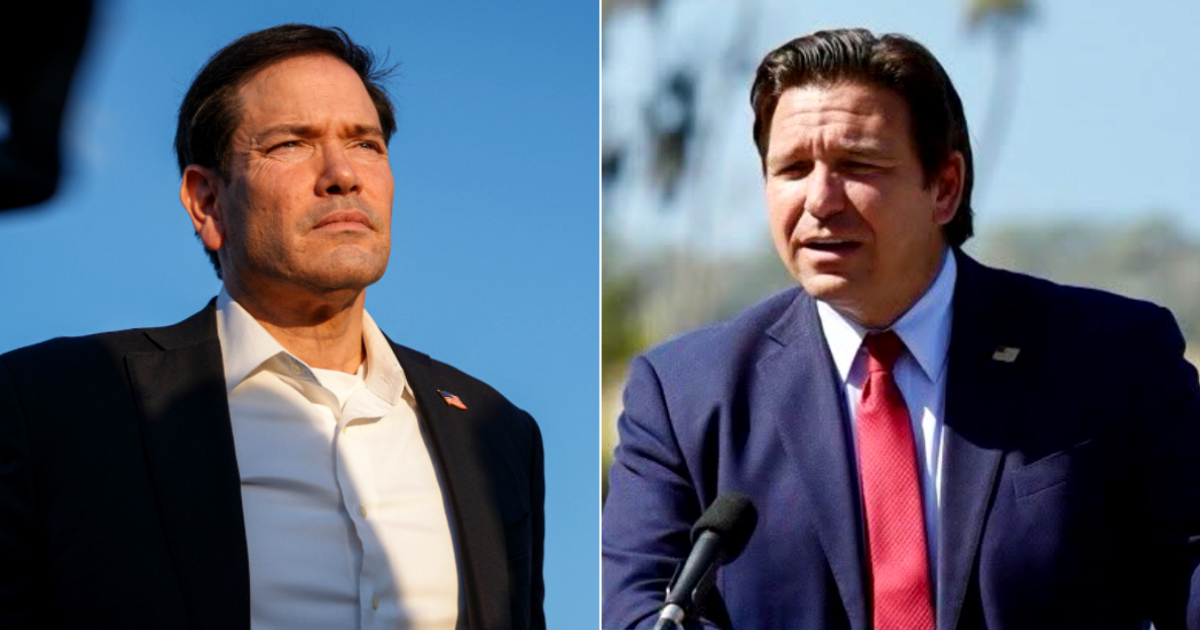
The Republican collapse in last Tuesday's midterm elections shook up the internal race within the Republican Party as it looks toward 2028 and placed two figures from Florida — outgoing Governor Ron DeSantis and Secretary of State Marco Rubio — at the center of the debate about who could succeed President Trump, according to an analysis by Axios.
Before that electoral day, the 2028 Republican primary seemed to be gearing up for a relatively easy coronation of Vice President JD Vance. The Democratic wave that swept through the Senate and the House of Representatives abruptly changed that calculation, and Florida —the only state in the red wall that resisted the tide— became the natural setting for the debate about the future of the party.
"They shattered us into pieces. Florida is the last one standing," DeSantis stated in a post-election interview, where he also warned that the national results should serve as "a wake-up call" for Republicans.
The governor, who will finish his term in January without the possibility of reelection, embarked on an intense media tour following the elections: he appeared on Stephen A. Smith's podcast on the very day of the elections and days later on CNN with Jake Tapper.
Although DeSantis denied having contacted any consultant to prepare a candidacy, he did not explicitly rule out competing, and a super PAC linked to him sent fundraising messages in the week following the elections. Prediction markets assigned him a 13% chance of winning the nomination.
Rubio's situation is more complex. The Secretary of State has repeatedly stated that his plan is to complete his term until January 2029, and last May he even referred to Vance as a "phenomenal candidate" whom he would support if he ran. However, Rubio acknowledged that he has no definite plans given the uncertainty of the moment.
On election night, his phone "filled up with messages" from supporters urging him to reconsider, according to a source familiar with the scene at the White House. "There was a feeling of 'we lost the Latino vote, you can regain it'", that source recounted. "For some, Rubio seemed to contemplate the idea for the first time. Or he didn't dismiss it quickly enough."
Two publications reported days later that Rubio was considering resigning to prepare for a campaign. He denied it to the New York Times, and close associates labeled those reports as false.
Still, the polls show a sustained rise: in May 2026, a survey by Emerson College had him in a virtual tie with Vance —35% to 36%— although in October, the poll by New York Times and Siena placed him at 23% compared to the vice president's 33%.
The son of Cuban immigrants and the first Latino to hold the position of Secretary of State, Rubio is viewed by major Republican donors as the candidate with the greatest potential to reclaim the Latino electorate that the party lost in the midterms. Trump publicly mentioned Vance and Rubio as possible successors at the end of October, without formally endorsing either.
A Republican consultant with extensive experience in Florida summarized the moment with a local image: «The alligator people are stirred up», referring to the official state reptile. An insider from the party was more direct about Rubio: «If Vance doesn’t run or if the president asks him to step aside for Marco to run, would he do it? Maybe. I don’t see it. But maybe.»
Related videos:
Filed under: