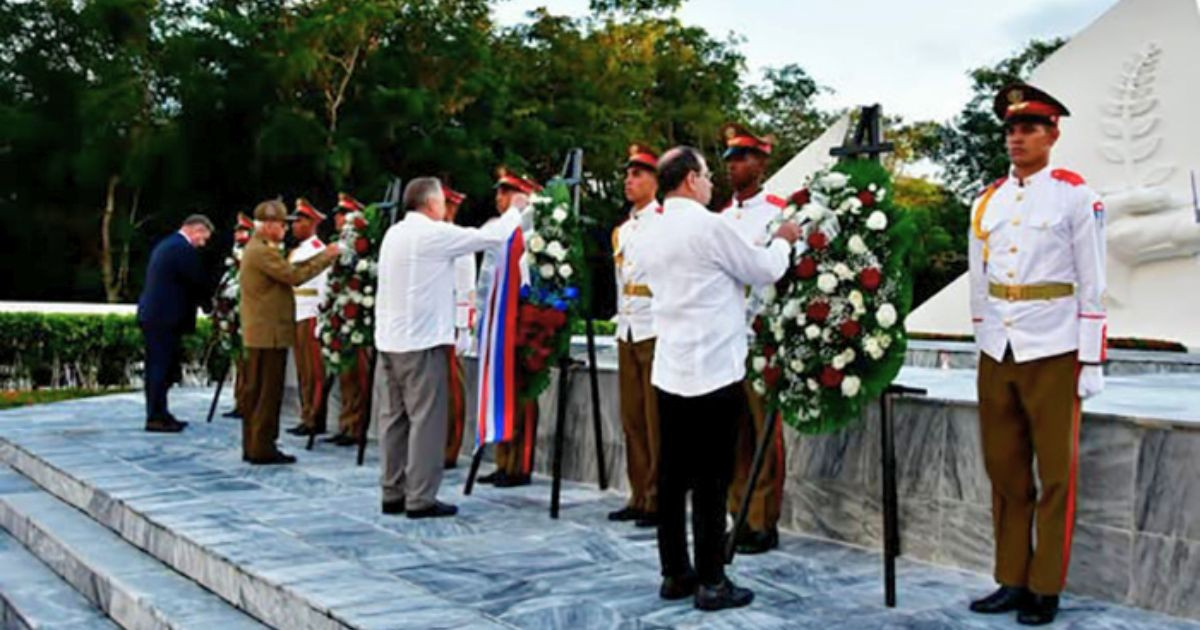
While millions of Cubans survive without electricity, food, and a future, the regime dedicated Saturday to what it does best: paying tribute to the past, in this case, to a revolution that took place 109 years ago in Russia.
With a political act and military ceremony at the Mausoleum of the Soviet Internationalist Soldier, in Havana, the Cuban state commemorated the 109th anniversary of the "Great Socialist October Revolution" with floral tributes and speeches on "justice, equality, and solidarity," reported the official ACN.
The event was presided over by Army Corps General Joaquín Quintas Solá, Deputy Minister of the Revolutionary Armed Forces (FAR), accompanied by Jesús Manuel Burón Tabit, member of the Central Committee of the Communist Party and Deputy Minister of the Ministry of the Interior, along with the ambassadors of Russia, Victor Koronelli, and Belarus, Vitaly Barchuk.
Fernando González Llort also participated, president of the Cuban Institute of Friendship with the Peoples, an institution whose name increasingly sounds ironic as half of the country tries to leave through any available border, to make friends... in other places.
Brigadier General José Pinell Mustelier, second-in-command of the Logistics Department of the FAR, delivered the customary remarks: the tribute, he said, "reaffirms Cuba's commitment to the shared history and the ideals of justice and equity that guided the revolutionaries." Justice and equity that have been glaringly absent on the island for decades.
The state agency ACN, true to its propagandistic mission, concluded by stating that "the October Socialist Revolution marked a milestone in universal history by demonstrating that it is possible to build a society based on justice, equality, and solidarity, principles that Cuba identifies as part of its Revolution and social project."
The contrast with the reality faced by ordinary Cubans on that very Saturday is hard to exaggerate. The national electrical system had only 1,070 MW available against a demand of 2,830 MW, providing just 38% of what the country needs, with a projected shortfall of up to 1,790 MW during the nighttime peak.
In some neighborhoods of Havana, more than 52 consecutive hours without electricity were accumulating at the beginning of November. While the generals laid flowers at a Soviet mausoleum, much of the capital remained in darkness.
Economic photography is no less bleak. The UN Economic Commission for Latin America and the Caribbean projects a decline in Cuba's GDP of 10.3% in 2026, the largest contraction expected in all of Latin America and the Caribbean. The dollar is trading at over 930 pesos in the informal market, while the average state salary amounts to less than nine dollars per month.
Independent estimates place basic needs between 50,000 and 96,060 pesos per person per month, which is seven to thirteen times that salary. The Cuban Observatory of Human Rights calculated in August that 94% of Cubans were living in extreme poverty and that eight out of ten respondents had skipped a meal at least once in the previous six months.
The scene repeats with almost liturgical fidelity. In 2025, when Díaz-Canel celebrated the 108th anniversary with the slogan "Up with the World's Poor!", the public's response was an avalanche of irony and reproaches. One comment summed up the general sentiment: "There is no electricity, no fuel, no food... and you dare to post that."
In 2026, the situation is even more serious, and the official script hasn't changed a comma.
Related videos:
Filed under: