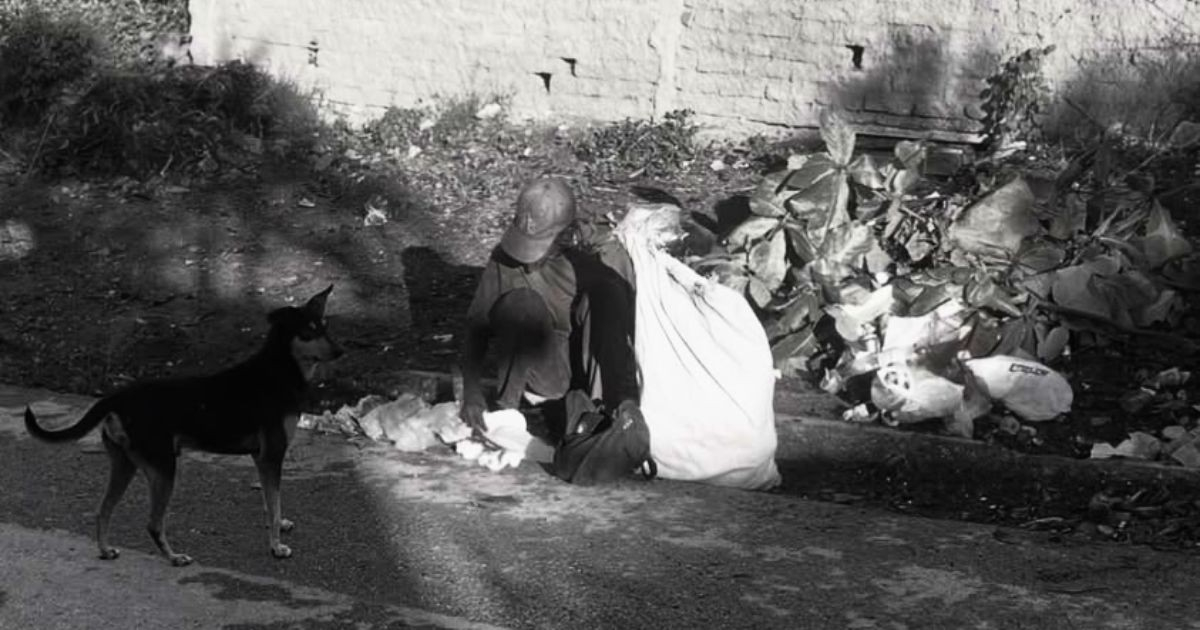
The jurist and professor René Fidel González García published a reflection this Sunday, from Santiago de Cuba, titled "Hunger, Man, and the Little Dog", in which he denounces the divide between a privileged minority and the impoverished majority of Cuba, referring to it as a "vicious circle of inequality."
The text —which seems to evoke the story by Senel Paz "The Wolf, the Forest, and the New Man," the basis for the script of the movie "Strawberry and Chocolate"— is accompanied by a black and white photograph depicting a person rummaging through trash alongside a black dog, an image that the author himself uses as a symbol of the social crisis he describes.
González García, Doctor of Legal Sciences and former tenured professor at the University of Oriente, identifies two dimensions of the problem: the degradation of state functions that should guarantee economic, social, and cultural rights to citizens, and the exclusive access to political power by an elite.
In his analysis, the jurist describes the emergence of "a new social class, vassal to the elite that controls power in Cuba," which acts as a dam against political equality, democratization, and the rule of law, and which sustains itself through "the ins and outs and levers that corruption and the lack of transparency in the Cuban political system offers in exchange for its obedience and subordination."
It also warns that the state's assets are being "deliberately reduced, dismantled, abandoned, and privatized," and that disputes over positions with a high concentration of discretionary power correspond to struggles for contracts, funding, and impunity. This process, it argues, is neither "insignificant nor apolitical."
The publication is part of a series of critical statements that González García has made throughout 2026. In August, he introduced the concept of "political indigence" to describe the exclusion of the majority, and in October he warned that "we no longer have time to lose".
The jurist was removed from teaching at the University of Oriente in November 2016 after publishing critical articles in independent media, which he and human rights organizations denounced as political retaliation.
The text appears at a time of unprecedented social crisis. The Cuban Observatory of Human Rights estimated in August 2026, based on 1,318 interviews across 79 municipalities, that 94% of Cubans live in extreme poverty, nine percentage points more than in 2025.
The image accompanying the text visually connects with other scenes documented in recent days. Independent journalist José L. Tan Estrada published on Saturday the photograph of an elderly man sitting alone in a dumpster in Camagüey. "Behind this image lies much more than accumulated filth. There is poverty, vulnerability, institutional neglect, and people who survive in conditions that no human being should have to endure," wrote Tan Estrada.
The Prime Minister Manuel Marrero Cruz acknowledged the existence of 876,522 people in a situation of greater vulnerability, a figure presented during the assessment of the 176 economic transformations approved in July 2026, a set of measures that analysts warn may primarily benefit officials and businesspeople with privileged connections, further widening the gap highlighted by the jurist.
González García concludes his reflection with a warning that encapsulates the extent of the problem: "All of this is a moat, slimy, foul-smelling, and increasingly deep and dangerous, placed right in front of the walls that we citizens must tear down in Cuba to achieve political equality and fullness, and to have a chance to decide our happiness and destiny."
Related videos:
Filed under: